This is the fourth in a Climate Rights International series on what Brazil’s election could mean for the Amazon and the climate crisis.
Brazil’s next president will oversee decisions on highways, railways, and waterways that could affect the Amazon’s forests, rivers, and communities for decades. Proponents argue that these projects can connect isolated communities and lower freight costs, but they can also open forests and Indigenous territories to illegal clearing.
Although Amazon deforestation under President Luiz Inácio Lula da Silva has fallen to its lowest level on record, according to a preliminary estimate, his government backs major infrastructure projects that could put those gains at risk. Lula and his challenger, Senator Flávio Bolsonaro, support many of the same projects, but differ over the safeguards and procedures governing their approval.
What’s at stake
In the Amazon, a road’s greatest harm often comes not from the forest cleared to build it but from the access it opens up. Loggers, land grabbers, and ranchers use roads to reach previously inaccessible areas, often opening unofficial side roads.
One of the most contested projects is the BR-319 highway, the only road connecting Manaus—a city of more than 2 million people surrounded by rainforest—to the rest of Brazil. The nearly 900-kilometer highway runs through a vast area of rainforest that has remained largely intact, in part because some 400 kilometers of its central section are unpaved and difficult to travel during the rainy season. Brazil’s federal transport-infrastructure agency, DNIT, says improvements would make travel and deliveries more reliable. But researchers modeled 60 percent more deforestation in Amazonas by 2100 if the highway is rebuilt than if it is not.
Another contested project is a proposed railway, known as Ferrogrão, that would carry grain from northern Mato Grosso to ports on the Tapajós River in Pará. The soybean growers’ association Aprosoja-MT says it would lower freight costs and truck traffic on the BR-163 highway, while the National Confederation of Industry argues that shifting freight to rail could reduce emissions. But Panará and Kayapó Indigenous organizations warn that the railway, together with associated ports and waterways, could spur clearing and threaten territories beyond the tracks themselves.
Jair Bolsonaro’s record
Jair Bolsonaro’s administration (2019–2022) prioritized roads serving agricultural exports. In 2019, it completed the last 51 kilometers of paving on BR-163, connecting Mato Grosso’s farms to Amazonian river ports. During his first two terms (2003–2010), Lula had also backed the road, but paired it with a regional sustainable-development plan in 2007, which Jair Bolsonaro’s government later repealed.
Jair Bolsonaro also pushed to pave BR-319. In July 2022, Ibama, the federal environmental agency, granted a preliminary license for its unpaved central section. Environmental organizations later challenged the license in court, citing the risk of deforestation and a lack of consultation with affected communities. In addition, his government promoted Ferrogrão, but in 2021 a Supreme Court justice put the project on hold, suspending a 2017 law that had removed part of a national park to make way for the railway.
Lula’s record
Since returning to office in 2023, Lula has advanced projects championed by Jair Bolsonaro’s administration, including BR-319. His government has promised increased monitoring and enforcement along the road and, in September, created four sustainable-development reserves covering some 669,000 hectares nearby. Yet the BR-319 work is going ahead without full environmental licensing, under a 2025 exemption for improvements to previously paved roads that Lula vetoed, Congress reinstated, and his own transport agency is now using. Environmental groups say the project amounts to reconstruction and have challenged it in court.
Lula’s administration has also pursued Ferrogrão. In March 2026, the federal audit court kept its review of the concession suspended, citing gaps in the project’s financing and the lack of consultation with Indigenous peoples. In May, the Supreme Court upheld the 2017 law reducing the park’s size, while stressing that construction still requires licenses.
The administration has pulled back, however, from several Amazonian waterway projects amid Indigenous opposition. In February 2026, after protesters occupied a Cargill grain terminal in Santarém, it revoked its own decree paving the way for private concessions on waterways including the Tapajós. In September, it canceled a tender to dredge that river after objections over licensing and consultation. Exporters say dredging is needed during low-water periods, but Indigenous groups warn of damage to fishing and river ecosystems.
The choice ahead
Flávio Bolsonaro’s infrastructure platform proposes R$900 billion in transport investment over four years. Like Lula, he backs Ferrogrão and has promised to proceed with BR-319, and he pledges to advance the Tapajós waterway, from which Lula’s government has pulled back. His platform says river projects will move forward “always with environmental responsibility,” with “prior dialogue with local communities,” and in compliance with the law.
Flávio also proposes that an environmental license be granted automatically if the responsible agency fails to act on a complete application by its deadline, arguing that state delays should not penalize developers who have done their part. Current law, even after the 2025 loosening of licensing requirements (see “What’s at Stake for Forest Protection?”), rules out such automatic licenses. Between 2010 and 2025, Ibama’s licensing caseload per staff member grew more than fivefold, and one of its licensing coordinators said the agency could not keep up. Where agencies miss deadlines, the proposal could let major projects advance before their environmental and social impacts have been fully assessed.
Lula’s platform pairs continued infrastructure investment with pledges to protect forests and cut emissions, yet his government’s handling of BR-319 and Ferrogrão leaves it unclear which would take priority in another term. Both candidates back major projects, but the election could shape which ones are built, how consultation and licensing are carried out, and the extent to which harm to forests, rivers, and communities is weighed before approval.
Read the other explainers in our Brazil election series.
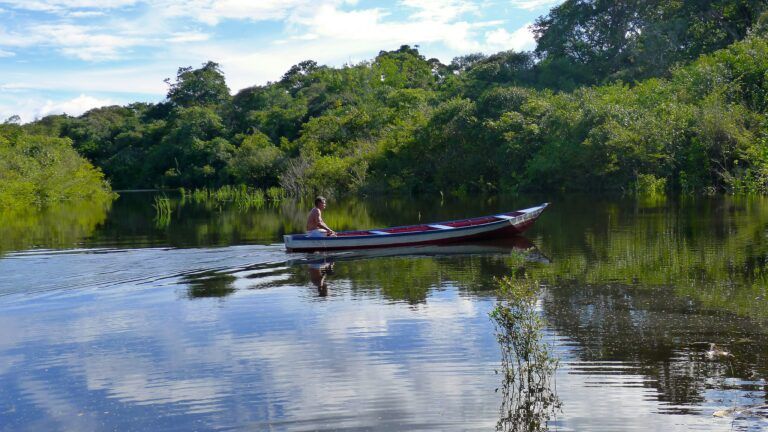
Photo: Manaus, Brazil. Credit: Gustavo Nacht / Unsplash.