This is the second in a Climate Rights International series on what Brazil’s election could mean for the Amazon and the climate crisis.
Brazil’s next president will make two decisions that shape the future of Indigenous lands and the forests on them. One is whether to formally recognize more territories as Indigenous. The other is whether to defend those already recognized against loggers, illegal miners, and ranchers. Under former President Jair Bolsonaro, recognition stopped and invasions surged. President Luiz Inácio Lula da Silva restarted both recognition and operations to remove invaders, but a large backlog of claims remains. Flávio Bolsonaro, Jair’s son and Lula’s challenger, has backed measures that would make recognition harder.
What’s at stake
Brazil’s Constitution recognizes Indigenous peoples’ original rights to the lands they traditionally occupy. Demarcation is the federal process that identifies and formally recognizes those territories. Presidential approval is the step that finally confirms their demarcation. Recognition gives communities firmer ground to defend their lands against those who would seize or exploit them.
Securing these rights is critical to protecting Brazil’s forests. Indigenous lands cover about 22 percent of Brazil’s Amazon region. A study of 381 territories found less forest and vegetation loss on lands currently in the recognition process than on comparable unprotected territory nearby, with the strongest effect after boundaries were physically demarcated.
But recognition is only part of the equation. Even formally demarcated territories remain exposed to loggers, illegal miners, and ranchers, whose incursions threaten both the communities living there and the forests they protect. Removing encroachers requires sustained monitoring and enforcement, work which mostly falls to federal agencies that answer to the president.
Jair Bolsonaro’s record
Before taking office in 2019, Jair Bolsonaro promised that he would not demarcate any more Indigenous land. He kept that promise: his government approved no new territories during his presidency.
Meanwhile, pressure on existing territories grew. The Indigenist Missionary Council (Cimi) recorded 109 cases of invasion, illegal resource extraction, or damage to Indigenous property in 2018, and 309 in 2022. Deforestation inside Amazon Indigenous territories was 195 percent higher in 2019–2021 than in 2013–2018, and it reached deeper into their interiors. Between 2018 and mid-2022, Funai, the federal Indigenous affairs agency, lost roughly a quarter of its career staff, and its spending fell by about 15 percent in real terms from 2019 to 2012.
Lula’s record
Lula reversed the funding cuts and demarcation freeze. His government created a Ministry of Indigenous Peoples and named Joênia Wapichana as Funai’s first Indigenous president. By November 2025, the administration had approved 20 territories covering about 2.5 million hectares. It also increased Funai’s budget and appointed hundreds of new staff.
The government also coordinated some operations to remove invaders from some territories, with uneven results. Lula launched an operation in Yanomami territory after declaring a public-health emergency there in January 2023. Government monitoring found that the area of active illegal mining in the territory fell by nearly 99 percent between March 2024 and January 2026. At Apyterewa, in the state of Pará, federal teams removed invaders in 2023, but invaders returned and carried out armed attacks on the Parakanã people in 2025, according to Cimi. Beyond Apyterewa, Cimi recorded 210 cases of invasion, illegal resource extraction, or damage to Indigenous property affecting at least 151 Indigenous territories that year.
The choice ahead
Whoever wins the election, the next administration will face a large backlog of Indigenous land claims and continuing invasions of territories already recognized. According to Cimi, 897 of Brazil’s 1,443 Indigenous lands and territorial claims still awaited some administrative action in 2025. For 582 of them, the process had not begun. Some are close to completion: Indigenous organizations have identified 107 claims awaiting either a ministerial declaration or presidential approval. Of the 151 territories Cimi found affected by invasions, illegal extraction, or related damage in 2025, 88 had already been fully recognized.
The rules governing the land recognition process are themselves coming into question. A legal doctrine known as the marco temporal, or “time frame,” would allow Indigenous peoples to claim only land they occupied or were actively disputing on October 5, 1988, when Brazil’s current Constitution was adopted. Communities expelled before that date would lose their claims. The Supreme Court has rejected the cutoff, but the Senate has approved a constitutional amendment to establish it. Flávio Bolsonaro co-sponsored that amendment, which is now before the Chamber of Deputies. He also co-sponsored a separate proposal that would require congressional approval for new demarcations, a step now carried out by the executive branch, and would reopen to legislative review territories already approved.
Speaking to journalists in Mato Grosso in April, Flávio said that if it were up to his government, none of the pending Indigenous land claims in the state would be demarcated. Together with his legislative record, that suggests that a Flávio Bolsonaro presidency would pose new obstacles to recognition. How he would handle enforcement is less clear, but his father’s term showed how diminished federal enforcement can leave Indigenous territories more vulnerable to invasion. Lula’s platform pledges to continue demarcating territories and removing invaders, though Indigenous organizations argue that approvals need to move faster and removal operations need to last longer.
In the near term, the next president will decide whether pending claims move forward and whether federal teams stay in territories under threat. Over the longer term, those choices will help determine whether Indigenous peoples can hold their lands, and whether the forests on those lands remain standing.
Read the other explainers in our Brazil election series.
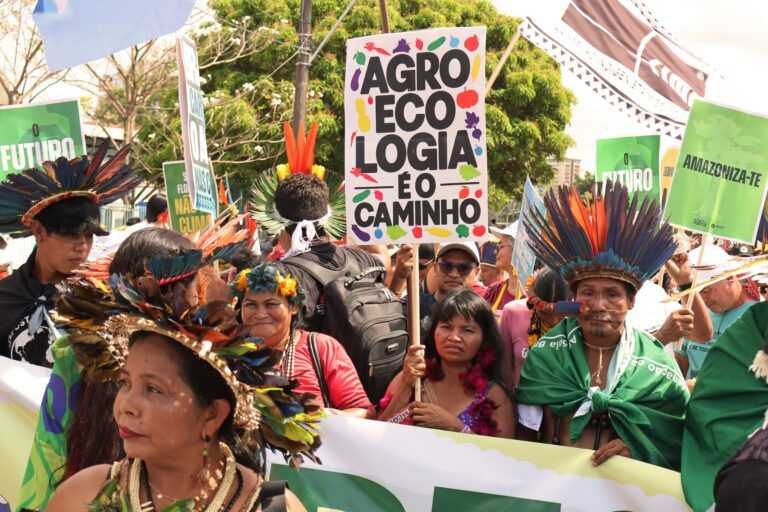
Photo: Indigenous demonstrators advocate for agroecology and Amazon protection during a public environmental march in Belém, State of Pará, Brazil. Credit: Mirna Wabi-Sabi/ Unsplash.