
(London, November 13, 2026) — Investor-State Dispute Settlement (ISDS) provisions that give foreign investors, including fossil fuel companies and major polluters, the right to sue governments when public policies, legislation, or government decisions affect their investments are thwarting action on climate change, Climate Rights International said in a new briefing paper released today. Governments meeting at COP31 in Antalya, Turkey should act to exclude governmental climate action from existing ISDS provisions and agree that ISDS provisions in any new agreements specifically exclude non-discriminatory action taken by a government to address climate change and environmental harms.
Fossil fuel companies are among those most frequently using ISDS claims to challenge climate action. According to one calculation, as of July 2025, there had been at least 349 investor-state disputes related to fossil fuel projects, with fossil fuel corporations receiving upwards of 82.8 billion USD through ISDS awards. A study released on November 12 found the current figure to be 86 billion USD. Given the secrecy of the system, in which the claim and award amount are often not made public, these figures are likely to be conservative.
“Provisions that allow fossil fuel companies to demand billions of dollars in claims based on new laws or policies to fight climate change are fundamentally at odds with the urgent need for rights-respecting climate action,” said Linda Lakhdhir, Legal Director at Climate Rights International. “It is critical that climate-related measures are excluded from ISDS provisions in all existing and new investment treaties and free trade agreements, or that such provisions are eliminated in their entirety.”
While ISDS provisions were initially designed to address expropriation, they are being used to challenge a broad range of climate actions on the basis that they could affect corporate profit. In July 2026, ExxonMobil filed an ISDS claim against the European Commission under the Energy Charter Treaty, challenging mandatory carbon storage obligations outlined in the EU’s Net Zero Industry Act. This law, adopted in May 2024, requires the construction of 50 million metric tons of annual CO2 storage capacity by 2030. Despite having advocated for carbon capture and storage for years, ExxonMobil has challenged the law, which requires oil and gas producers to pay for and build the capacity themselves, rather than relying on public subsidies.
With investors often demanding enormous sums for speculative “lost future profits” and a process that is expensive, lacks transparency, limits public participation, and allows arbitrators to treat as irrelevant a state’s reasons for taking action, the threat of ISDS claims has had a significant chilling effect on climate action. Legal fees alone can run into the millions of dollars—a heavy burden for lower-income countries. The mere threat of arbitration may cause some countries to give in to foreign investor demands or limit climate action, even if the claims are entirely unjustified, to avoid the cost of arbitration.
ISDS provisions in existing investment treaties and free trade agreements should be eliminated or amended to make clear that governmental action to address environmental harm and climate change cannot be a basis for an ISDS claim, said Climate Rights International. The government of Nigeria, among others, has called for reform of the system, including the integration of public-interest considerations such as climate action, environmental protection, human rights obligations, community welfare and sustainable development, while other countries have called for it to be eliminated completely.
When negotiating new investment treaties and contracts, states must ensure that they contain explicit clauses excluding non-discriminatory climate-related measures, as well as bona fide environmental and public health initiatives, from state conduct that can give rise to claims for compensation.
The recent advisory opinion by the International Court of Justice provides a strong legal and political case for states to insist on such exclusions and should fundamentally reshape the legal landscape in which ISDS claims must be assessed, said Climate Rights International. The opinion makes clear that states have a duty under international law to prevent climate harm, to protect the climate system, and to protect the human rights of present and future generations. Critically, in the context of ISDS claims, the Court underscored that states must regulate non-state actors within their jurisdiction, especially fossil fuel companies whose activities drive climate breakdown, and that fossil fuel consumption, subsidies, and licensing decisions may lead to legal responsibility under international law. This obligation applies not only to domestic companies, but also to foreign-owned energy companies that might seek to use ISDS provisions in contracts or investment treaties to challenge such action.
Under international law, businesses have an obligation to ensure that their operations do not cause human rights violations and limit environmental harms. Using ISDS provisions to thwart state action intended to protect the climate system and the environment is inconsistent with those obligations and carries serious reputational and other risks. Similarly, financial institutions should adopt policies that exclude companies using or threatening ISDS claims to block climate action from those eligible for investment or financing as part of their climate and human rights commitments.
“Fossil fuel companies and major polluters should no longer be allowed to thwart climate action through ISDS claims,” said Lakhdhir. “It is critical that governments at COP31 address the harms of the current ISDS system and work together to address them.”
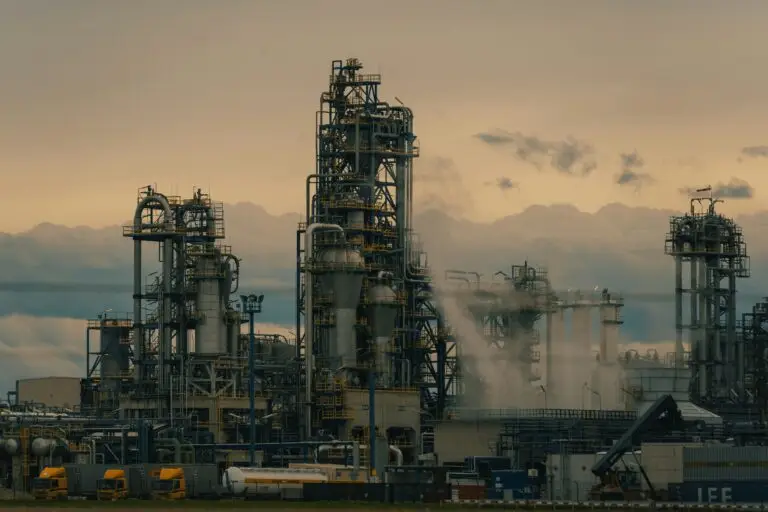
An industrial oil refinery emits smoke into the atmosphere. Photo: Michael Pointner/Unsplash.