(Kinshasa, October 29, 2026) — The government of the Democratic Republic of Congo (DRC) must ensure that all upcoming projects within the proposed “Green Corridor” protect the environment, meet climate goals, and respect the rights of local communities, Climate Rights International said in a new report published today.
Land rights must be respected, environmental defenders must be protected, the moratorium on new logging concessions should become permanent, and oil exploration and extraction, as well as destructive mining, should be prohibited.
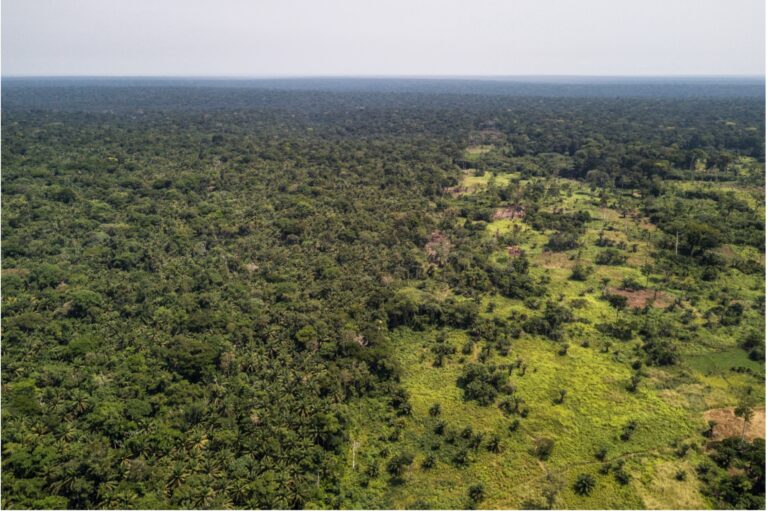
Announced in 2025, the Green Corridor is touted by the government and its backers as a means of promoting both nature conservation and the development of a green economy. Stretching from the province of North Kivu to the capital, Kinshasa, some 2,400 kilometers to the west, the Green Corridor is the size of France and home to 25 million people. It lies at the heart of the Congo Basin, the world’s largest net carbon sink and home to some of the world’s most threatened tropical forests.
“The Green Corridor is an ambitious initiative filled with opportunity and risk,” said Fabien Offner, researcher at Climate Rights International. “It could be the engine for economic growth, modernization, and protection of the DRC’s critical forests and peatlands. Yet current plans do not prohibit major resource extraction and do not cancel planned large-scale extractive activities. The authorities should adopt legislation that makes it clear that destructive mining, drilling for oil and gas, and logging will be prohibited in the Green Corridor.”
The hoped-for implementation of the Green Corridor relies on the establishment of a “Green Economy” centered around four sectors: renewable energy, industrial processing of agricultural products, transport, and carbon finance. The Virunga Foundation, which will play a key role in the implementation of those sectors, estimates that these projects will create 500,000 new jobs by 2030. Each of these elements, however, carries human rights and environmental risks if not managed properly.
In May 2025, just four months after President Felix Tshisekedi announced the creation of the Green Corridor, the authorities opened 52 oil blocks for bidding for exploration, in addition to three previously awarded. Of the 55 blocks, 28 overlap with 72 percent of the Green Corridor. The coalition Our Land Without Oil, which brings together more than a hundred Congolese and international organizations, has denounced this as a “choice incompatible with the commitment of the Democratic Republic of the Congo as a [climate] solution country.”
Agro-industry in the DRC has led to human rights abuses, including excessive use of force against activists and defenders. Those engaged in documenting and denouncing the harmful consequences of extractive industries on the rights of local communities and the environment continue to suffer killings, violence, threats, and strategic lawsuits against public participation (SLAPPs) from perpetrators who are often protected by powerful economic and political interests. A particular area of concern, given past history, is a potential increase in forced evictions and dispossession of land, particularly in light of the various tax and customs incentives designed to attract investment into the Green Corridor.
Congolese authorities appear determined to move forward with new mining projects carrying significant human and environmental risks within or close to the boundaries of the Green Corridor. The mining sector, however, is mired in corruption, controlled by armed groups in certain provinces, and responsible for serious human rights violations ranging from excessive use of force to environmental pollution causing severe health consequences.
Planned economic activities, such as the ambitious goals for transport and renewable energy, will need transparent, independent, and internationally recognized social and environmental impact assessments that include extensive community consultation.
“The DRC’s ambition to play the role of a ‘solution country’ for the climate is laudable, but it will only be taken seriously if the authorities make the protection of land and environmental defenders their highest priority and hold violators accountable,” Offner said.
Aware of these challenges, the initiators of the Green Corridor have placed community consent at the core of the project. But the ease with which Free, Prior and Informed Consent (FPIC) has been circumvented or disregarded in other projects in the DRC raises concerns about whether to expect a different outcome absent a significantly strengthened enforcement framework.
The Virunga model
The Congolese authorities are relying on the expertise of the Virunga Foundation, which has long enjoyed the trust of international donors thanks to its strategy of combining conservation, the protection of local communities, and economic and social development, to manage the Green Corridor through a public-private partnership. The plan is to progressively replicate the “conservation-development” model of the Virunga National Park at an entirely different scale. The Virunga Foundation co-manages the Green Corridor within the framework of a public-private partnership with the Congolese Institute for Nature Conservation (ICCN).
The Virunga Alliance’s planning study indicates that the project’s promoters have a clear understanding of the challenges it faces. As the study notes, “The Green Corridor, benefiting from a new legal framework and high-level political support, can draw on these lessons to chart a more inclusive and effective path forward.” The country has recently adopted two new laws intended to reflect its intention to better protect rights in the face of land dispossession, notably by extractive industry interests: the December 2025 law amending the general regime of property, land tenure, real estate, and securities, and the country’s first land-use planning law, promulgated in July 2025.
Yet operations in Virunga Park and other DRC protected areas have also drawn criticism, including the conduct of eco-guards, who have been accused of abuses against local populations while they are themselves targeted by armed groups. The Virunga model of Forward Operating Bases—which process agricultural products and protect people and conservation areas via facilities safeguarded by eco-guards and the Armed Forces of the Democratic Republic of the Congo—requires scrutiny before being replicated nineteen times and placing 760 new eco-guards across the Green Corridor.
Civil society representatives have expressed concerns to Climate Rights International about the capacity of ICCN to supervise the work of the Foundation. ICCN already struggles to manage protected areas representing nearly 15 percent of the country’s area and is partly financially dependent on the Virunga Foundation.
The lack of clarity about governance and oversight of the Green Corridor, and the lack of details about timelines and the role of civil society, stand in contrast to the eagerness of donors to participate. The European Union, which is conducting “one of [its] most ambitious Global Gateways initiative” with the Green Corridor, has pledged at least 78.6 million Euros in financial support without clear benchmarks.
In this regard, the recent establishment of an Independent Civil Society Committee for the Participatory Governance of the Kivu-Kinshasa Green Corridor, along with the publication of a Corridor Governance Charter, is welcome. However, given its responsabilities and powers, it remains to be seen whether the Committee can provide a true counterweight. The Green Corridor’s “pilot phase,” scheduled to run from 2025 to 2028, will also provide an opportunity to gauge the real influence of this counterweight and of the broader governance architecture.
“Discussions with Congolese and members of civil society, interviews with stakeholders, and a review of documents available about the Green Corridor create both hope and concern,” said Offner. “In a country facing such massive challenges of human rights and governance, an initiative of this scale—aiming both to conserve forests vital to humanity as a whole and to bring food security and stability to the continent’s second-largest country—requires transparency, inclusion, and strong independent oversight to succeed. No matter how good the intentions, it is essential to establish a governance structure that includes an independent oversight body with genuine authority that includes Congolese civil society, affected communities, provincial authorities, and relevant ministries.”
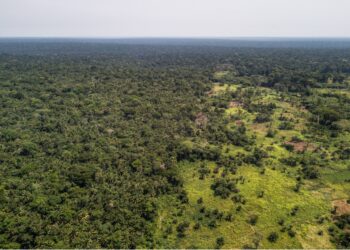
Fields bordering the forest near Yangambi, DRC. Photo by Axel Fassio/ CIFOR.