(San Francisco, November 19, 2026) — The Chinese government is failing to fulfill the recommendations it accepted in a United Nations (UN) human rights, climate, and environmental review, Climate Rights International said in a new briefing paper released today. Beijing’s progress on those commitments has been undermined by its reliance on fossil fuels, a politicized legal system, the use of forced labor, repression of independent civil society, and harmful practices in other countries. UN member states, particularly the governments that made those recommendations, should call on Beijing to provide an update on progress.
In January 2024, Beijing underwent its most recent Universal Periodic Review, a UN process that evaluates countries’ human rights records every five years. In the briefing paper, Climate Rights International examined China’s progress on some of the environment- and climate-related recommendations that it accepted during that review, including ones made by the Bahamas, Bolivia, Burkina Faso, Cameroon, Costa Rica, the Democratic Republic of Congo, the Maldives, Kenya, Timor-Leste, and Zambia.
“The Chinese government gets credit for investing in a green transition, but that investment has not been accompanied by progress on many of the issues it agreed to address, undermining the integrity of UN reviews,” said Brad Adams, Executive Director at Climate Rights International. “It cannot claim global leadership on climate while relying on repression at home to advance that transition.”
Climate Rights International assessed Beijing’s efforts to fulfill recommendations on several environmental issues, including recommendations on public participation, conservation, pollution, and the use of renewable energy sources. Progress is at best uneven: unprecedented installation of wind and solar power, alongside the adoption of laws without public input or strong human rights protections.
In some cases, policies undertaken in the name of environmental protection have caused harm, such as compulsory relocations across the Qinghai-Tibet plateau, which authorities described as necessary for ecological preservation and poverty alleviation. Similarly, on climate-focused recommendations, the record on implementation of its commitments to reduce emissions is mixed.
China’s 2024 Energy Law and the Fifteenth Five-Year Plan, published in October 2025, only make vague aspirational statements about reducing emissions. Recent assessments of China’s energy plans conclude that its targets “are insufficient for China to meet its existing climate commitments,” and still leave room for emissions increases. And while the Chinese government has notched some progress on emissions and re-forestation at home, Chinese state-owned enterprises and companies operating in other countries are contributing to significant deforestation and land degradation, such as with the East Africa Crude Oil Pipeline project in Uganda.
Climate Rights International urged the Chinese government to adopt and pursue aggressive policies to reduce emissions and commit to providing timely, credible climate-related data. It should respect the rights of individuals and independent civil society to participate in developing policies and laws without fear of reprisals, as well as input into Universal Periodic Reviews, as that process requires.
“Chinese officials at the UN-sponsored COP 31 climate summit in Turkey are proclaiming their support for international cooperation on the climate crisis,” Adams said. “But it has thus far failed to implement recommendations at the UN’s Universal Periodic Review, calling into question whether their rhetoric can be taken seriously.”
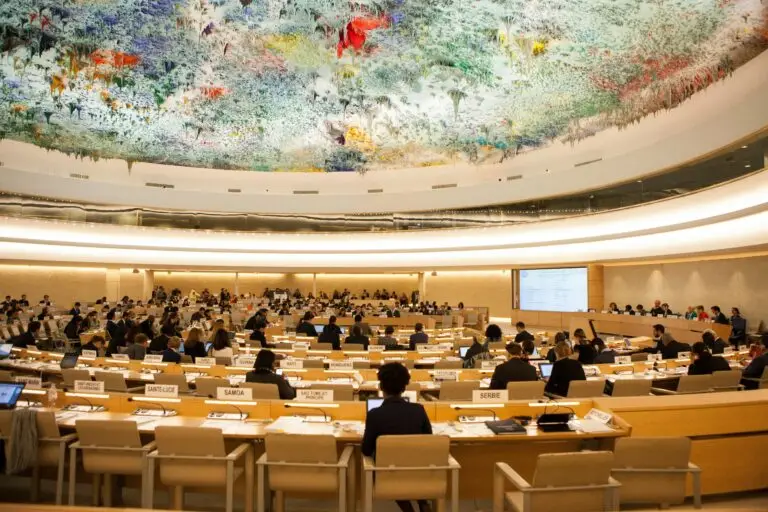
Human Rights Council meeting room. Photo: Siavosh Hosseini/Unsplash.