“If the concept spreads, it could be beneficial, because here in Équateur province nothing happens in protected areas apart from armed conservation.” — Julien Mathe, coordinator of the Groupe d’Action pour Sauver l’Homme et son Environnement (GASHE)
“The overlap between oil blocks and the Kivu–Kinshasa Green Corridor not only threatens to jeopardize the international funding and partnerships supporting this project, but also risks undermining the credibility of all the initiatives meant to embody the DRC’s vision as a ‘solution country’.” — Our Land Without Oil coalition
“One of our most ambitious Global Gateway initiatives is taking shape in the Democratic Republic of Congo.” — Jozef Síkela, EU Commissioner for International Partnerships
At the January 2025 World Economic Forum, Democratic Republic of Congo (DRC) President Félix Tshisekedi announced that the Kivu-Kinshasa “Green Corridor” would be “the world’s largest protected tropical forest reserve.”1Presidency of the DRC (@Presidence_RDC), “Ce mercredi au Forum économique mondial de Davos, en Suisse, le Chef de l’État a participé aux travaux du panel ayant pour thème : « Le dernier poumon de la terre ». Dans son intervention, le Président Félix Tshisekedi a annoncé la création de la plus grande réserve forestière tropicale protégée au monde appelée « Le Couloir vert Kivu-Kinshasa », également connu sous le nom de « Réserve du fleuve Congo,” X, January 22, 2025, https://x.com/Presidence_RDC/status/1882098646944002357. The Green Corridor is indeed massive, covering an area the size of France and stretching from the province of North Kivu to the capital, Kinshasa, some 2,400 kilometers to the west.
A January 2025 decree defined the Green Corridor’s purpose: “To promote nature conservation and the development of a Green Economy… [and] protect more than 100,000 square kilometers of primary forests and facilitate the development of a strategic corridor for socioeconomic development and the sustainable management of natural resources for the benefit of local communities.”2Decree No. 25/01 of January 15, 2025 establishing the protected area intended as a community reserve, the “Kivu–Kinshasa Green Corridor,” https://kivukinshasagreencorridor.org/wp-content/uploads/2025/07/DECRET-N25-01-PORTANT-CREATION-DE-LAIRE-PROTEGEE-A-VOCATION-DE-RESERVE-COMMUNAUTAIRE-COULOIR-VERT.pdf.
Protecting the Congo Basin, the world’s largest net carbon sink—even larger than the Amazon Basin—is of global importance in the fight against climate change.3United Nations Environment Program, “Critical ecosystems: Congo Basin peatlands,” February 23, 2023, https://www.unep.org/news-and-stories/story/critical-ecosystems-congo-basin-peatlands. Between 2002 and 2025, the country lost eight million hectares of primary tropical forest, an area the size of Panama.4Global Forest Watch, “Dashboard, Democratic Republic of the Congo,” https://www.globalforestwatch.org/dashboards/country/COD/?category=forest-change. Only Indonesia and Brazil suffered more tropical forest loss during this period.5World Resources Institute, “Global Forest Review,” https://gfr.wri.org/top-ten-lists. The Congo Basin is also home to the world’s largest peatlands, a key carbon sink.6Ramsar.org, “Historic agreement signed to protect the world’s largest tropical peatland,” March 26, 2018, https://www.ramsar.org/news/historic-agreement-signed-protect-worlds-largest-tropical-peatland.
The Green Corridor is also crucial to the lives and livelihoods of the 25 million people within its borders. If implemented properly, it could conserve nature and promote a green economy in one of the world’s most resource-rich regions. Connecting the east and the west of the country by harnessing the potential of the natural link of the Congo River could lead to significant economic investment and growth. Many in Congolese civil society and abroad have high hopes that the Green Corridor can deliver environmental protection and economic prosperity.
Government officials point to the Green Corridor as a key component of their climate diplomacy, one that makes the DRC a “solution country” in the face of the climate crisis.7Ministry of Environment, Sustainable Development, and the New Climate Economy, “Brazzaville: La Ministre Marie Nyange présente la vision de la RDC comme ‘pays-solution’ face au changement climatique,” February 12, 2026, https://medd.gouv.cd/brazzaville-la-ministre-marie-nyange-presente-la-vision-de-la-rdc-comme-pays-solution-face-au-changement-climatique/. By managing its resources sustainably, the government hopes the country can position itself at the forefront of the fight against the climate crisis while improving the living conditions of its people.
* * * * * *
This report identifies the opportunities and risks presented by the creation of the Green Corridor.
Backed by funding from the European Union and the Virunga Foundation, ambitious plans include renewable energy facilities, industrial processing of agricultural products, modern transportation networks, and carbon financing. Even though the country holds enormous agricultural potential, only a fraction of it is currently being developed, creating the possibility of significant growth in this sector. This is important, as approximately 24.8 million people, or 21 percent of the country’s population, are experiencing high levels of acute food insecurity.8Integrated Food Security Phase Classification, “Democratic Republic of the Congo: Acute Malnutrition Situation For July – December 2025 and Projection for January – June 2026,” https://www.ipcinfo.org/ipc-country-analysis/details-map/en/c/1159809/.
The DRC’s natural resources are staggering. It possesses ten percent of the planet’s freshwater reserves, including 52 percent of those on the African continent.9United Nations Environment Program, “Water Issues in the Democratic Republic of the Congo: Challenges and Opportunities – Technical Report,” March 22, 2011, https://reliefweb.int/report/democratic-republic-congo/water-issues-democratic-republic-congo-challenges-and-opportunities. The Congo River, with the second-highest average discharge in the world after the Amazon, has a hydropower capacity of 100 gigawatts.10The estimate comes from the National Agency for Investment Promotion (ANAPI), https://anapi.cd/en/potentialities. A World Bank document cites the same figure, but attributes it to “the country’s abundant water resources,” without singling out the Congo River, https://documents1.worldbank.org/curated/en/231141609951093070/pdf/Concept-Project-Information-Document-PID-DRC-Electricity-Water-Access-and-Governance-Project-P173506.pdf. The country’s subsoil is rich in minerals such as coltan, cobalt, copper, and lithium.11U.S. International Trade Administration, “Democratic Republic of the Congo – Mining and Minerals,” https://www.trade.gov/country-commercial-guides/democratic-republic-congo-mining-and-minerals.
The Green Corridor is an extremely ambitious project. But there is a precedent: Virunga National Park. Located in the northeast of the country, Virunga is Africa’s oldest national park, combining conservation and local economic development in challenging security conditions.12Virunga National Park, “About Virunga National Park,” https://virunga.org/about/. The Congolese authorities are relying on the expertise of the Virunga Foundation, which has long enjoyed the trust of international donors thanks to its strategy of combining conservation, the protection of local communities, and economic and social development, to manage the Green Corridor through a public-private partnership with the Congolese Institute for Nature Conservation (ICCN), the public body responsible for the management of nationally protected areas.
A planning study by the Virunga Alliance, a public-private partnership, indicates that the project’s promoters have a clear understanding of the challenges it faces.13Alliance Virunga, “Economic Development Study for the Congo River Green Corridor in DRC. A Focus on Renewable Energy, Agriculture and Agro-Industrial Transformation, Transport and Carbon Financing,” April 7, 2025, https://kivukinshasagreencorridor.org/wp-content/uploads/2025/07/20250429-Etude-developpement-economique-EN-.pdf. It asserts that they intend to build on past experiences and the highest existing standards to develop the Green Corridor. As the study notes, “the Green Corridor, benefiting from a new legal framework and high-level political support, can draw on these lessons to chart a more inclusive and effective path forward.”14Alliance Virunga, “Economic Development Study for the Congo River Green Corridor in DRC. A Focus on Renewable Energy, Agriculture and Agro-Industrial Transformation, Transport and Carbon Financing,” April 7, 2025, https://kivukinshasagreencorridor.org/wp-content/uploads/2025/07/20250429-Etude-developpement-economique-EN-.pdf.
Reflecting its intention to better protect rights in the face of land dispossession, notably by extractive industries, the National Assembly has recently adopted two new laws, the December 2025 law amending and supplementing the general regime of property, land tenure, real estate, and securities,15December 2025 Law Amending and Supplementing Law No. 73-021 of July 20, 1973 on the General Property Regime, https://www.affairesfoncieres.gouv.cd/actualites/se-la-nouvelle-loi-fonciere. and the country’s first spatial planning law, promulgated on July 5, 2025.16Law No. 25/045 of July 1, 2025 on Land-Use Planning, https://www.rainforestfoundationuk.org/wp-content/uploads/2025/07/LAT-N%C2%B025-045-du-01juil2025-Journ-Officiel-11juil25-66-e-annee-N%C2%B0special.pdf.
The Green Corridor presents significant environmental and climate change risks. Despite commitments by successive governments,17For example, the DRC is a signatory to the Glasgow Leaders’ Declaration on Forests and Land Use, through which it commits “to working collectively to halt and reverse forest loss and land degradation by 2030 while delivering sustainable development and promoting an inclusive rural transformation.” officials have been unable or unwilling to prevent large-scale deforestation, which has harmed community livelihoods and biodiversity across the country.18Ruth Kamnitzer, “DRC hit by record deforestation in 2024, satellite data show,” Mongabay, November 26, 2025, https://news.mongabay.com/2025/11/drc-hit-by-record-deforestation-in-2024-satellite-data-show/.
Further, the government has not committed to ending environmentally harmful mining and other activities within the Green Corridor. Illegal mining continues apace in wildlife preserves and parks—mainly in the east—causing environmental degradation and pollution.19Jérémie Kyaswekera, “RDC: Deux sociétés minières sans permis d’exploitation, opérant près du Parc de la Maiko, suspendues,” Mongabay, July 7, 2026, https://fr.mongabay.com/2026/07/rdc-deux-societes-minieres-sans-permis-dexploitation-operant-pres-du-parc-de-la-maiko-suspendues/; “Tshopo: l’exploitation minière illicite continue malgré l’interdiction de l’Assemblée provinciale,” Actualité.cd, February 10, 2025, https://actualite.cd/2025/02/10/tshopo-lexploitation-miniere-illicite-continue-malgre-linterdiction-de-lassemblee. Indeed, the Green Corridor does not meet the International Union for Conservation of Nature (IUCN) definition of a protected area, which is “a clearly defined geographical space, recognized, dedicated and managed, through legal or other effective means, to achieve the long-term conservation of nature.”20Although the IUCN has no formal legal authority over the designation or governance of protected areas, it is widely recognized as the world’s leading technical authority and standard-setting organization on protected areas. Its definitions, management categories, and guidance are internationally accepted and are used by governments and multilateral environmental agreements, International Union for the Conservation of Nature, “Guidelines for Applying Protected Area Management Categories,” https://portals.iucn.org/library/sites/library/files/documents/PAG-021.pdf. Instead, the Green Corridor is intended to be a territory of mixed economicandconservationactivities.
The 2025 decree adopted to implement the Green Corridor stipulates that it will only be opened to activities and project proposals after a pilot phase, scheduled to end in late 2028, from which lessons are to be drawn.21Decree No. 25/01 of January 15, 2025 establishing the protected area with a community-based purpose, ‘Kivu–Kinshasa Green Corridor’, https://kivukinshasagreencorridor.org/wp-content/uploads/2025/07/DECRET-N25-01-PORTANT-CREATION-DE-LAIRE-PROTEGEE-A-VOCATION-DE-RESERVE-COMMUNAUTAIRE-COULOIR-VERT.pdf. This pilot phase is itself contingent on the prior adoption of several guiding documents, including principles for participatory governance and operational guidelines for the management of the protected area.
Surprisingly, the Green Corridor plan does not include the creation of any new protected areas “at this stage of the pilot phase,” as confirmed by the Virunga Foundation and the ICCN in a June 2026 response to a letter from Climate Rights International.22“Technical note in response to concerns raised by Climate Rights International,” sent on behalf of the Virunga Foundation and the ICCN by the Director of External Relations of the Virunga Foundation, June 18, 2026. Indeed, the 2025 decree creating the Green Corridor stipulates that it “does not create, modify, or extinguish any pre-existing rights held by local communities or any other third party, as long as the zoning and allocation of areas have not yet been carried out, following in particular the public inquiry.”23Law No. 24/020 of December 30, 2024, amending and supplementing Law No. 14/003 of February 11, 2014, relating to nature conservation, https://faolex.fao.org/docs/pdf/Cng232220.pdf. While local communities welcome the protection of existing rights, questions have been raised about the reference to “third parties,” which signals that current extractive and other potentially harmful activities will be allowed to continue at least until the conclusion of a “public inquiry” for which no timeline has been announced.
The announcement in May 2025 of the opening of 52 oil exploration blocks, 29 of which overlap with 72 percent of the Green Corridor—only four months after President Tshisekedi announced its creation—has raised questions regarding the coherence of the authorities’ policies, if not the sincerity of their commitments.24Ministry of Communication and Media, Minutes of the 42nd Ordinary Meeting of the Council of Ministers, May 2, 2025, https://www.rainforestfoundationuk.org/wp-content/uploads/2025/05/COMPTE-RENDU-DE-LA-QUARANTE-DEUXIEME-REUNION-ORDINAIRE-DU-CONSEIL-DES-MINISTRES-DU-02-MAI.pdf. Contrary to stated Green Corridor aspirations, plans to tap into fossil fuel deposits threaten peatlands and risk increasing the DRC’s emissions.25The authorities are also reportedly seeking to explore the oil reserves of Lake Albert, which sits on the border with Uganda. Although the lake itself lies outside the Green Corridor, its southern shore belongs to Irumu territory, which is partly included in the Green Corridor. On the Ugandan side of the lake, oil extraction by TotalEnergies, the China National Offshore Oil Corporation (CNOOC), and the Uganda National Oil Company (UNOC), along with the transport of the crude by pipeline to Tanzania, will soon commence. These projects have already led to serious environmental and human rights abuses, as documented by Climate Rights International.
While new laws, such as those developed in relation to the Green Corridor initiative, could strengthen protections against land dispossession, many of their provisions are vague and, in some cases, conflicting. Powerful actors, particularly state interests, agribusiness, and extractive companies, continue to interpret these laws in ways that strengthen their claims to use or develop land, leaving rural communities dispossessed and disempowered.
For the “Green Corridor” to succeed, the government will have to protect the land, safety, and other rights of communities that live within its borders. Decades of conflict, corruption, lack of rule of law, and poor governance present enormous challenges. Concerns include possible violations of workers’ rights in agro-industrial activities, transport, and mining projects; risks to health from mining and other economic activities; non-compliance with the new land law and the law on land use planning; and excessive use of force in response to protests.
A particular area of concern, given past history, is a potential increase in forced evictions and dispossession of land, particularly in light of the various “tax and customs incentives” designed to attract investment into the Green Corridor.26The Oakland Institute, “From Abuse to Power. Ending Fortress Conservation in the Democratic Republic of Congo,” report, 2024, https://www.oaklandinstitute.org/sites/default/files/files-archive/from-abuse-to-power.pdf. Several protected areas within the Green Corridor area have already been threatened or could be threatened by extractive industries.27UNESCO Okapi Wildlife Reserve, Decision 47 COM 7A.11, 2025, https://whc.unesco.org/en/decisions/8678/; Jérémie Kyaswekera, “RDC : Deux sociétés minières sans permis d’exploitation, opérant près du Parc de la Maiko, suspendues,” Mongabay, July 7, 2026, https://fr.mongabay.com/2026/07/rdc-deux-societes-minieres-sans-permis-dexploitation-operant-pres-du-parc-de-la-maiko-suspendues/.
Predatory practices have also targeted Local Community Forest Concessions (CFCLs), a forest governance and land rights instrument established by a 2014 decree that grants local communities free and perpetual forest concessions over forests they hold under customary law.28Decree No. 14/018 of 2 August 2014 establishing the procedures for the allocation of forest concessions to local communities, https://faolex.fao.org/docs/pdf/cng140362.pdf. 236 CFCLs have already been allocated and 91 others are under review across 17 provinces, a large portion of them located in the Green Corridor.29Ministry of Environment, Sustainable Development, and the New Climate Economy, “Community Forest Database,” https://rdc.geocfcl.org/applications/. The CFCL mechanism is under threat from mining concessions outside the Green Corridor, raising concerns that they could face similar threats within the Green Corridor.30Jonas Kiriko, “On Paper, It’s a Community Forest. On the Map, It’s a Mine,” InfoNile, February 27, 2026, https://infonile.org/en/2026/02/on-paper-its-a-community-forest-on-the-map-its-a-mine/.
The initiators of the Green Corridor have rightly placed community consent at the core of the project. As stated in the decree creating the Green Corridor, compliance with Free, Prior, and Informed Consent (FPIC) from Indigenous peoples and local communities is a prerequisite for any new economic development or nature conservation project that requires an Environmental and Social Impact Assessment under applicable law.31Decree No. 25/01 of January 15, 2025 establishing the protected area with a community-based purpose, ‘Kivu–Kinshasa Green Corridor’. Although FPIC traditionally applies only to Indigenous peoples, the decree provides for broader application of those principles. Article 5 of the decree establishing the Green Corridor states: “Any new economic development or nature conservation project within the Kivu–Kinshasa Green Corridor for which an Environmental and Social Impact Assessment (ESIA) is required under the applicable law shall respect the right of Free, Prior and Informed Consent (FPIC) of local communities and Indigenous Pygmy peoples, in order to preserve the community-based purpose of the protected area, ensure its social acceptability, and maintain its consistency with the objective of the Green Economy.”
The ease with which FPIC has been circumvented or disregarded in other projects in the DRC raises concerns about whether to expect a different outcome in the Green Corridor without a significantly strengthened enforcement framework. Moreover, many of the expectations surrounding the Green Corridor depend on aspects of its implementation about which no public information has yet been disclosed. Referring to the possible arrival of projects harmful to people and their environment, one conservation expert warned Climate Rights International that “we are letting the fox guard the henhouse.”32Climate Rights International interview with a conservation expert, Kinshasa, Democratic Republic of Congo, January 2026.
Despite the adoption in 2023 of the long-awaited law on the protection and responsibilities of human rights defenders, the DRC is the deadliest country in Africa for environmental and human rights defenders.33Global Witness, “‘Roots of resistance. Documenting the global struggles of defenders protecting land and environment rights,” report, September 17, 2025, globalwitness.org/en/campaigns/land-and-environmental-defenders/roots-of-resistance/. Many activists face SLAPP suits (strategic lawsuits against public participation), often “commissioned by multinationals and mining and logging operations.”34Alerte congolaise pour l’environnement et les droits de l’homme (ACEDH), “Répression, attaque contre des défenseurs militants fonciers et climatiques. Tous debouts contre les SLAPP, meurtres et les attaques contre nos héros en RDC. Rapport de monitoring sur la situation des défenseurs de l’environnement et foncier en RDC. Du 1er août. 2025 au 31 mars 2026.” Yet their work will be essential in identifying possible abuses linked to the economic activities that will gradually be integrated into the Green Corridor. Concerns include possible violations of workers’ rights in agro-industrial activities, transport, and mining projects; risks to health from mining and other economic activities; non-compliance with the new land law and the law on land use planning; and excessive use of force in response to protests. If the authorities fail to protect environmental and human rights defenders from criminalization, physical violence, intimidation, and SLAPP suits and the harms of previous development initiatives are repeated, the entire project could fall into disrepute.
For the Green Corridor to succeed, the authorities will have to demonstrate strong political will to make sure that the problems identified above, which have a long history in many areas in the DRC, including within the Green Corridor, are not repeated or, given the immense competition for natural resources in the area, even become one of its features. Experienced researchers in the DRC believe the Green Corridor will only be able to fulfill its promises if “access to benefits is made conditional on enforceable ecological and social performance,” if this conditionality is “embedded in institutions of structural justice,” and if “strong public accountability is ensured.” In the absence of these conditions, “the conservation-development coupling does not go beyond the accumulation of ‘green’ labels: it produces reputational value rather than justice value.”35Bisoka, A. N., Bertrem, L., Ntububa, M., & Giraud, C. “Conservation, économie verte et appropriation locale: Innovations et tensions dans le Couloir Vert Kivu – Kinshasa,” Conjonctures de l’Afrique centrale 2025.
More than a year after its creation, the Corridor remains a vast, loosely structured project, with little transparency and public information, despite recent efforts to make some important documents available online.36For example, the public-private contract and a “methodological note” on the Corridor’s boundaries were published online: Kivu-Kinshasa Green Corridor, “Green Corridor Boundaries: Methodological Note,” December 2024, https://kivukinshasagreencorridor.org/wp-content/uploads/2026/06/CorridorVert_Methodo_Delimitation_v4.pdf. As it gradually takes shape, it will only succeed if the human rights and environmental risks are adequately and transparently addressed.
This cannot be achieved without increased vigilance on the part of the DRC’s partners. At present, there is no indication that the DRC’s donors and diplomatic partners have made—or intend to make—their support contingent upon the necessary withdrawal of oil blocks or potential new logging concessions that overlap with the Green Corridor, or upon guarantees that such extractive activities will not be authorized within its boundaries.
The question is straightforward: will the Green Corridor serve to protect forests, the natural environment, and people, or will it become a device for further exploitation?
To the Congolese Government:
Cancel all logging projects that would overlap with national parks, community forests, and peatlands,37Rainforest Foundation UK, “Logging off: plans to lift the DRC logging moratorium threaten forest protection efforts in the Congo Basin,” briefing, June 2026, https://www.rainforestfoundationuk.org/wp-content/uploads/2026/07/RFUK-Briefing_ENG_FINAL.pdf. and maintain the national moratorium on new industrial logging concessions, in place since 2002.
Impose an immediate moratorium on new industrial mining activity or exploration within the Corridor boundaries. No new activity should be allowed unless and until land disputes have been resolved, community consultation carried out, and an environmental impact assessment done, in accordance with international best practice.
Enforce the 2023 law on the protection of human rights defenders and remove the repressive provisions contained in articles 26, 27, and 28, which impose prison sentences and fines on defenders.
Institute FPIC as a continuous, ongoing process with the right of communities to withhold or withdraw consent at each significant decision point, and establish an independent, effective mechanism to monitor both the implementation of and ongoing respect for FPIC requirements, as stated by the United Nations Declaration on the Rights of Indigenous Peoples.
To the Virunga Foundation:
To International Donors:
ACHPR: African Commission on Human and Peoples’ Rights
ADF: Allied Democratic Forces
ADOPAG: Association pour le Développement Intégral des Peuples Autochtones Pygmées de Bongandanga (Association for the Integral Development of the Indigenous Pygmy Peoples of Bongandanga)
AFD: Agence Française de Développement (French Development Agency)
ANAPAC-RDC: National Alliance for the Support and Promotion of Indigenous and Community Heritage Areas and Territories in the DRC
CCCC: China Communications Construction Company
CFCLs: Concessions Forestières des Communautés Locales (Local Community Forest Concessions)
CODECO: Coopérative pour le développement du Congo (Cooperative for the development of Congo)
CREFDL: Centre de Recherche en Finances Publiques et Développement Local (Research Center on Public Finance and Local Development)
DIAF: Direction Inventaire et Aménagement Forestiers (Directorate of Forest Inventory and Management)
FPIC: Free, Prior, and Informed Consent
FRIVAO: Fund for the Reparations and Compensation of Victims of Uganda’s Unlawful Activities
ICCN: Institut Congolais pour la Conservation de la Nature (Congolese Institute for Nature Conservation)
IPC: Integrated Food Security Phase Classification
IPDHOR: Initiative pour la Protection des Droits de l’Homme et la Réinsertion Sociale (Initiative for Human Rights Protection and Reintegration)
IS: Islamic State
IUCN: International Union for Conservation of Nature
MIFOR: Mines de Fer de la Grande Orientale
OECMs: Other Effective Area-Based Conservation Measures
PELDDH: Patrice Emery Lumumba pour le Développement Communautaire, la Défense et la Promotion des Droits Humains
PHC: Plantations et Huileries du Congo (Congo Plantations and Oil Mills)
R-EDH: Réseau Environnement et Droits Humains (Environment and Human Rights Network)
SEZ: Special Economic Zone
This report is based on information collected during field research in Kinshasa, Democratic Republic of Congo and desk research. Climate Rights International interviewed 35 people: fifteen representatives of NGOs working on climate and conservation issues, five conservation experts, two representatives of the ICCN, four representatives of embassies or diplomatic delegations, two representatives of government and UN agencies, three academic researchers, and four journalists. All participants provided verbal consent prior to the start of each interview. The ICCN and the Virunga Foundation were made aware of this research prior to publication and were given an opportunity to respond. Climate Rights International shared the report’s main findings with the Virunga Foundation on September 29, 2026. Climate Rights International also wrote to the EU Delegation in Kinshasa and the Taranis company. Copies of all correspondence can be found in the appendix of the report.
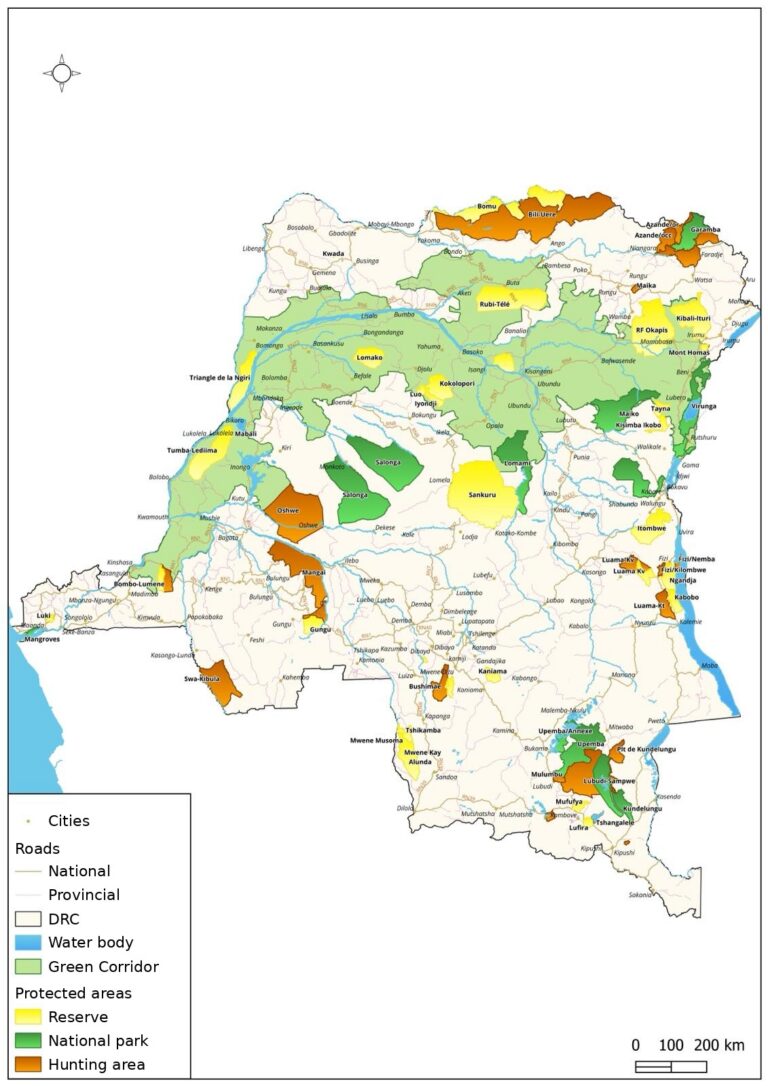
In November 2024, President Félix Tshisekedi announced the creation of the Kivu–Kinshasa Green Corridor. In December 2024, the National Assembly passed a law establishing “protected areas designated as community reserves,”38Law No. 24/020 of December 30, 2024, amending and supplementing Law No. 14/003 of February 11, 2014, relating to nature conservation, Law No. 24/020 of December 30, 2024, amending and supplementing Law No. 14/003 of February 11, 2014, relating to nature conservation, https://faolex.fao.org/docs/pdf/Cng232220.pdf. a new status designed for the Green Corridor. In 2025, a decree was adopted to create the Corridor.39Decree No. 25/01 of January 15, 2025 establishing the protected area intended as a community reserve, the “Kivu–Kinshasa Green Corridor,” https://kivukinshasagreencorridor.org/wp-content/uploads/2025/07/DECRET-N25-01-PORTANT-CREATION-DE-LAIRE-PROTEGEE-A-VOCATION-DE-RESERVE-COMMUNAUTAIRE-COULOIR-VERT.pdf. It comprises “more than 285,000 square kilometers of primary tropical forest, including 67,000 square kilometers of peatlands.”40Kivu-Kinshasha Green Corridor, “Transforming the Congo Basin: A Green Corridor for the Future,” https://kivukinshasagreencorridor.org/.
The stakes for the Green Corridor are enormous, commensurate with the geographic scale of the project. Some 130 localities in nine of the country’s 26 provinces, representing approximately 25 million inhabitants, or a quarter of the country’s population, lie within the Green Corridor, as do the cities of Kinshasa, Goma, Beni, Kisangani, Butembo, and Mbandaka, each of which has a population of at least 500,000 inhabitants. The capital, Kinshasa, with around 18 million inhabitants, is one of the three most populous cities in Africa, alongside Cairo and Lagos.
The government recognizes that the Congo’s vast natural resources make the DRC a country of global importance for biodiversity and the climate.
But the project faces massive external challenges. According to the 2026 Global Report on Food Crises, the country has the second-largest number of people in the world facing high levels of acute food insecurity. This is largely due to recurring cycles of conflict, primarily—but not exclusively—in the eastern part of the country. As of March 2026, more than five million people were internally displaced, 87 percent as the result of conflict, mostly in the eastern provinces.41International Organization for Migration, “DRC – Internal Displacement Overview 2026,” https://dtm.iom.int/reports/drc-internal-displacement-overview-2026.
Even if political speeches at major international events place strong emphasis on conservation and climate, the Green Corridor’s “role in stabilization and peace is one of the main reasons for its creation,” according to a 2024 ICCN report, and confirmed to Climate Rights International by experts involved in the implementation of the project.42Climate Rights International remote interview with conservation expert, January 30, 2026. By formalizing an economy based on the sustainable processing of agricultural commodities, the Green Corridor aims to “overcome the systemic causes of violence linked to the illegal exploitation of natural resources.”43Ministry of Environment, “Sustainable Development and New Climate Economy, Interactive Forest Atlas,” https://cod.forest-atlas.org/pages/carte.
The boundaries of the Green Corridor reflect a series of complex inclusion and exclusion decisions, shaped by a difficult balance between conservation imperatives and their practical feasibility in areas affected by conflict and extractive activities. Within the Green Corridor, the Ministry of Environment’s Interactive Forest Atlas50 reveals a complex mosaic of protected areas, mining and logging concessions, forest conservation concessions, and agribusiness activities—many of which overlap—reflecting competing interests, many of which have had harmful consequences for the human rights of local communities.
According to an EU Biodiversity for Life (B4Life) initiative report published on the Corridor website, the boundaries were decided following a process that included the use of Marxan software, whose methodology is “based on spatial prioritization algorithms that optimize the protection of biodiversity values while minimizing socio-economic costs.”44“Green Corridor Boundaries: Methodological Note,” December 2024, https://kivukinshasagreencorridor.org/wp-content/uploads/2026/06/CorridorVert_Methodo_Delimitation_v4.pdf. The report, dated December 2024, details this methodology and outlines the priorities that it says guided the delimitation of the Green Corridor, such as the connectivity of the different protected areas, representativeness in terms of biodiversity, the complementarity of newly selected sites with pre-existing protected areas, the resilience of these sites to climate change and other disturbances, and efficiency.45“Green Corridor Boundaries: Methodological Note,” December 2024, https://kivukinshasagreencorridor.org/wp-content/uploads/2026/06/CorridorVert_Methodo_Delimitation_v4.pdf.
The Green Corridor includes various types of protected areas: all or part of three of the DRC’s nine national parks (Virunga, Maiko,46NGO Fauna & Flora International, which signed in 2025 a public-private partnership agreement with the ICCN to manage Maiko National Park, wrote to Climate Rights International that “under current plans two sectors of Maiko would be included in the Green Corridor.” Email from Fauna and Flora International to Climate Rights International, June 22, 2026. and Lomami47NGO Frankfurt Zoological Society, which co-manages the Lomami National Park, wrote to Climate Rights International that “according to our team in DRC, the green corridor has included only the northern part of the park.” Email from Frankfurt Zoological Society to Climate Rights International, June 6, 2026.); the Okapi Wildlife Reserve (a UNESCO World Heritage Site), the Tumba-Lediima Reserve, the Ngiri Reserve, the Yangambi Biosphere Reserve, the Lomako-Yokokala Fauna Reserve, the Rubi-Tele Hunting Domain, the Ekolo Ya bobo Provincial Protected Reserve, and the Bombo-Lumene Hunting Domain and Fauna Reserve.
To manage the Green Corridor, the Congolese authorities have opted for a public-private partnership with the Virunga Foundation, which, since 2008, has co-managed the park of the same name—Africa’s oldest national park—in partnership with the ICCN.
In May 2025, the Virunga Foundation announced the signing of “an amendment to the Virunga Park management contract, extending it by 10 years, until 2050.” The announcement further states that the contract “also extends its scope to cover the establishment and management of the Green Corridor.”48François-Xavier de Donnea, “Création d’un couloir vert du Nord Kivu à Kinshasa,” May 2025, https://www.fxdedonnea.be/?p=870. Francois-Xavier de Donnea is a member of the board of the Virunga Foundation. According to the amended contract, the provisions concerning the Green Corridor run for 25 years from the date of signature.49Kivu-Kinshasha Green Corridor, “Amendment to the Management Agreement for Virunga National Park between the ICCN and the Virunga Foundation,” May 2025, https://kivukinshasagreencorridor.org/wp-content/uploads/2026/06/ICCN-VF-Contract-2025_Signed.pdf. The Virunga Foundation has the option to “subcontract all or part of the obligations incumbent upon it under this public-private partnership.”50Ibid. Moreover, the Virunga Foundation must pay the ICCN’s general management a monthly “amount as institutional support and to cover mission expenses,” set at 140,000 USD per month. The Foundation will also “mobilize and manage” the financing necessary “for the rehabilitation of the Kinshasa Botanical Garden, including the construction of infrastructure intended for the Congolese Institute for Nature Conservation, a secretariat for the Green Corridor, and facilities to host the project’s institutional and technical partners.” Lastly, the Foundation will “mobilize and manage financing to develop a high-end tourism product in the Kivu-Kinshasa Green Corridor, notably leveraging the presence of gorillas and chimpanzees, as well as the potential of the Congo River.”51Amendment to the Management Agreement for Virunga National Park between the ICCN and the Virunga Foundation, May 2025, https://kivukinshasagreencorridor.org/wp-content/uploads/2026/06/ICCN-VF-Contract-2025_Signed.pdf.
The allocation of roles is set out in the January 2025 decree. The ICCN delegates to the Virunga Foundation the establishment of “a multi-year management strategy and work programme,” “the modalities for project implementation and private sector participation” within the Green Corridor, and “the coordination and monitoring and evaluation of development and conservation initiatives” therein. The ICCN retains responsibility for the supervision of these functions. The Virunga Foundation is also responsible for ensuring “the consultation of relevant stakeholders in the development of the Kivu-Kinshasa Green Corridor management plan, strategies and operational plans, as well as implementation manuals aimed at meeting the requirements of green economy development, effective management and good governance.”52Decree No. 25/01 of 15 January 2025 establishing the protected area intended as a community reserve, the “Kivu–Kinshasa Green Corridor”, https://kivukinshasagreencorridor.org/wp-content/uploads/2025/07/DECRET-N25-01-PORTANT-CREATION-DE-LAIRE-PROTEGEE-A-VOCATION-DE-RESERVE-COMMUNAUTAIRE-COULOIR-VERT.pdf.
However, the appointment in March 2026 of a special adviser to the Head of State in charge of the Green Corridor, tasked with “assisting the President of the Republic in the design, coordination, and monitoring of the implementation of development-related initiatives,” raises questions about the allocation of roles, notably the ICCN’s effective role in the relationship between the Presidency and the Virunga Foundation. Special adviser Pacifique Kahasha Birindwa holds ministerial rank and has, on his own, a staff of 21 employees, including five assistants, one chargé de mission, one private secretary, and seven research officers, according to the document of his appointment.53Ordonnance n°26/025 du 23 mars 2026 portant nomination d’un conseiller spécial du chef de l’Etat en charge du Couloir Vert Kivu – Kinshasa, https://kivukinshasagreencorridor.org/wp-content/uploads/2026/04/ORDONNANCE-N%C2%B026-025-DU-23-MARS-2026-PORTANT-NOMINATION-DUN-CONSEILLER-SPECIAL-DU-CHEF-DE-LETAT-EN-CHARGE-DU-COULOIR-VERT-KIVU-KINSHASA.pdf. His profile as a mining entrepreneur and former presidential envoy on agricultural matters appears to lean far more toward economic objectives than conservation ones.54African Media Connections, “Interview with Pacifique Kahasha,” YouTube video, 10:46, October 10, 2017, https://www.youtube.com/watch?v=d2GyWFT3LHg (accessed September 24, 2026).
“The Green Corridor is an initiative of rare ambition, but this ambition can only materialize if the house is in order,” the NGO coalition Réseau Environnement et Droits Humains wrote in a May 19, 2026 statement.55Réseau Environnement et Droits Humains (R-EDH), Communiqué, May 19, 2026. “However, the risk of role confusion among the various entities involved is today one of the most serious threats to the survival of the project.”
The Congolese authorities have described the Green Corridor as “the world’s largest protected tropical forest reserve” or as “destined to become the largest protected area in the world.”56Eve Bazaiba (@Evebazaiba), “Étendu sur 1 Million de km2, le «couloir vert Kivu-Kinshasa », constitue: 1. l’engagement supplémentaire du Gouvernement en faveur de la conservation; 2. Il est destiné à devenir la plus vaste aire protégée au monde; 3. Il contribue aux objectifs internationaux dont le défi de Bonn,” X, December 15, 2024, 4:01 pm, https://x.com/Evebazaiba/status/1868401029248958526. At the time of the post, Bazaiba was the Minister of the Environment. However, whether intentionally or not, these statements are misleading.
The International Union for the Conservation of Nature defines a protected area as a site which is “recognized, dedicated and managed for conservation.”57International Union for the Conservation of Nature, “Guidelines for Applying Protected Area Management Categories,” https://portals.iucn.org/library/sites/library/files/documents/PAG-021.pdf. The Virunga Foundation confirmed to Climate Rights International that, “at this stage of the pilot phase,” there are no plans for the creation of new protected areas within the Green Corridor.58“Technical note in response to concerns raised by Climate Rights International,” sent on behalf of the Virunga Foundation and the ICCN by the Director of External Relations of the Virunga Foundation, June 18, 2026. Instead, the plan, as explained to Climate Rights International by the Virunga Foundation, is based on the model of Other Effective Area-Based Conservation Measures (OECMs), “which makes it possible to contribute to conservation objectives without necessarily resorting to additional protected zoning.”59An OECM is “a geographically defined area other than a Protected Area, which is governed and managed in ways that achieve positive and sustained long-term outcomes for the in situ conservation of biodiversity, with associated ecosystem functions and services and where applicable, cultural, spiritual, socio–economic, and other locally relevant values,” https://www.cbd.int/doc/decisions/cop-14/cop-14-dec-08-en.pdf.
This approach would help achieve the DRC’s commitments under the Kunming–Montreal Global Biodiversity Framework, which aims to ensure that, by 2030, at least 30 percent of terrestrial, inland water, marine, and coastal areas are effectively conserved through ecologically representative protected areas.60The Kunming–Montreal Global Biodiversity Framework, https://www.cbd.int/gbf. The DRC’s National Biodiversity Strategy and Action Plan 2025-2030 clearly defines the Green Corridor as a “strategic opportunity within the framework of the 30×30 strategy for ecological connectivity, community involvement and the development of a green economy around biodiversity.”61Ministry of Environment, Sustainable Development, and the New Climate Economy, “Stratégie et plan d’action nationaux pour la biodiversité 2025-2030 de la République démocratique du Congo,” https://medd.gouv.cd/wp-content/uploads/2026/01/SPANB-2025-2030-_-Document-Principal-Texte-Complet-VF-29_10.pdf. The Virunga Foundation wrote to Climate Rights International that “as an OECM, the Green Corridor can indeed contribute to the accounting of the 30×30 targets, provided that standards of governance, conservation effectiveness, and community participation are documented and verified. The 2025–2027 pilot phase is precisely intended to demonstrate this effectiveness on the ground, before any formal accounting.”62“Technical note in response to concerns raised by Climate Rights International,” sent on behalf of the Virunga Foundation and the ICCN by the Director of External Relations of the Virunga Foundation, June 18, 2026.
In the Congolese context, potential OECMs include several types of areas, notably Local Community Forest Concessions (CFCLs), a model that is already being implemented across the country. According to the ICCN, their expansion within the Green Corridor would help “strengthen and connect the network of protected areas … by linking isolated protected zones through functional ecological corridors.”63ICCN, “Création d’une aire protégée à vocation de réserve communautaire dénommée ‘Couloir Vert Kivu Kinshasa’,” December 18, 2024, https://kivukinshasagreencorridor.org/wp-content/uploads/2025/01/20241218-Etude-Couloir-Vert.pdf.
With more than 14 percent of the country’s total territory already covered by various protected areas according to the Congolese Ministry of Environment,64Ministry of Environment, Sustainable Development, and the New Climate Economy, “Protected Area in the Democratic Republic of Congo,” https://cod.forest-atlas.org/pages/dash-ap. the DRC hopes to close the gap to its 30 percent target by scaling up the creation of OECMs. The Green Corridor alone accounts for nearly a quarter of the national territory, so if the government includes all of it as protected in its accounting, it will meet the target. However, the creation of OECMs does not in itself guarantee the pursuit of conservation objectives. As one conservation expert explained to Climate Rights International: “Deforestation has quadrupled in some community forest concessions, as the rights granted over their lands have incentivized communities to sell them to elites from the capital who proceed to clear the forests.”65Climate Rights International remote interview with conservation expert, January 30, 2026. Furthermore, the identification and reporting of a site as an OECM remains voluntary, allowing the authorities to identify a site as protected without any oversight.66International Union for the Conservation of Nature, “Guidance on other effective area-based conservation measures (OECMs),” https://portals.iucn.org/library/sites/library/files/documents/GPG-036-En.pdf.
The government’s broad description of the Green Corridor as “protected” matters because it shapes donor expectations, community perceptions, and ultimately accountability. A formal, publicly available document clarifying the Corridor’s legal nature, its governance structure, and the list of activities that are strictly prohibited within its boundaries would be a necessary and meaningful first step.
The Green Corridor contains a complex mosaic of protected areas, mining and logging concessions, forest conservation concessions, and agribusiness activities. In this already complex space, plans for the Green Corridor envisaged by the Virunga Alliance in an economic development study published on the official website of the Green Corridor include the establishment of a “Green Economy” centered around four sectors: renewable energy, industrial processing of agricultural products, transport, and carbon finance.67The study “aims to describe what the economic development potential would mean in financial terms, should it be adopted and executed following a ‘private-market’ approach. Results provided in this study are exploratory and would require in-depth analysis of each at a later stage.” Alliance Virunga, “Economic Development Study for the Congo River Green Corridor in DRC. A Focus on Renewable Energy, Agriculture and Agro-Industrial Transformation, Transport and Carbon Financing,” April 7, 2025, https://kivukinshasagreencorridor.org/wp-content/uploads/2025/07/20250429-Etude-developpement-economique-EN-.pdf.
The investment projects identified in the study are ambitious: 19 “industrial hubs,” six “special economic zones” around the main urban centers, electrification benefiting more than 17 million people for over one billion dollars, development of food crops and cash crops, construction of a barge fleet to modernize transport on the Congo River, and carbon financing to monetize more than 40 gigatons of CO₂ stored in forests and peatlands. These projects are projected to create 500,000 new jobs by 2030.68Ibid.
Each of these elements, however, carries either human rights or environmental risks, or both, if not managed properly.
The electrification strategy of the Green Corridor is primarily based on hydropower for large cities with more than 500,000 inhabitants that have nearby hydro potential. For all other towns and villages, solar energy is being considered.
The development of renewable energy could encourage the use of electric cooking instead of charcoal—one of the main causes of deforestation in the country—and promote electric motorcycles, thereby both reducing air pollution and enabling motorcycle taxi drivers to earn more by limiting their dependence on fossil fuels.
The hydroelectricity model envisaged in the Virunga study is “a run-of-river approach across the six key cities of Kinshasa, Kisangani, Goma, Butembo, Beni Mbandadue.”69Ibid. In several cases, such as Kisangani, this would involve rehabilitating existing infrastructure. Run-of-river dams, although less problematic than large infrastructure projects, carry risks of forced displacement, deforestation, and aquatic habitat degradation.70Alban Kuriqi, António N. Pinheiro, Alvaro Sordo-Ward, María D. Bejarano, Luis Garotte, “Ecological impacts of run-of-river hydropower plants—Current status and future prospects on the brink of energy transition,” Renewable and Sustainable Energy Reviews, Vol. 142, May 2021, https://doi.org/10.1016/j.rser.2021.110833. Regarding the construction of the Rwanguba-1 (14 MW), Matebe (13 MW), and Rwanguba-2 (14 MW) hydropower plants, funded by the European Union and already functioning,71European Commission, “Virunga conservation and development initiative in the Democratic Republic of the Congo,” https://international-partnerships.ec.europa.eu/policies/global-gateway/virunga-conservation-and-development-initiative-democratic-republic-congo_en. the Virunga Foundation told Climate Rights International that “environmental and social assessments were carried out in accordance with European Union procedures for each of these projects,” and that “the findings of these assessments were shared with the affected communities as part of local consultation processes.”72“Technical note in response to concerns raised by Climate Rights International,” sent on behalf of the Virunga Foundation and the ICCN by the Director of External Relations of the Virunga Foundation, June 18, 2026.
The total cultivated area of the Green Corridor is estimated by the Virunga study at around three million hectares, producing 13 million tons per year of agricultural products, such as cocoa, coffee, oil palms, rubber trees, cassava, plantain bananas, maize, and rice. Fifteen percent of the land is fallow or uncultivated, according to the study, which states that the area offers important potential for local development that is currently underexploited due to a lack of investment and the absence of local processing.73Alliance Virunga, “Economic Development Study for the Congo River Green Corridor in DRC. A Focus on Renewable Energy, Agriculture and Agro-Industrial Transformation, Transport and Carbon Financing,” April 7, 2025, https://kivukinshasagreencorridor.org/wp-content/uploads/2025/07/20250429-Etude-developpement-economique-EN-.pdf, p. 46-47.
The Virunga study also points, for example, to the possibility of increasing rubber production, which it describes as “almost non-existent” because of a limited number of village smallholdings and abandoned plantations.74Ibid, p. 46-47. It notes that, in the Opala territory of Tshopo Province, “around twenty thousand hectares of rubber plantations invaded by bush vegetation” remain from the colonial period. Underutilized industrial oil palm plantation sites also have “enormous recovery potential.” In its effort to promote both conservation and the development of sustainable agriculture, the Green Corridor therefore seeks “to restore old plantations instead of clearing new primary forests.”75Ibid.
The stated objective is to “develop local processing centers at various stages” along the Green Corridor in order to create added value locally rather than exporting raw products: an artisanal chocolate factory in Beni to process cocoa from the eastern region, community-owned oil mills near Mbandaka to produce palm oil, a rubber processing plant in Gemena to transform latex, coffee washing stations in Kivu, and other projects.76Ibid, p. 182.
The hydroelectric power generated by the renewable energy projects could help enable the local processing of these products, as exemplified by Virunga chocolate.77Virunga Origins, “Chocolate from the Heart of Congo,” https://origins.virunga.org/collections/chocolate. To achieve this, the implementation of 19 new “industrial hubs” is planned—a model already existing in Virunga National Park that combines conservation, security, and economic development. Each hub would be located inside a Forward Operating Base (FOB).78Virunga Alliance, “Forward Operating Base: Security and Opportunities for Local Communities,” video, Facebook, August 29, 2025, https://www.facebook.com/watch/?v=1291227139142504 (accessed September 25, 2026).
According to the study, six Special Economic Zones are also planned near six cities to serve as “economic growth hubs” through a “favorable tax framework” and the concentration of “value-added agro-industrial activities within clearly defined geographic areas.”79Alliance Virunga, “Economic Development Study for the Congo River Green Corridor in DRC. A Focus on Renewable Energy, Agriculture and Agro-Industrial Transformation, Transport and Carbon Financing,” April 7, 2025, https://kivukinshasagreencorridor.org/wp-content/uploads/2025/07/20250429-Etude-developpement-economique-EN-.pdf, p. 58. The idea is to foster “strong synergies among processing industries, logistics providers, and renewable energy developers, thereby improving overall operational efficiency and profitability.”80Ibid, p. 50-57.
However, the expansion of such activities in the Green Corridor is not without risk. Agro-industry in the DRC has seen disastrous experiences leading to human rights abuses including forced evictions from land, labor abuses, violations of the right to a healthy environment, and excessive use of force against activists and defenders. In the province of Tshopo, which is entirely within the Green Corridor, intercommunal violence has caused several hundred deaths since the beginning of 2023.81OCHA, “Tshopo: Entre inondations ravageuses et conflits intercommunautaires, les communautés font preuve de resilience.” October 31, 2024, https://reliefweb.int/report/democratic-republic-congo/tshopo-entre-inondations-ravageuses-et-conflits-intercommunautaires-les-communautes-font-preuve-de-resilience. According to several sources, including the United Nations,82Actualité.cd, “Tshopo: le BCNUDH exhorte le gouvernement à résoudre les causes profondes des tensions ethniques pour promouvoir la cohabitation pacifique entre Mbole et Lengola,” January 18, 2025, https://actualite.cd/2025/01/18/tshopo-le-bcnudh-exhorte-le-gouvernement-resoudre-les-causes-profondes-des-tensions? journalists,83Le journal Afrique, TV5Monde, (@JTAtv5monde), “RD Congo: la société d’activités agropastorales “CAP Congo” est-elle “à l’origine de tueries”, depuis son implantation à Kisangani? Réponse ce samedi dans “RDC – Les palmiers du sang,” une enquête choc de Simon Rodier, Lola Collombat et Simon François @TV5MONDEPLUS. X, April 18, 2025, 2:17 p.m., https://x.com/JTAtv5monde/status/1913295753025376690 (accessed September 25, 2026). and civil society organizations,84Afrikarabia (@afrikarabia), “#RDC Les associations de femmes de la #Tshopo écrivent au président #Tshiskedi pour dénoncer le conflit intercommunautaire entre les #Mbole et #Lengola, ainsi que l’insécurité qui règne à #Kisangani (18.000 déplacés internes),” X, May 3, 2024, https://x.com/afrikarabia/status/1786419886521995328. the conflict was fueled by the allocation by the former governor of several thousand hectares in the province to a private agribusiness company, Cap-Congo. The government announced in 2024 the cancellation of these contracts.85InfoPlus RDC, “À la 17ème réunion ordinaire du Conseil des ministres, la Ministre d’État, Ministre des affaires foncières Acacia Bandubola, a informé les membres du Conseil sa décision d’annuler plusieurs contrats de concession emphytéotique et d’occupation provisoire conclus illégalement avec la société CAP-Congo dans les provinces de la Tshopo et du Kwilu,” Facebook, October 13, 2024, 12:39 p.m., https://www.facebook.com/watch/?v=811895997556507 (accessed September 25, 2026). In the province of Kwilu, a similar situation involving the same company led to the mobilization of farmers and livestock breeders, prompting the central government to intervene and cancel the illegal agreement.86Yannick Kenné, “En RDC, le gouvernement annule la concession de 42 000 hectares de terres attribuée à la société agropastorale libanaise CAP Congo,” Mongabay, September 18, 2024, https://fr.mongabay.com/2024/09/en-rdc-le-gouvernement-annule-la-concession-de-42-000-hectares-de-terres-attribuee-a-la-societe-agropastorale-libanaise-cap-congo/. According to the land law, the allocation of rural land exceeding 1,000 hectares in area falls within the prerogatives of the President of the Republic.87Law No. 73-021 of July 20, 1973, on the General Property Regime, Land and Real Estate Regime, and Security Interests Regime, as Amended and Supplemented by Law No. 80-008 of July 18, 1980, https://www.droitcongolais.info/files/215.07.73-Loi-du-20-juillet-1973_Regime-des-biens.pdf.
Feronia, a Canadian company that has received financial support from several European development banks, was reportedly responsible for serious abuses and environmental damage88Human Rights Watch, “A Dirty Investment: European Development Banks’ Link to Abuses in the Democratic Republic of Congo’s Palm Oil Industry,” report, November 25, 2019, https://www.hrw.org/report/2019/11/25/dirty-investment/european-development-banks-link-abuses-democratic-republic. at its subsidiary Plantations et Huileries du Congo (PHC), the former Unilever oil palm plantations.89Grain, “A Century of Agro-Colonialism in the DR Congo,” March 25, 2022, https://grain.org/e/6826. Following Feronia’s bankruptcy in 2020, PHC is now owned by Kuramo Capital Management, a New York-based investment management firm. Communities living near PHC plantations have long raised grievances over land rights and access to their ancestral territory.90The Oakland Institute, “Colonial Legacy of Exploitation Thrives Today on the PHC Oil Palm Plantations,” May 3, 2022, https://www.oaklandinstitute.org/our-take/colonial-legacy-exploitation-thrives-today-phc-oil-palm-plantations; Yannick Kenné, “DRC communities turn up heat on EU lenders funding palm oil giant PHC,” Mongabay, August 12, 2024, https://news.mongabay.com/2024/08/drc-communities-turn-up-heat-on-eu-lenders-funding-palm-oil-giant-phc/. While a formal mediation process initiated in 2018 officially ended in February 2026, with an independent monitoring committee now tasked with overseeing the implementation of agreed commitments, core issues, including the return of over 58,000 hectares of land, remain unresolved.91PHC-Congo, “PHC and local communities: ICM mediation concludes, paving way for agreements monitoring committee by local civil society organizations,” February 20, 2026, https://phc-congo.com/en/phc-and-local-communities-icm-mediation-concludes-paving-way-for-agreements-monitoring-committee-csa-by-local-civil-society-organisations/.
In such a context, both agricultural cultivation and agricultural processing projects within the Green Corridor must respect FPIC and protect both human rights and the environment.
The development of oil palm, rubber, coffee, and cocoa plantations must be based on protection of primary forests. As underlined by the Virunga study, “without planning, the expansion of monospecific plantations or the opening of new agricultural land risks further fragmenting the forest.”92Alliance Virunga, “Economic Development Study for the Congo River Green Corridor in DRC. A Focus on Renewable Energy, Agriculture and Agro-Industrial Transformation, Transport and Carbon Financing,” April 7, 2025, https://kivukinshasagreencorridor.org/wp-content/uploads/2025/07/20250429-Etude-developpement-economique-EN-.pdf, p. 42.
The hoped-for job creation should constitute a countermodel that respects workers’ rights. In this regard, the Congolese authorities must ensure that companies are acting responsibly and respecting their environmental and human rights obligations; and the expected private actors must follow the United Nations Guiding Principles on Business and Human Rights, in particular by implementing ongoing and proactive human rights due diligence procedures to identify, prevent, and mitigate the impact of the company on human rights.
The transport component of the Green Corridor aims to turn the Congo River into the aquatic “highway” that the roughly 1,700 navigable kilometers between Kisangani and Kinshasa could represent, and which according to the Virunga study is currently “severely underutilized due to inadequate dredging, lack of navigational aids, aging vessels and insufficient maintenance.”93Ibid, p. 69. A new fleet of container barges would make it possible to transport the expected agricultural production from the east of the country to the capital, Kinshasa, in the west, at a lower cost than road or air transport. This would involve rehabilitating port infrastructure located along the river, which is “mostly dilapidated,” according to the study. For example, “significant investments would be needed to build adequate jetties and warehouses in Mbandaka.”94Ibid.
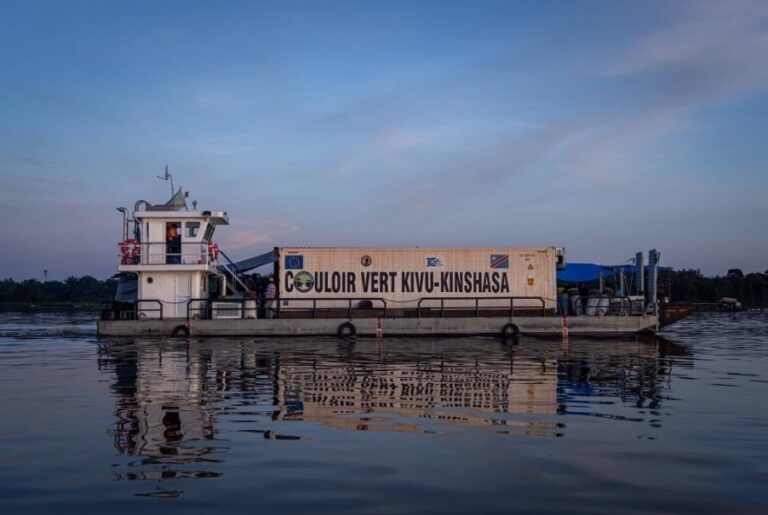
The Green Corridor relies heavily on carbon finance to preserve its forests while helping to fund some of the initiatives mentioned above.
Initiated by Article 6 of the 2015 Paris Agreement, carbon finance consists of assigning a financial value to greenhouse gas emissions in order to encourage their reduction. This value is monetized through carbon credits, which are sold to companies, states, or investors seeking to offset their emissions or meet their climate targets. Programs can be described as voluntary—that is, carried out by private actors such as for-profit companies and/or NGOs—or as jurisdictional programs, which are led by a public authority at the scale of an entire jurisdiction (country, region, state, province, etc.), as is envisioned in the case of the Green Corridor. One of the best-known tools is REDD+, which stands for Reducing Emissions from Deforestation and Forest Degradation, with the “+” referring to the role of conservation, sustainable management of forests, and enhancement of forest carbon stocks in developing countries.95United Nations Climate Change, “What is REDD+?,” https://unfccc.int/topics/land-use/workstreams/redd/what-is-redd.
Based on historical emissions associated with forest loss and degradation, estimates indicate that, over a five-year period, the Green Corridor could avoid up to 125 million tons of carbon dioxide, corresponding to potential revenues ranging from 800 million to 1.5 billion USD. The Virunga study envisages “a package of interventions that address multiple drivers” of deforestation, including “supporting sustainable agriculture and agroforestry to reduce slash-and-burn farming; improving energy access to curb charcoal-driven forest loss; strengthening protected areas and community forests (through patrols, community eco-guards, and legal recognition of land rights); and road/infra planning to minimize new deforestation from transport projects.”96Alliance Virunga, “Economic Development Study for the Congo River Green Corridor in DRC. A Focus on Renewable Energy, Agriculture and Agro-Industrial Transformation, Transport and Carbon Financing,” April 7, 2025, https://kivukinshasagreencorridor.org/wp-content/uploads/2025/07/20250429-Etude-developpement-economique-EN-.pdf, p. 110.
In theory this approach appears to be a gift from the canopy, but in practice carbon finance programs have often undermined local communities. A 2025 Rainforest UK report stated that “despite the [DRC] government’s positive rhetoric … forest carbon initiatives are proliferating chaotically and without sufficient safeguards.”97Rainforest Foundation UK, “The great green rush: The exponential rise and social impacts of forest carbon offset projects in the DRC,” report, October 2025, https://www.rainforestfoundationuk.org/wp-content/uploads/2025/10/JA-605-The-Great-Green-Rush-FINAL.pdf. The NGO identified dozens of projects covering nearly half of the country’s surface area that have failed to respect FPIC, leading to harmful social consequences and an absence of tangible benefits for the populations concerned.
The DRC’s vast forests have become a promised land for different kinds of would-be investors in carbon finance. For example, Perenco, the only oil producer in the country, has invested through its “investment and asset management company” Taranis,98Taranis, “About,” https://taranis.eu/about/. in two REDD+ projects spanning 400,000 hectares across two former logging concessions located inside the Green Corridor—one in Équateur Province and the other in Mongala.99Gloria Pallares, “Exclusif : un géant du bois convertit discrètement des sites d’exploitation forestière du Congo en programmes de crédit carbone,” Mongabay, March 10, 2022, https://fr.mongabay.com/2022/03/exclusif-un-geant-du-bois-convertit-discretement-des-sites-dexploitation-forestiere-du-congo-en-programmes-de-credits-carbone/.
According to a letter to Climate Rights International from the Share Wood Company, the project developer and the operating body in the field, the carbon emissions that the projects intend to preserve will be used to offset the emissions resulting from Perenco’s oil operations in the country. According to the company, “the FPIC process has been completed in all the 100 villages dependent of the two concessions, with consent obtained by the end of 2025,” and the company has “contracted an independent external auditor, EcoLance Private Limited, to conduct the validation process.”100Letter from Laurent Valiergue, Founding Partner, Share Wood Company Kongo, to Climate Rights International, sent by email on June 12, 2026. Some villages are located outside the concessions but depend on them for aspects, such as planting and harvesting. Perenco’s attempts to offset its emissions—at a time when the company is facing serious accusations of pollution and environmental damage and is due to stand trial before the Paris Civil Court101Disclose, “Perenco: oil group to face trial in France for ‘environmental harm’ in DRC,” October 17, 2025, https://disclose.ngo/en/article/perenco-oil-group-to-face-trial-in-france-for-environmental-harm-in-drc.—must not exempt either the company or the relevant authorities from complying with international and national law on the right to a healthy environment. DRC environmental law provides that “every person has the right to breathe air that does not harm their health. Any emission into the air likely to cause a nuisance to the population or to harm the environment and health is prohibited.”102Article 47 of Ordonnance-Loi n°23/007 du 3 mars 2023 modifiant et complétant la loi n°11/009 du 9 juillet 2011 portant principes fondamentaux relatifs à la protection de l’environnement, https://faolex.fao.org/docs/pdf/Cng224306.pdf.
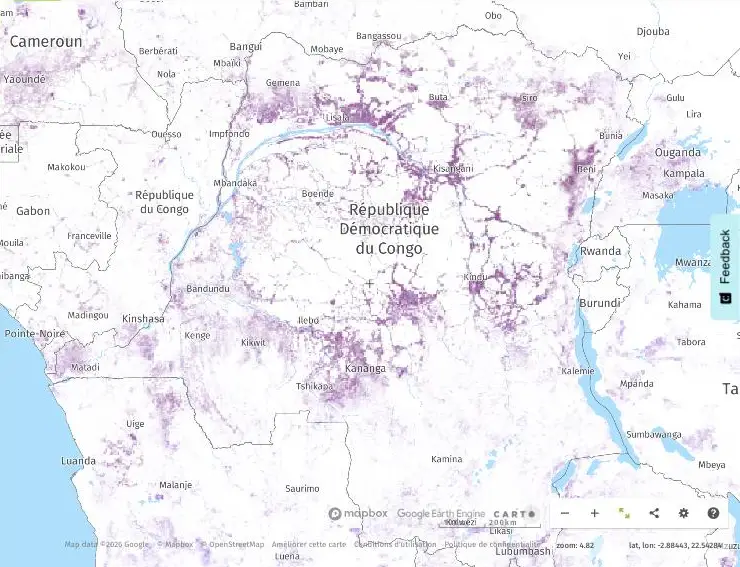
According to a recent report by Greenpeace Africa, existing mining permits cover approximately 12.3 million hectares within the Green Corridor, representing 23% of its area.103Greenpeace Africa, “The Kivu–Kinshasa Green Corridor: Red Flags and the Urgent Need for a Moratorium on New Extractive Projects,” policy brief, July 27, 2026, https://www.greenpeace.org/africa/en/press/61301/exposed-oil-blocks-and-mining-concessions-cover-almost-100-of-worlds-largest-green-corridor/.
The 2024 ICCN report listed among the “notable ambitions” of the Green Corridor “the prohibition of destructive industrial activities, such as intensive logging or mining, which threaten the ecological integrity or biodiversity of the Green Corridor or the rights of the communities living there.” This was consistent with statements made by the former Minister of the Environment, who, in a late-2024 interview, spoke of “revoking titles where mining activity occurs” within the Corridor.104Jonas Gerding, Jean-Noël Ba-Mweze, “La RDC ambitionne de créer un couloir vert,” DW, December 16, 2024, https://www.dw.com/fr/sur-dw-ministre-congolaise-nvironnement-eeve-bazaiba-condamne-attitude-grands-pays-pollueurs/video-71054247. However, Article 4 of the decree creating the Green Corridor explicitly states that its creation “does not create, modify, or extinguish any pre-existing right held by local communities or any other third party, until the allocation and assignment of zones has been carried out, following in particular the public inquiry.”105Law No. 24/020 of December 30, 2024, amending and supplementing Law No. 14/003 of February 11, 2014, relating to nature conservation.
The leading person for the Green Corridor within the Virunga Foundation wrote to Climate Rights International that “to our knowledge, there are no immediate plans to cancel or suspend mining concessions.”106Email correspondence to Climate Rights International from Jérôme Gabriel, lead of the Green Corridor protected area at the Virunga Foundation, June 23, 2026. Indeed, after reviewing the Mining Rights Registry as of September 30, 2026, Climate Rights International identified more than 50 mining permits, mostly exploration permits, granted in the Green Corridor since the President of the Republic announced its creation in January 2025.107Ministry of Mines, “Cadastre Minier. Registre des droits miniers et de carrières actifs,” September 30, 2026, https://cami.cd/registre-des-droits-miniers-et-de-carrierres-actifs-en-date-du-30-septembre-2026/.
Illegal mining activities are also widespread in the eastern provinces, including in territories within or bordering the Green Corridor. Although the consequences for human rights and the environment are severe, state control over mineral extraction and trade is weak, and is undermined by corruption and the presence of armed groups.
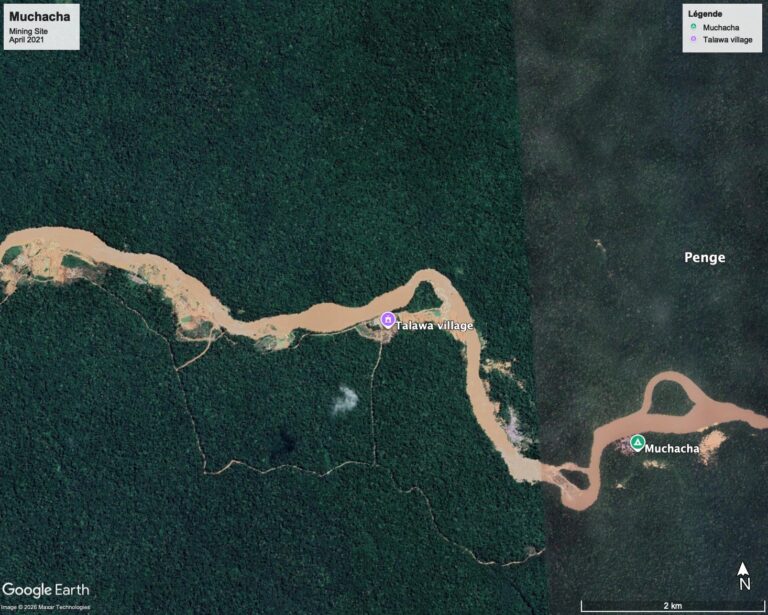
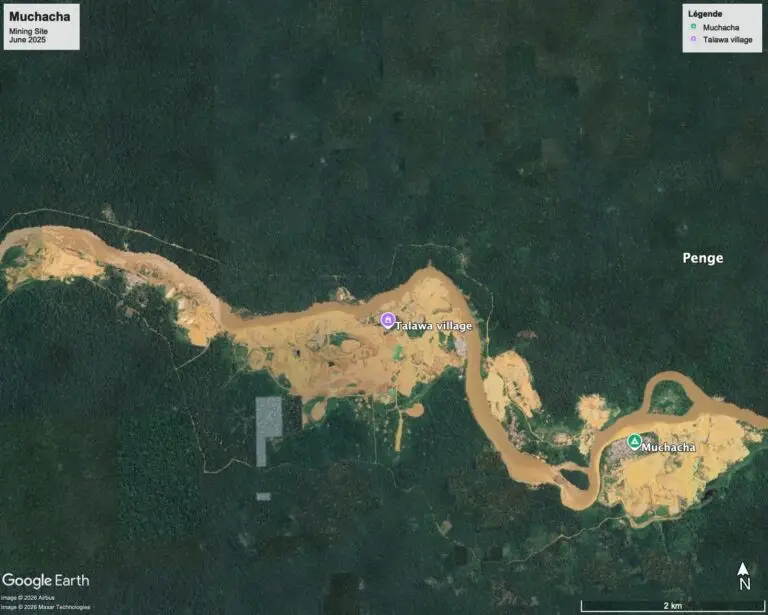
For example, in the Okapi Wildlife Reserve, a UNESCO World Heritage Site in Danger,108UNESCO, “List of World Heritage in Danger,” https://whc.unesco.org/en/danger-list/. illegal gold mining has been causing severe environmental damage, including deforestation and the pollution of waterways.109Ruth Kamnitzer, “Illegal gold mining drives deforestation in DRC reserve home to ‘African unicorn’,” Mongabay, November 26, 2024, https://news.mongabay.com/2024/11/illegal-gold-mining-drives-deforestation-in-drc-reserve-home-to-african-unicorn/. In its southern section, more than 5,000 hectares of forest cover have been lost since 2022, according to UNESCO.110UNESCO, Okapi Wildlife Reserve (Democratic Republic of the Congo), Decision 47 COM 7A.11, 2025, https://whc.unesco.org/en/decisions/?id_decision=8678. Compounding this, mining permits have been granted within the reserve itself, with the Mining Cadastre producing a redrawn map that artificially reduces the reserve’s boundaries, undermining its legal protection.111Ruth Kamnitzer, “‘It’s a real mess’: Mining and deforestation threaten unparalleled DRC wildlife haven,” Mongabay, October 13, 2023, https://news.mongabay.com/2023/10/its-a-real-mess-mining-and-deforestation-threaten-unparalleled-drc-wildlife-haven/. In 2025, UNESCO “urged the DRC to implement an immediate moratorium on all industrial and artisanal mining activities in the legally disputed areas [and] strongly reiterated its request that all mining permits granted within the property be revoked, that all mining sites within the property and their access roads be closed, and that restoration activities be initiated in degraded areas.”112UNESCO, Okapi Wildlife Reserve (Democratic Republic of the Congo), Decision 47 COM 7A.11, 2025, https://whc.unesco.org/en/decisions/?id_decision=8678. According to Article 6 of the Mining Code, “no mining or quarry rights may be granted within a protected area, nor may an artisanal mining zone be established there.”113Law No. 007/2002 of 11 July 2002 establishing the Mining Code, as amended by Law No. 18/001 of 9 March 2018, https://www.icnl.org/wp-content/uploads/miningcode.pdf.
In Maiko National Park, which straddles Tshopo, Maniema, and North Kivu114The section of the park located in Maniema Province is not part of the Green Corridor. provinces and has been jointly managed by the ICCN and NGO Fauna & Flora International since 2025 under a public-private partnership, the park’s director has denounced illegal mining operations. According to him, these operations are carried out by Chinese entrepreneurs who have been granted access to extract resources, including gold, by landowners or armed groups.115Yannick Kenné, “Matthieu Mirambo: ‘Les Chinois exploitent de manière illicite les minerais au Parc national de la Maiko’,” Mongabay, January 29, 2026, https://fr.mongabay.com/2026/01/matthieu-mirambo-les-groupes-armes-vendent-les-terres-aux-chinois-dans-le-parc-national-de-maiko/. In Ituri Province, Chinese company Kimia Mining has been repeatedly accused of paying “undisciplined elements of [a] brigade to protect its sites and equipment.”116International Peace Information Service, “Mapping of artisanal mining sites in western Mambasa, Ituri Province,” report, October 2023, https://ipisresearch.be//wp-content/uploads/2023/10/20231026_IPIS-Mapping-ASM-in-western-Mambasa_EN.pdf. There are also allegations that military officials, with protection from provincial authorities, are involved in both illegal logging and gold exploitation.117Ibid.
In the provinces of Bas-Uele118Radio Okapi.net, “Des députés provinciaux de Bas-Uélé dénoncent un « pillage minier » par la société Oasis SARL à Ango et Poko,” March 4, 2026, https://www.radiookapi.net/2026/03/04/actualite/societe/des-deputes-provinciaux-de-bas-uele-denoncent-un-pillage-minier-par-la. and Haut-Uele,119Radio Okapi, “Haut-Uélé : Félix Tshisekedi appelé à interdire l’exploitation artisanale de l’or par des Chinois à Wamba,” September 19, 2021, https://www.radiookapi.net/2021/09/19/actualite/societe/haut-uele-felix-tshisekedi-appele-interdire-lexploitation-artisanale-de. violations of the DRC Mining Code— which prohibits artisanal mining by foreigners, or mining with simple exploration permits120Law No. 007/2002 of 11 July 2002 establishing the Mining Code, as amended by Law No. 18/001 of 9 March 2018, https://www.icnl.org/wp-content/uploads/miningcode.pdf. Article 27 states: “Only adult natural persons of Congolese nationality who hold artisanal miner cards and are affiliated with approved mining or quarry products cooperatives are eligible for artisanal mining.”—have frequently caused tensions and prompted appeals from civil society to the central authorities.121Ebuteli, “Dans le Haut-Uélé, la présence contestée d’exploitants chinois dans le secteur minier,” July 13, 2022, https://www.ebuteli.org/publications/blogs/dans-le-haut-uele-la-presence-contestee-d-exploitants-chinois-dans-le-secteur-minier.
The widespread use of mercury and other hazardous chemicals in artisanal and semi-industrial gold mining in the DRC is one of the longest lasting human rights and environment impacts of this industry.122IPIS, “Voix du Congo: Study on gold panning and the use of mercury in artisanal mining in Ituri,” report, July 23, 2018, https://ipisresearch.be/publication/voix-du-congo-etude-sur-lorpaillage-et-lutilisation-du-mercure-dans-lexploitation-miniere-artisanale-en-ituri/. A similar situation in Cameroon was the subject of a May 2025 letter from several UN Special Procedures mandate holders to the President of Cameroon, raising concerns about the impact of mercury on human rights. The Special Rapporteurs noted that people are sometimes forced to drink contaminated water due to a lack of access to safe drinking water, and that “in some areas surrounding gold mines, residents have reported that they can no longer water their livestock, eat fish from the river, or use the water for their own needs due to mercury contamination.” Letter from Mandates of the Working Group on the issue of human rights and transnational corporations and other business enterprises; the Special Rapporteur on the right to education; the Special Rapporteur on the right to food (…), May 21, 2025, https://spcommreports.ohchr.org/TMResultsBase/DownLoadPublicCommunicationFile?gId=29930.
In May 2024, 13 people reportedly died in villages along the Télé River after drinking water contaminated by mining activities.123Radio Okapi, “Bas-Uele: 13 décès en un mois à la suite de la pollution de la rivière Télé,” June 7, 2024, https://www.radiookapi.net/2024/06/07/actualite/environnement/bas-uele-13-deces-en-un-mois-la-suite-de-la-pollution-de-la. Reports stated that a joint commission representing the provinces of Tshopo and Bas-Uélé would be set up “to clarify the situation and implement measures that could facilitate an appropriate resolution of the issue.”124Agence Congolaise de Presse, “RDC: pollution de rivière « Télé », la commission mixte inter province recommandée,” June 6, 2024, https://acp.cd/nation/rdc-pollution-de-riviere-tele-la-commission-mixte-inter-province-recommandee/. Climate Rights International was unable to find additional information about implementation. A report published in September 2025 by two Congolese NGOs, Initiative pour la Protection des Droits de l’Homme et la Réinsertion (IPDHOR) and Patrice Emery Lumumba pour le Développement Communautaire, la Défense et la Promotion des Droits Humains (PELDDH) documented “severe pollution of watercourses” in the same area and reported “cases of skin diseases” among communities living along the Télé River.125IPDHOR/PELDDH. “Qui alimente l’exploitation illégale de l’or et diamant de Tshopo ? Défis, impacts et voies de réforme. Investigation Year: September 2025,” joint report, November 12, 2025, https://ipdhor-drc.org/ipdhor-qui-alimente-lexploitation-illegale-de-lor-et-diamant-de-tshopo/.
As long ago as September 2021, President Tshisekedi called for an investigation into the problem of mining operations under exploration permits.126Radio Okapi.net, “Fraude minière en RDC : Félix Tshisekedi demande une enquête détaillée,” September 18, 2021, https://www.radiookapi.net/2021/09/19/actualite/justice/fraude-miniere-en-rdc-felix-tshisekedi-demande-une-enquete-detaillee. Arrests and sentences have been frequently publicized.127Radio Okapi, “Ituri: 11 Chinois et 3 Congolais arrêtés pour exploitation minière illégale à Nizi,” April 28, 2026, https://www.radiookapi.net/2026/04/28/actualite/societe/ituri-11-chinois-et-3-congolais-arretes-pour-exploitation-miniere?; Joseph Winter, “Chinese nationals arrested with gold bars and $800,000 cash in DR Congo,” BBC, January 5, 2025, https://www.bbc.com/news/articles/cdx9w4j5q92o; . Crispin Kyala, “Congo jails three Chinese citizens in illegal mining crackdown,” Reuters, January 15, 2025, https://www.reuters.com/world/africa/congo-jails-three-chinese-citizens-illegal-mining-crackdown-2025-01-15/. Since December 2024, authorities have taken some measures, such as the suspension by the Tshopo Provincial Assembly of all mining in the province, citing 142 illegal operators.128Radio Okapi, “Tshopo: 142 entreprises minières privées opèrent dans l’irrégularité, dénonce le minister provincial des mines,” January 2, 2025, https://www.radiookapi.net/2025/01/02/actualite/societe/tshopo-142-entreprises-minieres-privees-operent-dans-lirregularite. In Ituri, gold mining was halted for several months in 2025, and the authorities recently publicized the closure of an illegal operation.129Louis Watam Kabamba (@LouisWKabamba), “À Djalasiga, chef-lieu de la chefferie d’Alur Djuganda, dans le territoire de Mahagi, nous avons constaté une exploitation illégale de l’or menée par des expatriés sans titres ni permis, utilisant des engins lourds en violation des lois de la République,” X, April 21, 2026, 9:28 a.m., https://x.com/LouisWKabamba/status/2046581899477361127. In 2026, the Ministry of Mines suspended the activities of two companies, at least one of which is Chinese, operating “near the boundaries of Maiko National Park,” for conducting mining operations under exploration permits.130Ministère des Mines RDC, “Communiqué officiel, Suspension à titre conservatoire des activités minières proches du parc national de la Maiko,” Facebook, June 2, 2026, https://www.facebook.com/photo/?fbid=1462869492526902&set=a.231332679013929.
Yet, illegal mining remains widespread across the country, frequently involving officials and/or armed groups.131US Department of the Treasury, “Treasury sanctions Rwandan gold refinery and network enabling illicit conflict minerals trade,” news release, June 25, 2026, https://home.treasury.gov/news/press-releases/sb0543. In Ituri, several mining sites are controlled by armed groups. A July 2025 UN report alleged that several national and provincial elected officials were involved in illegal gold mining in these areas, each reportedly paying 10,000 USD per month to armed groups for protection.132United Nations, “Letter dated 3 July 2025 from the Group of Experts on the Democratic Republic of the Congo addressed to the President of the Security Council,” UN Doc. S/2025/446, July 3, 2025, docs.un.org/en/s/2025/446.
A similar situation is occurring in the neighboring province of Tshopo, where Chinese companies and others are causing deforestation and pollution of waterways in the course of gold mining in a situation of “near-total impunity,” according to a 2025 report by Congolese NGOs.133IPDHOR/PELDDH. “Qui alimente l’exploitation illégale de l’or et diamant de Tshopo? Défis, impacts et voies de réforme. Investigation Year: September 2025,” joint report, November 12, 2025, https://ipdhor-drc.org/ipdhor-qui-alimente-lexploitation-illegale-de-lor-et-diamant-de-tshopo/.
Congolese authorities also appear determined to move forward with new mining projects carrying significant human and environmental risks, potentially within or close to the boundaries of the Green Corridor. For example, Louis Watum Kabamba, the Minister of Mines, has frequently extolled the merits of the Mines de Fer de la Grande Orientale (MIFOR) project.134Louis Watum Kabamba, “#RDC_MINES | #PDAC2026 Lors du “Spotlight on DRC” organisé par Prospectors & Developers Association of Canada (PDAC) à Toronto, le Ministre des Mines, SEM Louis Watum Kabamba, a présenté les avancées et les perspectives du secteur minier congolais devant des investisseurs, développeurs et partenaires internationaux,” Facebook, March 4, 2026, https://www.facebook.com/permalink.php?story_fbid=pfbid0GCqPTKDL8Nj5nkB52RG7PYq5oD3vz3Pu1bbQddCSTsEr2Jn1sVuKxbx7z5aEBudsl&id=61588567629397. MIFOR aims to position the DRC among the world’s major iron ore producers by exploiting several deposits located in the former Orientale Province, whose territory is now in the provinces of Tshopo, Ituri, Bas-Uele, and Haut-Uele.
In March 2026, at the time of the signing of a Memorandum of Understanding between the DRC and China on cooperation in the fields of geology and mineral resources, the Ministry of Mines stated, in a posting on X, that MIFOR would benefit from “priority support, with the involvement of companies that are members of the Chinese Chamber of Commerce.”135Ministère des Mines RDC, (@MinMinesRDC), “La République Démocratique du Congo et la République populaire de Chine ont procédé, ce jeudi à Beijing, à la signature d’un Mémorandum d’Accord sur la coopération dans les domaines de la géologie et des ressources minérales,” X, March 26, 2026, 1:04 p.m., https://x.com/MinMinesRDC/status/2037214090720886978.
The lack of publicly available information about the MIFOR project and its geographic footprint stands in stark contrast to the growing strategic importance it appears to be assuming, as well as to the significant human rights and environmental risks it may entail. Mining projects of this scale, particularly those involving China, whose human rights and environmental standards are weak, can lead to forced evictions, excessive use of force against artisanal miners, violations of the right to peaceful assembly and freedom of expression, and deforestation.
According to information collected by Climate Rights International, the project could connect the city of Bunia in Ituri to the port of Banana on the Atlantic coast via a 2,000-kilometer electrified railway line that could pass through the Green Corridor. The Virunga Foundation wrote to Climate Rights International: “We do not have precise information on this project, but we are monitoring its potential development.”136Email correspondence to Climate Rights International from Jérôme Gabriel, lead of the Green Corridor protected area at the Virunga Foundation, June 23, 2026.
Any substantial mining activity would also likely require roads and other infrastructure, which would have their own environmental impacts. In addition to the deforestation caused by the construction of these routes, such infrastructure could facilitate other environmentally destructive activities, such as logging, charcoal production, and poaching. For every hectare of active mine site in Africa, an additional 34 hectares of forest are estimated to be lost to supporting infrastructure like roads, housing, and agriculture, according to a recent University of Sheffield-led study.137University of Sheffield, “Infrastructure for African mines destroying forests at 34 times the rate of the mines themselves,” June 3, 2026, https://sheffield.ac.uk/news/infrastructure-african-mines-destroying-forests-34-times-rate-mines-themselves.
The MIFOR project and related infrastructure exemplify the challenge of reconciling conservation and development that lies at the heart of the Green Corridor plan. The Congolese authorities should clarify whether this project is expected to take place within the Green Corridor and specify what the current official position is regarding existing and new mining activities within the Corridor.
In May 2025, just four months after the president announced the creation of the Green Corridor, the authorities opened 52 oil blocks for bidding for exploration, in addition to three previously awarded. Of the 55 blocks total, 29 overlap with 72 percent of the Green Corridor.138Earth Insight, “Forests to Frontlines: Oil Expansion Threats in the DRC,” report, July 28, 2025, https://earth-insight.org/report/drc-oil-expansion/. See also Greenpeace Africa, “The Kivu–Kinshasa Green Corridor: Red Flags and the Urgent Need for a Moratorium on New Extractive Projects,” policy brief, July 27, 2026, https://www.greenpeace.org/africa/en/press/61301/exposed-oil-blocks-and-mining-concessions-cover-almost-100-of-worlds-largest-green-corridor/. The Coalition Notre Terre Sans Pétrole, which brings together more than a hundred Congolese and international organizations, has denounced a “choice incompatible with the commitment of the Democratic Republic of the Congo as a solution country,” and regretted that “this overlap risks jeopardizing the international funding and partnerships that accompany this project.”139Our Land Without Oil, “Notre Terre Sans Pétrole: pétrole contre forêts, un choix destructeur du gouvernement,” May 5, 2025, https://notreterresanspetrole.org/article-notre-terre-sans-petrole-petrole-contre-forets-un-choix-destructeur-du-gouvernement. While these blocks do not appear to have been taken up as of yet by oil companies, most likely due to the security situation in some areas and accessibility challenges in others, there is no indication that the government intends to withdraw them from the market.
This is all the more alarming as these new oil blocks span nearly the entire DRC portion of the Congo peatlands,140Earth Insight, “Forests to Frontlines: Oil Expansion Threats in the DRC,” report, July 28, 2025, https://earth-insight.org/report/drc-oil-expansion/. which together with the Republic of Congo peatlands form the Cuvette Centrale, the world’s largest tropical peatland, storing an estimated 30 gigatons of carbon. Exploiting or even exploring for oil and gas could have a considerable impact on emissions, especially since recent research has shown that “large lakes within this ecosystem are releasing long-buried carbon, which could incur a long-term impact on the global climate.”141ETH Zurich, “Peatland lakes in the Congo Basin release carbon that is thousands of years old,” February 23, 2026, https://ethz.ch/en/news-and-events/eth-news/news/2026/02/peatland-lakes-in-the-congo-basin-release-carbon-that-is-thousands-of-years-old.html.
Beyond being the primary driver of the climate crisis, fossil fuels have a direct impact on human rights, as evidenced by residents of villages near the town of Muanda, on the Atlantic coast of the DRC, where Perenco operates oil fields. In recent years, several NGO reports, journalistic investigations,142Disclose, “Perenco: oil group to face trial in France for ‘environmental harm’ in DRC,” October 17, 2025, https://disclose.ngo/en/article/perenco-oil-group-to-face-trial-in-france-for-environmental-harm-in-drc. and a report by the Congolese Senate143Sénat, “Commission d’enquête sur la pollution causée par l’exploitation pétrolière à Muanda dans la province du Bas-Congo,” September 2013, https://www.amisdelaterre.org/wp-content/uploads/2022/08/201310-rapport-senat-rdc-commission-enquete-senatoriale-pollution-perenco.pdf. have documented violations of the right to a healthy environment caused by flaring and industrial discharges and the pollution of farmland, as well as the militarization of production sites, raising concerns about the excessive use of force.
This is not the first time Congolese authorities and global companies have threatened biodiversity-rich sites and their inhabitants in favor of oil exploitation. In 2018, the DRC government issued oil concessions that directly overlapped with Salonga National Park, posing a serious threat to one of Africa’s largest protected areas.144Greenpeace, “Greenpeace Africa calls on DRC president to cancel Oil Contract in Salonga National Park and Central Cuvette peatlands,” news release, March 12, 2019, https://www.greenpeace.org/africa/en/press/6515/greenpeace-africa-calls-on-drc-president-to-cancel-oil-contract-in-salonga-national-park-and-central-cuvette-peatlands/. Only after sustained pressure from UNESCO, which warned of potential damage to the park’s World Heritage status, were plans for oil development in the area effectively abandoned.145In Decision 44 COM 7A. 44, taken in 2021, the UNESCO World Heritage Committee wrote that it: “Takes note of the clarification provided by the State Party that although the oil concessions awarded by presidential ordinance and straddling the property have not yet been cancelled, the rights to the oil blocks have now lapsed, as well as the assurance given that these blocks will be excluded from any tender, and reiterates its request to permanently cancel these oil concessions, while not authorizing new concessions within the property and its periphery which could have negative and irreversible impacts on its Outstanding Universal Value (OUV) (…),” https://whc.unesco.org/en/decisions/?id_decision=7706. Similarly, in 2014, the DRC government had granted oil exploration rights within Virunga National Park to the British company SOCO International, threatening the integrity of the continent’s oldest national park. It was only following a major international campaign led by conservation organizations that SOCO International agreed to halt its exploration activities.146WWF, “Virunga oil permits should be cancelled, UNESCO rules,” June 17, 2014, https://wwf.panda.org/es/?223716/Virunga-oil-permits-should-be-cancelled-UNESCO-rules.
Perenco is currently the only company exploiting oil—both onshore and offshore—in the DRC. It is due to stand trial before the Paris Civil Court147Disclose, “Perenco: oil group to face trial in France for ‘environmental harm’ in DRC,” October 17, 2025, https://disclose.ngo/en/article/perenco-oil-group-to-face-trial-in-france-for-environmental-harm-in-drc. over allegations of environmental damage, following repeated accusations of pollution and ecological harm, including findings highlighted in a parliamentary commission report.148Sénat, “Commission d’enquête sur la pollution causée par l’exploitation pétrolière à Muanda dans la province du Bas-Congo,” September 2013, https://www.amisdelaterre.org/wp-content/uploads/2022/08/201310-rapport-senat-rdc-commission-enquete-senatoriale-pollution-perenco.pdf.
On behalf of itself and the ICCN, the Virunga Foundation wrote to Climate Rights International: “Our position is that any oil exploration or exploitation activity incompatible with the objectives of the Green Corridor should be subject to review, in accordance with the spirit of Decree No. 25/01. We encourage the Congolese government to publicly clarify its position on this matter.”149“Technical note in response to concerns raised by Climate Rights International,” sent on behalf of the Virunga Foundation and the ICCN by the Director of External Relations of the Virunga Foundation, June 18, 2026.
Industrial logging has frequently been associated with human rights violations in the DRC, notably the excessive use of force by soldiers or police mobilized by companies to suppress protests by local communities whose land has been stolen, who have been displaced, or who have not received adequate or promised compensation.150GASHE, “Exploitation anarchique du bois : les victimes réclament réparation des préjudices dans la province de la Tshuapa en RDC,” November 4, 2024, https://gasheong.org/exploitation-anarchique-du-bois-les-victimes-reclament-reparation-des-prejudices-dans-la-province-de-la-tshuapa-en-rdc/; Alerte congolaise pour l’environnement et les droits de l’homme (ACEDH), “Répression, attaque contre des défenseurs militants fonciers et climatiques. Tous debouts contre les SLAPP, meurtres et les attaques contre nos héros en RDC. Rapport de monitoring sur la situation des défenseurs de l’environnement et foncier en RDC. Du 1er août. 2025 au 31 mars 2026,” https://www.acedh-rdc.org/rapport/U2FsdGVkX190Cz3b5%2BDXNcwi8I5IOW5szRs2xeLD%2BNo%3D.
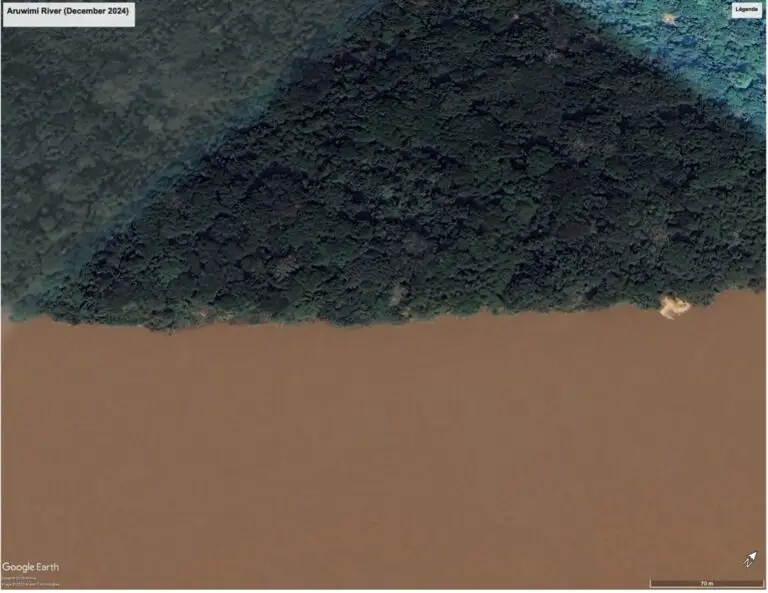
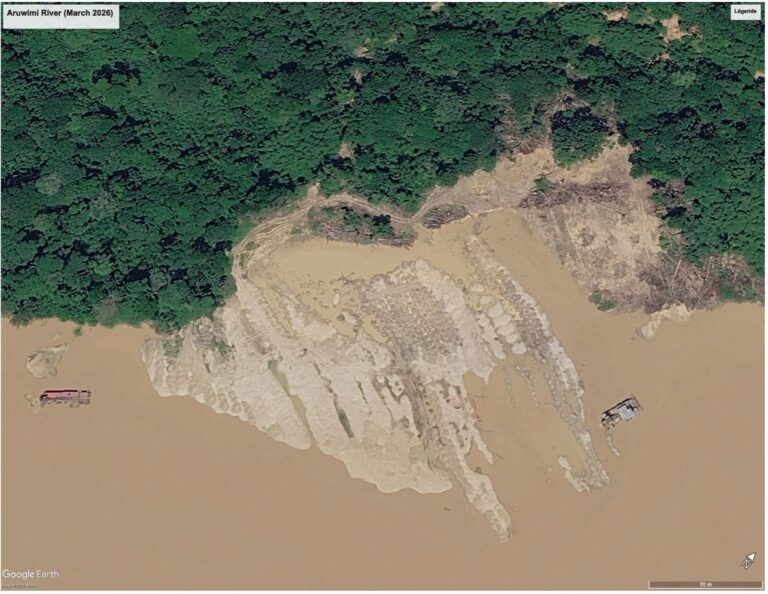
Between 2004 and 2023, around 150 million tons of carbon dioxide were emitted due to deforestation or degradation of forests within the limits of the Green Corridor, according to the Virunga study.151Alliance Virunga, “Economic Development Study for the Congo River Green Corridor in DRC. A Focus on Renewable Energy, Agriculture and Agro-Industrial Transformation, Transport and Carbon Financing,” April 7, 2025, https://kivukinshasagreencorridor.org/wp-content/uploads/2025/07/20250429-Etude-developpement-economique-EN-.pdf, p. 88.
Small-scale shifting cultivation reportedly drove 86 percent of primary forest loss in DRC between 2002 and 2025.152World Resources Institute, “Tropical Rainforest Loss Slowed in 2025, but Fire is a Growing Threat to Forests Worldwide,” https://gfr.wri.org/latest-analysis-deforestation-trends. Shifting cultivation is a traditional subsistence farming system in which farmers clear a small area of forest (often by cutting and burning vegetation), cultivate it until soil fertility declines, and then leave the plot fallow to regenerate naturally while moving to a new plot. NGO reports find that “logging, including industrial logging, is a key driver and catalyst of forest degradation and deforestation in the country,”153Environmental Investigation Agency, “DRC’s Logging Industry Marred by Systemic Illegalities, New Findings Show,” October 14, 2024, https://eia.org/press-releases/drcs-logging-industry-marred-by-systemic-illegalities/. the scale of which is likely underestimated due to the significant proportion of illegal logging activity.154Rainforest Foundation UK, “New research finds that most industrial logging in the DRC is illegal,” July 15, 2025, https://www.rainforestfoundationuk.org/new-research-finds-that-nearly-all-industrial-logging-in-the-drc-is-illegal/.
The impact of roads constructed to support the logging industry is likely underestimated. Recent NGO155Rainforest Foundation UK, “Use it and lose it – Industrial logging and its role in deforestation in the Democratic Republic of Congo,” May 2021, https://www.rainforestfoundationuk.org/wp-content/uploads/2021/10/logging.pdf. and academic studies156Nature, “Mining triggers extensive additional deforestation in sub-Saharan Africa,” June 3, 2026, https://www.nature.com/articles/s41586-026-10551-2. have shown how industrial logging contributes to cascading patterns of deforestation, largely because “accelerated logging road construction is followed by increased human immigration and degradation of natural resources.”157Rainforest Foundation UK, “Use it and lose it – Industrial logging and its role in deforestation in the Democratic Republic of Congo,” May 2021, https://www.rainforestfoundationuk.org/wp-content/uploads/2021/10/logging.pdf.
In response to an open letter158“Subject: Maintaining the moratorium on the granting of new industrial forest concessions,” July 3, 2026, https://www.rainforestfoundationuk.org/wp-content/uploads/2026/07/20260622_Lettre-au-Premier-ministre-RDC_Moratoire_GB_with-logos.pdf. sent to the Prime Minister on July 3, 2026, by a coalition of NGOs warning of the economic, social and environmental risks of lifting the national moratorium on new industrial logging concessions—in place since 2002—Minister of the Environment, Development and New Climate Economy Marie Nyange Ndambo reaffirmed in July 2026 that the moratorium will remain in force.159Ministry of Communication and Media, “Special Press Briefing: Environment, Sustainable Development and New Climate Economy,” YouTube video, 1:20:44, July 7, 2026, https://www.youtube.com/live/nkpZNClmo-I (accessed September 25, 2026).
However, the letter sent by the Direction Inventaire et Aménagement Forestiers (DIAF) director in response to the coalition’s letter presents an entirely different position.160DIAF is one of the technical directorates responsible for the forestry sector under the General Secretariat for the Environment and Sustainable Development. According to the director, “the moratorium has lasted too long … has not stopped logging,” but has “merely pushed it into the informal sector.” He said that “validation of the geographic planning map” and the “draft decree lifting the moratorium” are already scheduled and will then go “for review by the National Forestry Advisory Council before being transmitted to the Council of Ministers.”161Letter from the Director-Head of Department of DIAF, Maurice Matanda Kafunda, to the coordinator of the NGO APEM, dated July 13, 2026, ref: MPALS/DIAF/SG.EDONEC/MAK.DER/CKY/2026. On file with Climate Rights International.
The recent zones for new industrial logging concessions proposed by the Direction Inventaire et Aménagement Forestiers (DIAF) are especially concerning, as several of them, in addition to being located within the Green Corridor, overlap with national parks, community forests, and peatlands.162Rainforest Foundation UK, “Logging off: plans to lift the DRC logging moratorium threaten forest protection efforts in the Congo Basin,” briefing, June 2026, https://www.rainforestfoundationuk.org/wp-content/uploads/2026/07/RFUK-Briefing_ENG_FINAL.pdf.
The government recently adopted its new national forest policy for 2025–2035. It notably promises “the development and implementation of a national plan to combat the illegal exploitation of forest resources and to fight corruption,” as well as “the integration of FPIC into the processes for allocating forest lands,” and the establishment of “compensation mechanisms for losses or changes in rights linked to land allocation decisions.”163Ministère de l’Environnement, “Politique forestière nationale 2025-2035,” November 2025, https://www.atibt.org/files/upload/6_Politique-Forestiere-Nationale-Finale-Mise-en-forme-finale.pdf. Control over logging in the Green Corridor will be essential if the government is to meet its conservation goals.
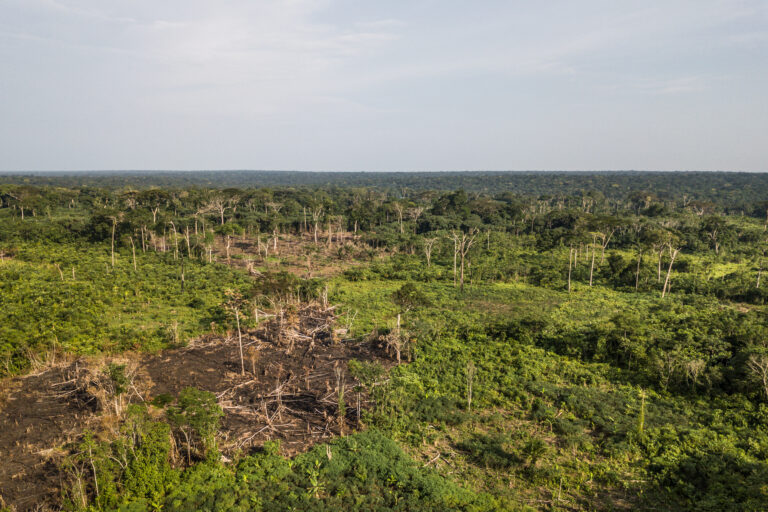
Given the rivalries they generate due to significant economic interests, extractive industries constitute a highly conflict-prone sector. The involvement of security forces in providing security to companies and in suppressing protests, particularly in the mining sector—is one of the main drivers of conflict.
Article 16 of the Mining Code states that, “Outside of the ministries responsible for Mines, the Environment, and Finance, provincial governments, the public services that depend on or fall under their authority, and the state bodies expressly designated in the Code or its implementing regulations, no other public or state body has the authority to enforce the provisions of the Code or to act directly in the mining sector.”164Law No. 18/001 of March 9, 2018 amending and supplementing Law No. 007/2002 of July 11, 2002 on the Mining Code, https://www.leganet.cd/Legislation/JO/2018/JOS.28.03.2018.pdf.
However, governmental armed forces are frequently cited as being involved in providing security for illegal extractive practices benefiting foreign or Congolese companies.165“Corruption, theft, murder… In eastern DRC, cocoa finances chaos,” Afrique XXI, July 18, 2025, https://afriquexxi.info/Corruption-theft-murder-In-eastern-DRC-cocoa-finances-chaos. According to a 2017 report by Global Witness, more than 750 million USD in mining revenues paid by companies to state entities in the country never reached the national treasury between 2013 and 2015. On numerous occasions, this situation has led to accusations of excessive use of force against people protesting—whether peacefully or not—against the consequences or terms of mining activities, mainly in the Copperbelt of the southeast.166Voice of America, “3 morts dans la répression d’une manifestation contre des exploitants miniers,” October 17, 2019, https://www.voaafrique.com/a/morts-dans-la-r%C3%A9pression-d-une-manifestation-contre-des-exploitants-miniers/5127947.html; Mines.cd, “Lualaba : une manifestation contre le pillage de la concession minière de COMIDE violemment réprimée à Kisankala,” July 2025, https://mines.cd/lualaba-une-manifestation-contre-le-pillage-de-la-concession-miniere-de-comide-violemment-reprimee-a-kisankala/; Mines.cd, “Kolwezi : un mort lors de la répression d’une manifestation des employés de Thomas Mining, la société civile accuse l’entreprise chinoise,” August 2025, https://mines.cd/kolwezi-un-mort-lors-de-la-repression-dune-manifestation-des-employes-de-thomas-mining-la-societe-civile-accuse-lentreprise-chinoise/; Radio France Internationale, “RDC: au moins un mort lors d’une manifestation dans la cité minière de Fungurume,” August 19, 2019, https://www.rfi.fr/fr/afrique/20190819-rdc-moins-mort-manifestations-cite-miniere-fungurume. These actions by soldiers or national police have notably occurred in the context of forced evictions.167Amnesty International, “Powering change or business as usual? Forces evictions at industrial cobalt and copper mines in the Democratic Republic of Congo,” September 12, 2023, https://www.amnesty.org/fr/documents/afr62/003/2014/fr/; PAX, “Giant Evictions, Giant Profits,” December 17, 2024, https://paxforpeace.nl/publications/giant-evictionsgiant-profits/.
The President’s call for withdrawal of the military came three months after the General Inspectorate of Mines announced, in April 2026, the creation of a new paramilitary unit dedicated to securing the mining sector.168General Inspectorate of Mines, “L’Inspection Générale des Mines annonce la création de la Garde Minière, une unité paramilitaire dédiée à la sécurisation du secteur minier en République démocratique du Congo,” press release, April 27, 2026, https://x.com/afrikarabia/status/2048697662925381673. Called the “Mining Guard,” its stated objectives include “securing mining sites across the entire national territory;” “ensuring the secure transport of minerals from extraction zones to processing facilities and border posts;” and “the gradual replacement of defense force personnel currently deployed in mining areas.”
The Mining Guard is expected to eventually comprise 20,000 personnel and is scheduled to be deployed across all mining provinces by the end of 2028, with an initial rollout beginning as early as late 2027 in “Greater Katanga” and “Greater Orientale,” according to the same press release.169Ibid. The recruits “will undergo an intensive six-month training program” and “will be equipped with state-of-the-art equipment.”170Ibid. The former Katanga Province is the main hub for copper and cobalt extraction. The former Orientale Province now corresponds to the provinces of Tshopo, Ituri, Bas-Uele, and Haut-Uele, where gold mining is particularly important. The Green Corridor passes through the territories of Tshopo, Ituri, and Bas-Uélé.
The recruitment methods and funding for this force remain unclear, raising concerns about the potential hiring of individuals formerly responsible for human rights violations, such as members of armed groups, as well as the lack of independent oversight mechanisms and complaint procedures to address potential abuses. The available information on the Mining Guard has so far focused on securing mineral resources, with no mention of protecting local populations. This is particularly concerning in regions already marked by deadly incidents ranging from landslides to armed attacks.
At the same time, recent mining agreements involving the United States and the United Arab Emirates have heightened fears that the force could ultimately be perceived as protecting strategic assets rather than people. Without strong oversight, accountability, and human rights protections, the new force risks becoming another source of abuse in a sector already marked by violence and impunity. The candidates for the Mining Guard should be carefully vetted to ensure that they have not been involved in criminal offenses or violations of international human rights law or international humanitarian law, and successful candidates should receive training on their human rights obligations, including respect for the rights to peaceful assembly and freedom of expression, and on minimizing the use of force.
In a country in which environmental and human rights defenders have routinely been threatened, arrested, imprisoned, tortured, and killed, their protection is critical to any conservation and green development project such as the Green Corridor. Their courage, dedication, and vigilance make it possible to document and expose serious environmental harms and human rights abuses affecting local communities, particularly in remote, hard-to-reach areas where such violations often go unreported.
However, and beyond the dramatic situation faced by human rights defenders due to the March 23 Movement’s (M23) offensive and the subsequent occupation of several towns in North Kivu and South Kivu,171United Nations, “DRC: UN experts warn of extreme M23 violence targeting human rights defenders,” February 26, 2026, https://www.ohchr.org/en/press-releases/2026/02/drc-un-experts-warn-extreme-m23-violence-targeting-human-rights-defenders. those engaged in documenting and denouncing the harmful consequences of extractive industries on the rights of populations and their environment in the DRC continue to suffer killings, strategic lawsuits against public participation (SLAPPs), violence, and threats from perpetrators often protected by powerful economic and political interests. With 78 land or environmental defenders killed or disappeared between 2012 and 2024, DRC ranks as the deadliest country in Africa, and eighth deadliest in the world, according to a Global Witness report published in 2025.172Global Witness, “Roots of resistance. Documenting the global struggles of defenders protecting land and environment rights,” report, September 17, 2025, globalwitness.org/en/campaigns/land-and-environmental-defenders/roots-of-resistance/.
Between August 2025 and March 2026, the NGO Alerte Congolaise pour l’Environnement et les Droits l’Homme (ACEDH) recorded six “assassinations or murders” and 16 cases of SLAPP suits, mostly in Tshopo and Haut-Uele provinces, noting that many were “commissioned by multinationals and mining and logging operations.”173Alerte congolaise pour l’environnement et les droits de l’homme (ACEDH), “Répression, attaque contre des défenseurs militants fonciers et climatiques. Tous debouts contre les SLAPP, meurtres et les attaques contre nos héros en RDC. Rapport de monitoring sur la situation des défenseurs de l’environnement et foncier en RDC. Du 1er août. 2025 au 31 mars 2026,” https://www.acedh-rdc.org/rapport/U2FsdGVkX1%2FvwF2MPu%2B4o0nmgaMZ%2Fo4MT09qFZ%2F0k38%3D. For example, in February 2026, 21 Congolese organizations denounced the “judicial harassment and strategic lawsuits” targeting defenders in the Tshopo Province “victimized by these practices orchestrated by mining companies that resort to state services to completely muzzle and silence any dissenting voice that dares to denounce these wrongdoings.”174“Action collective des organisations non gouvernementales de la société civile du secteur environnemental, droits humains, fonciers et aménagement du territoire,” undated. On file with Climate Rights International.
Climate Rights International also reviewed an arrest warrant dated April 30, 2026, concerning seven individuals from the village of Mombongo, also in the province of Tshopo, charged with “threat of attack, rebellion, and disturbance of public order.” According to a press release by the NGO PELDDH, the warrant was issued after the accused had already been arrested, even though they had only “peacefully protested, calling on the logging company Booming Green to honor its commitments under the terms of reference agreed upon by both parties.”175Organisation Patrice Emery Lumumba pour le Développement Communautaire et la Défense, la Promotion des Droits de l’Homme (PELDDH), press release, April 30, 2026. In 2024, a government audit consulted by the Environmental Investigation Agency concluded that Booming Green had been involved in the “fraudulent acquisition of a forest concession contract” for a concession in Mai-Ndombe Province, and had failed to pay the required taxes in several provinces.176Environmental Investigation Agency, “Until the last log. How a log export ban can strengthen DRC’s economy, stop corporate delinquents, and address the climate crisis,” October 2024, https://eia.org/wp-content/uploads/2024/10/Until-the-Last-Log.pdf.
In May 2026, the NGO ACEDH denounced the “arbitrary arrest and unlawful detention” of Eluo Kombe, President of the Association for the Integral Development of the Indigenous Pygmy Peoples of Bongandanga (ADOPAG), in Mongala Province, part of which lies in the Green Corridor. According to ACEDH, Kombe was charged with “contempt of court” after his organization filed a complaint against Booming Green for forest destruction and damage to water sources. NGOs announced his release on May 19, 2026.177Makoki International Hub et Alerte Congolaise pour l’Environnement et les Droits de l’Homme, “Communiqué de Presse conjoint No 001/2026,” June 8, 2026, https://mkih.org/article/communique-de-presse-conjoint-no-001-2026-makoki-international-hub-et-alerte-congolaise-pour-lenvironnement-et-les-droits-de-lhomme-se-felicitent-de-la-liberation-du-defenseur-climatique-franck-eluo-kombe.
These situations persist despite the adoption in 2023 of the long-awaited law on the protection and responsibility of human rights defenders.178Law No. 23/027 of June 15, 2023 on the protection of and responsibility for human rights defenders in the Democratic Republic of the Congo, https://faolex.fao.org/docs/pdf/cng233437.pdf. Though welcomed by human rights defenders at the time of its enactment, the law contains significant weaknesses that undermine its purpose.179International Service for Human Rights, “DRC adopts national law to protect, promote rights of defenders,” October 23, 2023, https://ishr.ch/latest-updates/the-drc-adopts-a-national-law-to-protect-and-promote-the-rights-of-human-rights-defenders/. Observers have criticized provisions that make it mandatory for defenders to register with the National Human Rights Commission, which would then establish an official list of defenders. Such a system exposes the individuals listed to potential pressure and threats in an area of work for which anonymity is often a necessity. The law also effectively grants authorities the power to decide who qualifies as a defender and who does not, limiting the right to freedom of association. A proposed revision of the law has been submitted to a member of parliament by civil society representatives, and “is now entering a crucial stage of its legislative process,” ACEDH stated in July.180ACEDH, “Révision de la Loi n° 23/027 du 15 juin 2023 relative à la protection et à la responsabilité du défenseur des droits de l’homme: l’ACEDH poursuit son plaidoyer pour une protection plus inclusive,” https://www.acedh-rdc.org/article/U2FsdGVkX18cT55hshhsoU3qNt6GxjhWliZDcLC2894%3D. According to the NGO, if adopted, the reform “will notably make it possible to remove the repressive provisions contained in articles 26, 27 and 28 of the current law.”181Ibid. Article 28 in particular provides for six months to two years’ imprisonment for “the human rights defender who discloses defamatory, abusive, or slanderous information,” a particularly vague definition that lends itself to arbitrary application. It would also eliminate the requirement to register, according to ACEDH director Olivier Ndoole.182Climate Rights International remote interview with Olivier Ndoole, Director of ACEDH, September 16, 2026.
The DRC’s ambition to play the role of a “solution country” for the climate cannot be taken seriously unless the authorities give due importance to the issue of land and environmental defenders. This requires, in particular, compliance with the UN Guiding Principles on Business and Human Rights, which state that “States should take appropriate steps to ensure the effectiveness of domestic judicial mechanisms when addressing business-related human rights abuses, including considering ways to reduce legal, practical and other relevant barriers that could lead to a denial of access to remedy.”183United Nations, Guiding Principles on Business and Human Rights, Guiding Principle 26, https://www.ohchr.org/sites/default/files/documents/publications/guidingprinciplesbusinesshr_en.pdf.
The fate of the Green Corridor is partly dependent on how the conflicts occurring within or close to its territory evolve, particularly in its eastern territories. More than 100 armed groups are reportedly operating in the country’s eastern provinces.184Global Center for the Responsibility to Protect, “Democratic Republic of the Congo: Populations at Risk,” July 15, 2026, https://www.globalr2p.org/countries/democratic-republic-of-the-congo/.
The Rwanda-backed M23 has controlled large parts of North Kivu, the majority of which is part of the Green Corridor, and South Kivu Provinces, since its renewed offensive in 2021. Since 2025, it has controlled the provincial capitals of Goma and Bukavu. M23 controls vast areas along the Rwandan border, where it continues to commit serious, systematic, and widespread human rights abuses, while financing itself through mining and other operations.185Amnesty International, “DRC: ‘They said we would die’ M23 and Wazalendo abuses in Eastern Congo,” briefing, August 20, 2025, https://www.amnesty.org/en/documents/afr62/0145/2025/en/. On December 4, 2025, the governments of the DRC and Rwanda signed the Washington Agreement, aimed at de-escalation and cessation of hostilities, but “commitments remained only partially implemented. Both Parties pursued their strategic objectives amid ongoing hostilities,” according to a UN report from June 2026.186United Nations Security Council, “Letter dated 5 June 2026 from the Group of Experts on the DRC addressed to the President of the Security Council,” UN Doc. S/2026/466, June 11, 2026, https://digitallibrary.un.org/record/4119763/files/S_2026_466-EN.pdf?ln=en.
In a report published in December 2024, the UN Group of Experts on the DRC estimated that the M23 collected at least 800,000 USD per month from the taxation of coltan production and trade in Rubaya, a mining town in North Kivu that is believed to produce between 15-30 percent of the world’s coltan.187United Nations Security Council, “Letter dated 27 December 2024 from the Group of Experts on the Democratic Republic of the Congo addressed to the President of the Security Council,” para.66, https://documents.un.org/doc/undoc/gen/n24/373/37/pdf/n2437337.pdf. A December 2025 report by the same UN Group of Experts showed that approximately half of South Kivu’s cassiterite and coltan production, as well as more than two-thirds of its wolframite output, originates from territories that were under Alliance Fleuve Congo/M23 control.188United Nations Security Council, “Letter dated 30 December 2025 from the Group of Experts on the Democratic Republic of the Congo addressed to the President of the Security Council,” UN Doc. S/2025/858, December 30, 2025, https://docs.un.org/en/s/2025/858; The AFC (Alliance Fleuve Congo) is a politico-military coalition founded in December 2023 by Corneille Nangaa, former president of the DRC’s National Independent Electoral Commission (CENI). From its inception, it included the M23 (March 23 Movement), an armed rebellion active in eastern Congo since 2012.
In the north-east of the country, the Allied Democratic Forces (ADF), which was formed in Uganda in the 1990s and has pledged allegiance to Islamic State (IS), has been carrying out massacres of civilians, primarily in the provinces of Ituri and North Kivu, with documented civilian fatalities in 2025 exceeding 1,000.189United Nations Security Council, “Letter dated 5 June 2026 from the Group of Experts on the Democratic Republic of the Congo addressed to the President of the Security Council,” para.12, UN Doc. S/2026/466, June 11, 2026, https://digitallibrary.un.org/record/4119763/files/S_2026_466-EN.pdf?ln=en. On September 9, 2025, an ADF attack in Lubero territory killed at least 72 people, while over 100 were abducted. In March 2026, the ADF attacked gold mining sites;190“IS-linked rebels stage deadly attack on DR Congo mines, says government,” Le Monde, March 16, 2026, https://www.lemonde.fr/en/international/article/2026/03/16/is-linked-rebels-stage-deadly-attack-on-dr-congo-mines-says-government_6751478_4.html. in April 2026, they killed 43 people in a village in the Mambasa territory, in Ituri Province.191“At least 43 people killed in ADF attack in northeast DR Congo, army says,” Al Jazeera, April 2, 2026, https://www.aljazeera.com/news/2026/4/2/at-least-43-people-killed-in-adf-attack-in-northeast-dr-congo-army-says. According to estimates, the ADF has killed at least 12,750 civilians since October 2014.192Patient Ligodi, “Les ADF, ce jihad que l’Afrique centrale n’a pas vu venir,” Radio France Internationale, March 30, 2026, https://www.rfi.fr/fr/connaissances/20260330-les-adf-ce-djihad-que-l-afrique-centrale-n-a-pas-vu-venir-1-2. In March 2026, UN Deputy High Commissioner for Human Rights Nada Al-Nashid stated that “the ADF has expanded its operations across Ituri, North Kivu, and Tshopo since October, killing more than 260 people.”193OHCHR, “Deputy High Commissioner Al-Nashif on the Democratic Republic of the Congo: As peace negotiations continue, people cannot wait,” speech, March 25, 2026, https://www.ohchr.org/en/statements-and-speeches/2026/03/deputy-high-commissioner-al-nashif-democratic-republic-congo-peace. A recent UN report observes “a discrete presence in eastern Tshopo Province, indicating possible future expansion.”194United Nations Security Council, “Letter dated 5 June 2026 from the Group of Experts on the Democratic Republic of the Congo addressed to the President of the Security Council,” para.14, UN Doc. S/2026/466, June 11, 2026, https://digitallibrary.un.org/record/4119763/files/S_2026_466-EN.pdf?ln=en. The Congolese Institute for Research on Politics, Governance, and Violence, Ebuteli, noted in April 2026 that “the group was spotted for the first time in Haut-Uele Province, confirming its movement deeper into the interior of the country.”195Ebuteli, “Les ADF pénètrent dans le Haut-Uele, les enlèvements à un niveau record,” April 20, 2026, https://www.ebuteli.org/publications/rapports/les-adf-penetrent-dans-le-haut-uele-les-enlevements-a-un-niveau-record. In Ituri Province, community militias such as CODECO and Zaïre have carried out deadly attacks against civilians in villages and displacement camps.196“Rebel fighters kill at least 69 people in northeastern DR Congo,” Al Jazeera.com, May 10, 2026, https://www.aljazeera.com/news/2026/5/10/rebel-fighters-kill-at-least-69-people-in-northeastern-dr-congo.
Conservation efforts are directly affected by the resurgence of insecurity in the areas mentioned. On May 21, 2026, “an unidentified, heavily armed group” attacked the ICCN post at Kamuhororo, on the southern shore of Lake Edward, killing two eco-guards, the Virunga National Park announced.197Virunga.org, “Two Rangers Killed in Armed Attack at Kamuhororo,” virunga.org/news/two-rangers-killed-in-armed-attack-at-kamuhororo/. The same month, an unclaimed drone strike also hit the ICCN operational base for eco-guards patrolling Virunga National Park, an ICCN spokesperson confirmed to Climate Rights International.198Climate Rights International WhatsApp exchanges with spokesman for ICCN, June 2026. In these territories and in others, eco-guards, who are the visible and armed face of this conservation effort, pay a heavy price for protecting protected areas. More than 200 eco-guards of the Virunga National Park have been killed since 1925.199Virunga National Park, “Virunga’s Rangers,” https://virunga.org/alliance/virunga-rangers/. In 2026, seven eco-guards were killed at Upemba National Park,200Emmet Livingstone, “‘She gave her life to protect the richness of Congo’: inside the deadly assault on Upemba wildlife park,” The Guardian, March 22, 2026, https://www.theguardian.com/environment/2026/mar/22/upemba-national-park-drc-militia-assault-rangers-killed-aoe. and one at the Okapi Wildlife Reserve.201Congolese Institute for Nature Conservation, “Communiqué officiel,” Facebook post, October 1, 2026, https://www.facebook.com/photo/?fbid=1092124510090164&set=a.163467566289201.
Even the western part of the Green Corridor does not escape violence. In the provinces surrounding Kinshasa, the Mobondo revolt has caused more than 5,000 deaths and several hundred thousand displaced persons since 2022.202IPIS, “The weight of silence: How the Mobondo revolt is shaking western DRC,” report, November 20, 2025, https://ipisresearch.be/publication/the-weight-of-silence-how-the-mobondo-revolt-is-shaking-western-drc/.
The DRC is ranked 163 out of 180 in the latest Corruption Perception Index published by Transparency International.203Transparency International, “Corruption Perceptions Index 2025,” https://www.transparency.org/en/cpi/2025.
The extractive industry is particularly affected. In 2026, following an eight-year investigation, Fleurette Properties, a company formerly linked to controversial businessman Dan Gertler, agreed to pay 25.8 million EUR (30 million USD) to settle a Dutch corruption case. Dutch prosecutors alleged that the company bribed a senior Congolese official to obtain valuable copper and cobalt mining licenses in the DRC between 2010 and 2011.204Netherlands Public Prosecution Service, “Fine Fleurette Properties Ltd for bribery in the Democratic Republic of Congo,” news release, March 10, 2026, https://www.prosecutionservice.nl/latest/news/2026/03/10/fine-fleurette-properties-ltd-for-bribery-in-the-democratic-republic-of-congo?utm_.
A 2024 report by the NGO Environmental Investigation Agency alleged that two of the largest industrial logging companies operating in the DRC were engaged in “systematic forest crimes and corruption.” According to the report, an official from one of the companies admitted the company had obtained a concession in violation of the moratorium on new forest concessions by bribing officials.205Environmental Investigation Agency, “Until the last log. How a log export ban can strengthen DRC’s economy, stop corporate delinquents, and address the climate crisis,” report, October 2024, https://eia.org/wp-content/uploads/2024/10/Until-the-Last-Log.pdf.
Defense and security forces, which are supposed to enforce the law against illegal extractive practices, are also particularly exposed to corruption. In 2025, President Tshisekedi referred to an “army of tramps” to describe the material shortages and low pay of soldiers.206Océane Bourdenet, “RD Congo : après l’avoir qualifié de “clochards”, le président Félix Tshisekedi veut redonner de la “dignité” à son armée,” TV5 Monde, December 16, 2025, https://information.tv5monde.com/afrique/rd-congo-apres-lavoir-qualifiee-de-clochards-le-president-felix-tshisekedi-veut-redonner-de-la-dignite-son-armee-2801659.
At the Council of Ministers meeting on July 10, 2026, President Tshisekedi “ordered the immediate withdrawal of soldiers and police officers illegally present at mining operations.”207Ministry of Communication and Media (@Com_mediasRDC), “94ᵉ Conseil des ministres : l’essentiel à retenir,” video, X, July 16, 2026, 10:26, a.m., https://x.com/Com_mediasRDC/status/2077760863725838667 (accessed September 28, 2026). According to the Council of Ministers’ communiqué, “this situation fuels negative perceptions of the governance of the country’s natural resources, weakens oversight mechanisms, encourages illicit trafficking, and undermines government efforts toward responsible, transparent mining that meets international standards.”208Ebale Ya Mozindo official, “RDC: GOUVERNEMENT. Le Président de la république Se appelle à la fin de la présence militaire dans les sites miniers,” Facebook, July 10, 2026, https://www.facebook.com/reel/3236700296509843.
Despite the president’s instructions, which were echoed by the military command,209Radio Okapi, “Le général Eddy Kapend ordonne le retrait des militaires sur le site minier de Kisenkala,” July 21, 2026, https://www.radiookapi.net/2026/07/21/actualite/securite/le-general-eddy-kapend-ordonne-le-retrait-des-militaires-sur-le-site. civil society organizations remain doubtful about their effectiveness. In a statement, the NGO Justicia noted that enforcement of this measure had already been called for by the president in 2019, 2022, and 2025, without success.210Justicia, “Retraits des Militaires et Policiers Illegaux des Sites Niniers: Justica ASLB Salue le Enieme Decision du Gouvernement Concolais mais Exige Plutot du Congret que des Intentions,” press release N. 019/JUST/2026, July 15, 2026, https://justicia-asbl.com/communique-de-presse-n019-just-2026/. “The ineffectiveness of these measures stems from the fact that this activity has become highly profitable, benefiting mafia-like networks that are now extremely powerful and that include military personnel, political actors, individuals who claim to have direct ties to the Head of State, and foreign nationals who sometimes finance cooperatives belonging to politically exposed persons,” said Timothée Mbuya, president of Justicia.211Ibid.
An audit of police staffing levels, published on July 7, 2026, also revealed that nearly 64,000 Congolese officers out of 157,800 are “inactive” or “fictitious.” These phantom jobs reportedly cost the state between 87 million and 204 million EUR (100 to 235 million USD) per year.212Christophe Châtelot, “En République démocratique du Congo, un policier sur deux n’existe pas,” Le Monde, July 14, 2026, https://www.lemonde.fr/afrique/article/2026/07/14/en-rdc-un-policier-sur-deux-n-existe-pas_6723334_3212.html?srsltid=AfmBOoo0tVaZjGrqcUvw5FLZj_IGsygjULMu92FFgME5WTNW9ZTsfNZN.
On September 18, 2026, the Court of Cassation sentenced former Minister of Justice Constant Mutamba to ten years of forced labor for embezzling funds from the Special Fund for Reparation and Compensation of Victims of Uganda’s Illegal Activities (FRIVAO), in a case involving more than 20 million USD.213Actualité.cd, “Affaire Frivao : après le verdict, le défi de la restitution des fonds et de la réparation des victimes,” September 21, 2026,https://actualite.cd/2026/09/21/affaire-frivao-apres-le-verdict-le-defi-de-la-restitution-des-fonds-et-de-la-reparation. FRIVAO was created to compensate victims of abuses committed by Ugandan forces in the DRC between 1998 and 2003.
ICCN has also been drawn into allegations of financial mismanagement. On April 22, 2026, in connection with the FRIVAO scandal and following a report by the General Inspectorate of Finance, the Minister of Justice ordered judicial investigations into possible acts of “embezzlement of public funds, corruption (…)” involving the 4 million USD that FRIVAO had paid to ICCN to rehabilitate the Kisangani zoological and botanical garden.214Ministry of Justice, “Communiqué n° 021/DMK/CAB/ME/MIN/G&GS/2026,” press release, April 22, 2026, https://www.facebook.com/photo/?fbid=1273435084926122&set=a.367435865526053.
In 2023, the United States imposed sanctions on the Institute’s former director, along with two other Congolese officials from the ICCN and CITES, after determining that “they abused their public positions by trafficking chimpanzees, gorillas, okapi, and other protected wildlife from the DRC, primarily to the People’s Republic of China, using falsified permits in return for bribes.”215US Embassy in the Democratic Republic of Congo, “Designation of Democratic Republic of the Congo (DRC) Public Officials for Significant Corruption,” news release, August 16, 2023, https://cd.usembassy.gov/designation-of-democratic-republic-of-the-congo-drc-public-officials-for-significant-corruption/. Allegations of wildlife trafficking have persisted in connection with a partnership between the ICCN and Vantara, a large wildlife facility in India, which allegedly received bonobo chimpanzees that had previously been covertly transferred from sanctuaries to the Kinshasa zoo.216Convention on International Trade in Endangered Species of Wild Fauna and Flora (CITES), Seventy-ninth meeting of the Standing Committee Samarkand (Uzbekistan), 23 November 2025, https://cites.org/sites/default/files/documents/E-SC79-06-03-04.pdf, para. 29-32.
The adoption of the December 2025 law amending and supplementing Law No. 73-021 of July 20, 1973, on the general regime of property, land tenure, real estate, and securities, and the country’s first spatial planning law of July 5, 2025, are meant to serve the Green Corridor by strengthening people’s guarantees for securing their land and clarifying its allocation, but the design and implementation of those laws raise questions.
The first law has been criticized for failing to include sufficient safeguards for community lands and customary rights, and for a lack of transparency in its final stages. An earlier version of the law included safeguards to protect community lands—provisions that had been advocated for by civil society organizations and customary leaders and had been accepted by all stakeholders following provincial and national validation workshops, according to the NGO Actions pour la Promotion et Protection des Peuples et Espèces Menacés (APEM).217Actions pour la Promotion et protection des peuples et espèces menacés (APEM), Letter to the Head of State, “Objet: Votre implication pour une révision de la Loi Foncière protectrice des droits des congolais,” December 14, 2025. However, the final bill excluded those safeguards.218“Loi n° 25/062 du 30 décembre 2025 modifiant et complétant la Loi 73/021 du 20 juillet 1973 portant régime général des biens, régime foncier et immobilier et régime des sûretés telle que modifiée et complétée par la Loi n° 80-008 du 18 juillet 1980,” https://www.affairesfoncieres.gouv.cd/ressources/documents/loi-25-062-du-30-decembre-2025-modifiant-et-completant-la-loi-fonciere.
Other experts consider this law to be “generally insufficient and unintelligible in several respects,” with its main flaw being that it “overlooked customary land issues and the question of the coexistence of land rights and natural resource exploitation rights on the same parcel of land.”219Nsolotshi Malangu, “Inventaire critique des innovations de la loi n°25/062 du 30 décembre 2025 modifiant et complétant la loi foncière en République démocratique du Congo,” https://fr.scribd.com/document/987041142/Critique-loi-fonciere-du-30-decembre-2025.
The President also promulgated the country’s first spatial planning law on July 5, 2025.220Law No. 25/045 of 1 July 2025 on Land Use Planning, https://faolex.fao.org/docs/pdf/cng240506.pdf. While it introduces meaningful progress, such as the formal recognition of customary land rights, the principle of “free, prior consent”—clearly defined in the law’s introductory articles as a “written consent given by individuals, local communities or any social group, including Indigenous Pygmy Peoples, affected or likely to be affected by a development project or other initiative”—subsequently disappears from the rest of the text, NGO representatives noted.221Rainforest Foundation UK, “Key land-use planning law passed in the DRC,” July 30, 2025, https://www.rainforestfoundationuk.org/key-land-use-planning-law-passed-in-the-drc/. It remains to be seen how these two laws will impact the treatment of FPIC, community lands, and customary rights in the Green Corridor.
Since its founding in 1925, Virunga Park, a UNESCO World Heritage Site in Danger and Africa’s first national park, has evolved over time from an abusive “fortress conservation” model inherited from colonialism toward an acknowledgment of the economic and social realities of the communities within and surrounding it.
In 2013, the Virunga Alliance was created, bringing together authorities, civil society, and the private sector around the objectives of “conservation of natural resources, poverty reduction and promotion of peace” to address insecurity and growing demographic pressure.222Virunga National Park, “Virunga Alliance,” https://virunga.org/alliance/. More than 200 of the park’s eco-guards have been killed since 1925.223Virunga National Park, “Virunga’s Rangers,” https://virunga.org/alliance/virunga-rangers/. The park is still threatened today by armed groups, including the M23224Human Rights Watch, “DR Congo: M23 Mass Killings Near Virunga National Park,” news release, August 20, 2025, https://www.hrw.org/news/2025/08/20/dr-congo-m23-mass-killings-near-virunga-national-park. and the ADF, who have been abducting, killing, and abusing women and girls as sexual slaves in North Kivu and Ituri provinces.225Amnesty International, “‘Tell everyone we are being massacred’: overlooked war crimes in the Democratic Republic of the Congo,” news release, December 19, 2025, https://www.amnesty.org/en/latest/news/2025/12/tell-everyone-we-are-being-massacred-overlooked-war-crimes-in-the-democratic-republic-of-the-congo/. Despite the creation of the Alliance, the progression of “human encroachment” in the park increased between 2021 and 2024, according to UNESCO.226UNESCO, “State of Conservation: Virunga National Park,” 2025, https://whc.unesco.org/en/soc/4664/?cf_chl_f_tk=jf36pYi2bufnMujUUpLwwXZewvifq2v4eIB4MHNccPs-1782993081-1.0.1.1-6vDXTmgBtWKxILr3kScasNzcUYdKMCinu89_16vO5jA.
Thirteen years after the founding of the Alliance, the evolution is notable. Virunga Energies—a subsidiary of Virunga Foundation and a socially-driven commercial enterprise funded notably by the European Union, several foundations, and British International Investment—claims to have become the leading electricity provider in North Kivu Province.227Virunga Energies, “About,” https://energies.virunga.org/en/a-propos/. By the end of 2025, it claimed to have connected more than 42,000 households to hydroelectric power, and said it was providing public lighting and free electricity to approximatively 20 facilities such as hospitals and schools.228Virunga Energies, “Impact,” https://energies.virunga.org/impact/. As the Congolese NGO ACEDH put it, this is proof that “it is possible to benefit from the park without destroying it.”229Congolese Alert for the Environment and Human Rights (ACEDH), Statement welcoming the recent increase in the park’s hydroelectric production capacity quoted by several media including the Agence Congolaise de Presse, “Nord-Kivu: une organisation salue les 15 mégawatts supplémentaires au profit de la population,” February 11, 2026, https://acp.cd/economie/nord-kivu-une-organisation-salue-les-15-megawatts-supplementaires-au-profit-de-la-population/.
As one European development official in Kinshasa told Climate Rights International, “It is quite remarkable. Virunga is carrying out industrial transformation to European standards in a very challenging context.”230Climate Rights International interview with a representative of a European country’s cooperation agency, Kinshasa, January 21, 2026. An international technical expert said that “what de Merode has managed to achieve is staggering,”231Climate Rights International interview with a forest conservation expert, Kinshasa, January 21, 2026. in reference to Emmanuel de Merode, the Belgian director of Virunga National Park and the ICCN’s director for North Kivu Province, whose commitment and courage were celebrated in a widely acclaimed documentary released on Netflix.232IMDB, “Virunga,” https://www.imdb.com/title/tt3455224/.
The idea of the Green Corridor is to progressively replicate this “conservation-development” model at an entirely different scale. Aymar Bisoka, professor at the University of Mons and at the Institut Supérieur de Développement Rural de Bukavu, considers this enthusiastic support as justified: “Unlike the Lobito Corridor [a major rail-and-port trade route connecting Angola’s Atlantic port of Lobito to the Copperbelt regions of the DRC and Zambia], the issue here is not only to make a profit but also to foster sustainable development. The Virunga Foundation is moreover a legitimate actor from the standpoint of effectiveness. That at least deserves to be acknowledged as a starting point—why not?”233Climate Rights International remote interview with Aymar Bisoka, February 2026.
Since the conception of the Green Corridor, the footprint of the Virunga Foundation has been omnipresent. Several interlocutors clearly perceive the project as “an idea of Virunga that the Congolese authorities have appropriated.”234Climate Rights International interview with the national coordinator of a Congolese organization, Kinshasa, January 20, 2026. Virunga co-manages the Green Corridor within the framework of a public-private partnership with the ICCN. It has played a major role in its strategy, as demonstrated by its “high-level roadmap for economic development projects within the Green Corridor,” developed across more than 100 pages.235Alliance Virunga, “Economic Development Study for the Congo River Green Corridor in DRC. A Focus on Renewable Energy, Agriculture and Agro-Industrial Transformation, Transport and Carbon Financing,” April 7, 2025, https://kivukinshasagreencorridor.org/wp-content/uploads/2025/07/20250429-Etude-developpement-economique-EN-.pdf. It was again from Virunga Park that the “first convoy” bearing the Kivu-Kinshasa Green Corridor stamp departed in March 2026, loaded with processed products.236EU International Partnerships, “In January 2025, we announced our support to an ambitious initiative: the Kivu-Kinshasa Green Corridor, which connects two ends of the DRC. Today, the first convoy is crossing the entire Corridor with agricultural products,” Facebook, March 19, 2026, https://web.facebook.com/EUPartnerships/posts/in-january-2025-we-announced-our-support-to-an-ambitious-initiativethe-kivu-kins/1340890061400707/?_rdc=1&_rdr. The Foundation announced in June 2026 the launch of construction work on the Mambasa Forward Operating Bases, “the first project of the Kivu-Kinshasa Green Corridor in Ituri Province.”237Virunga Alliance, “Ce samedi 23 mai, les travaux de construction de la FOB (Forward Operating Base) de Mambasa ont été officiellement lancés par l’Administrateur adjoint du territoire de Mambasa, le colonel Maxime Tshishimbi, aux côtés du Directeur de la Fondation Virunga, Emmanuel de Merode, et du Chef de la chefferie de Mambasa, le Mwami Tahero Assumani Tito ainsi que des acteurs de la société civile, les confession religieuse et la FEC,” Facebook, May 23, 2026, https://www.facebook.com/virungaalliance/posts/pfbid02Lg4q8b5agPZFoX4sQWuenuYm53BdSTKzibYh7EccqVWa6a17duaDVP8dycdv8q99l.
Many Congolese interviewed by Climate Rights International, including NGO officials who have not visited Virunga Park, believe that, as Julien Mathe, coordinator of the Groupe d’Action pour Sauver l’Homme et son Environnement (GASHE) puts it, “if the concept spreads, it could be beneficial, because here in Équateur province nothing happens in protected areas apart from armed conservation.”238Climate Rights International remote interview with Julien Mathe, coordinator of the Groupe d’Action pour Sauver l’Homme et son Environnement (GASHE), February 2026.
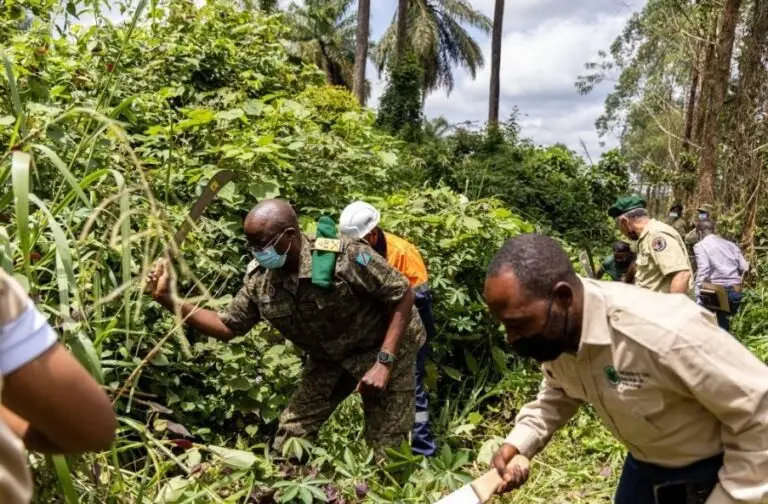
The operations in Virunga Park have also come in for serious criticism—particularly the actions of the park’s eco-guards, who have sometimes been accused of abuses against local populations. On several occasions, such as in 2011239Radio Okapi, “Parc national des Virunga : l’ICCN rejette les allégations de violations des droits de l’homme,” January 24, 2011, https://www.radiookapi.net/environnement/2011/01/24/parc-national-des-virunga-l%25e2%2580%2599iccn-rejette-les-allegations-de-violations-des-droits-de-l%25e2%2580%2599homme?utm_. and 2018,240Actualité.cd, “Parc des Virunga : L’ICCN démend les allégations des viols attribués aux écorgardes à Rusayo (Nyiragongo),” October 10, 2018, https://actualite.cd/2018/10/10/parc-des-virunga-liccn-dement-les-allegations-des-viols-attribuees-aux-ecogardes-rusayo. the ICCN has faced allegations of rape allegedly committed by eco-guards. A 2020 academic report, based on research conducted between 2012 and 2019, concluded that eco-guard “arrests and joint operations with the army sometimes involve harsh treatment of citizens and occasionally result in alleged human rights violations.”241Judith Verweijen, Saidi Batundi, Esther Marijnen, Janvier Murairi, Chrispin Mvano, “Conflicts around Virunga National Park: Grassroots perspectives,” The Hague: Knowledge Platform Security & Rule of Law, May 2020, https://www.researchgate.net/publication/347576730_Conflicts_around_Virunga_National_Park_Grassroots_perspectives. In 2023, UNESCO noted that “continued cooperation between the Congolese Institute for Nature Conservation and the DRC military (FARDC) for protecting the sites is considered essential. However, allegations of human rights abuses directly linked to law enforcement operations are a serious concern.”242UNESCO, “State of Conservation, Virunga National Park,” 2023, https://whc.unesco.org/en/soc/4272/?utm_.
Such abuses also occurred in other protected areas in the country. In 2019, Rainforest Foundation UK denounced murders, gang rapes, and torture committed by eco-guards against communities living near Salonga National Park.243Rainforest Foundation UK, “Graves abus des droits humains rapportés dans et autour du parc national de la Salonga,” briefing, November 2018 (updated in May 2019), https://rainforestfoundationuk.org/wp-content/uploads/2019/06/358527c1-5580-43f1-aa7a-b3672af11a6c.pdf. In 2020, a military court in Mbandaka sentenced five eco-guards for the rape and torture of four women in the park, handing down prison terms of five to twenty years and ordering the ICCN to pay 100,000 USD in damages, as the public body responsible for overseeing the eco-guards.244Rainforest Foundation UK, “Huge leap in in fight against impunity for conservation-related abuses in DRC as park rangers are sentenced for rape and torture,” news release, January 13, 2021, https://www.rainforestfoundationuk.org/huge-leap-in-fight-against-impunity-for-conservation-related-abuses-in-drc-as-park-rangers-are-sentenced-for-rape-and-torture/. In 2022, the African Commission on Human and People’s Rights (ACHPR) declared that “the conservation model used in the Kahuzi-Biega has failed, by excluding the Batwa as custodians of the forest,” and requested the DRC to “reintegrate the Batwa in their ancestral territory.”245African Commission on Human and People’s Rights, “Communication 588/15 Minority Rights Group International and Environnement Ressources Naturelles et Développement (on behalf of the Batwa of Kahuzi-Biega National Park, DRC) v. Democratic Republic of Congo (DRC),” decision, adopted at the session held from April 21, 2022 to May 13, 2022, https://minorityrights.org/app/uploads/2024/07/communcation-588-002-decision–english-version.pdf. A report by the NGO Minority Rights Group had previously documented abuses against the Batwa.246Minority Rights Group, “Fortress Conservation and International Accountability for Human Rights Violations against Batwa in Kahuzi-Biega National Park,” briefing, May 5, 2022, https://minorityrights.org/resources/fortress-conservation-and-international-accountability-for-human-rights-violations-against-batwa-in-kahuzi-biega-national-park/. An ICCN inquiry commission said it “had not confirmed all allegations against eco-guards and the FARDC.”247“Parc Kahuzi-Biega: Toutes les allégations de violation de droits humains attribuées aux écogardes et FARDC n’ont pas été confirmées (ICCN),” actualitie.cd, May 31, 2022, https://actualite.cd/2022/05/31/parc-de-kahuzi-biega-toutes-les-allegations-de-violation-de-droits-humains-attribuee-aux.
In 2024, in Tshopo Province, eco-guards from Lomami National Park were accused of murdering two local residents.248Desknature.com, “RDC: Meurtre de deux personnes autour du parc de la Lomami, les écogardes indexés (APEM),” April 15, 2024, https://desknature.com/2024/04/15/rdc-meurtre-de-deux-personnes-autour-du-parc-de-la-lomami-les-ecogardes-indexes-apem?utm. Media outlets subsequently reported the destruction of ICCN facilities by an angry population.249Radio Okapi, “Opala: tension entre population et agents de l’ICCN après le meurtre de 2 jeunes,” April 11, 2024, https://www.radiookapi.net/2024/04/11/actualite/societe/opala-tension-entre-population-et-agents-de-liccn-apres-le-meurtre-de-2. The NGO ACEDH, which is providing legal defense for the eco-guards, reported that the Kisangani military tribunal acquitted them on May 31, 2026, and that the civil parties have appealed the ruling.250Alerte congolaise pour l’environnement et les droits de l’homme (ACEDH), “Répression, attaque contre des défenseurs militants fonciers et climatiques. Tous debouts contre les SLAPP, meurtres et les attaques contre nos héros en RDC. Rapport de monitoring sur la situation des défenseurs de l’environnement et foncier en RDC. Du 1er août. 2025 au 31 mars 2026,” https://www.acedh-rdc.org/rapport/U2FsdGVkX1%2BAnxvUftIs2YRBzdyqaEGWOgf8GZHTTps%3D.
Given this track record, the planned deployment of hundreds of eco-guards in new localities must be given particular attention. Indeed, the Virunga Alliance economic development study has identified “19 priority sites for the deployment of industrial hubs, combined with a Forward Operating Base (FOB),” a fortified camp designed to protect inhabitants from incursions by armed groups through the presence of ICCN eco-guards and members of the armed forces (FARDC), and to host the processing activities.251Alliance Virunga, “Economic Development Study for the Congo River Green Corridor in DRC. A Focus on Renewable Energy, Agriculture and Agro-Industrial Transformation, Transport and Carbon Financing.” April 7, 2025, https://kivukinshasagreencorridor.org/wp-content/uploads/2025/07/20250429-Etude-developpement-economique-EN-.pdf. Each FOB is expected to host between 10 and 40 eco-guards, for a total of up to 760 ICCN eco-guards.
The opening of these new “fronts” of conservation and economic development could help improve the situation in critical areas such as the Okapi Wildlife Reserve and the Maiko National Park, which are seriously threatened by the presence of armed groups and illegal mining. But without proper training and supervision, this could also lead to serious abuses.
The eco-guard and FOBs model deserves particular scrutiny before it is replicated nineteen times across new territories.252According to the Virunga Foundation study, “19 priority sites have been identified for the deployment of industrial hubs, combined with a FOB, where most of palm oil and cocoa production and insecurity lie.” Deploying up to 760 eco-guards into areas sometimes marked by armed group presence, intercommunal violence, and fragile community-state relations requires, at minimum, a mandatory human rights due diligence protocol for each new FOB, an independent complaints mechanism accessible to affected communities, and a clear chain of accountability that does not route through the ICCN alone.
As with the Mining Guard, candidates for positions as eco-guards should be carefully vetted to ensure that they have not been involved in criminal offenses or violations of international human rights law or international humanitarian law, and successful candidates should receive training designed to teach them to respect human rights, including the rights to protest and freedom of expression, and minimize the use of force.
Virunga has made it clear that it takes these issues seriously. In response to a request for information from Climate Rights International, the Virunga Foundation stated, regarding the eco-guards, that “a formal human rights verification process is currently being formalized for the new FOBs,” and that “recruitment follows the procedures established for Virunga National Park, including background checks and community references.”253“Technical note in response to concerns raised by Climate Rights International,” sent on behalf of the Virunga Foundation and the ICCN by the Director of External Relations of the Virunga Foundation, June 18, 2026.
Eco-guards also receive “human rights training before deployment, in accordance with Virunga National Park standards,” and “we are committed to developing and publishing a training module specific to the Green Corridor, incorporating FPIC obligations and the complaints management mechanism.”254Ibid.
Additionally, according to Virunga Foundation, the supervision of the eco-guards falls jointly under the Virunga Foundation and the ICCN, and a complaints mechanism accessible to local communities will be put in place. Finally, “the FOB model is designed as a joint program between the community, the park, and state security services, including the FARDC.”255Ibid.
The issue of Virunga Park’s boundaries remains a source of tension between eco-guards and farmers—an issue that could emerge with the Green Corridor. The establishment of the Park “was accompanied by the dislocation and expropriation of local populations,” which “sparked conflicts, as people were no longer able to access their ancestral grounds and related natural resources, creating hardship and rancor.”256Judith Verweijen, Saidi Batundi, Esther Marijnen, Janvier Murairi, Chrispin Mvano, “Conflicts around Virunga National Park: Grassroots perspectives,” The Hague: Knowledge Platform Security & Rule of Law, May 2020, https://www.researchgate.net/publication/347576730_Conflicts_around_Virunga_National_Park_Grassroots_perspectives. In February 2026, two farmers were reportedly shot and injured by eco-guards in the Mayangose area.257Actualité.cd, “Beni: deux agriculteurs grièvement blessés par balles lors d’une altercation avec des écogardes de l’ICCN à Mayangose,” February 2, 2026, https://actualite.cd/2026/02/02/beni-deux-agriculteurs-grievement-blesses-par-balles-lors-dune-altercation-avec-des. In September 2025, farmers blocked roads after the destruction of hectares of crops in the same area by eco-guards.258Radio Okapi.net, “Tensions entre agriculteurs et éco-gardes du parc Virunga sur fond de destruction de champs à Beni,” September 25, 2025, www.radiookapi.net/2025/09/25/actualite/societe/tensions-entre-agriculteurs-et-eco-gardes-du-parc-virunga-sur-fond-de. The significant number of arrests reported by the authorities in 2024—more than 1,600 —for illegal fishing, farming, charcoal-making, or poaching, reflects the scale of human pressure on the park.259UNESCO, “State of Conservation: Virunga National Park,” 2025, whc.unesco.org/en/soc/4664/.
Conflicts over land are not unique to Virunga National Park. The same holds true for Maiko National Park,260Jérémie Kyaswekera, “Descendants of people pushed out for DRC national park lead forest conservation efforts,” Mongabay, June 2, 2026, https://news.mongabay.com/2026/06/descendants-of-people-pushed-out-for-drc-national-park-lead-forest-conservation-efforts/. most of whose territory lies within the Green Corridor, and for Lomami National Park, which lies partly within the Corridor.261Mwaikenga, Marie & Ramazani, Lucien & Gloria, Ruphin, “La création du parc de la Lomami et la délocalisation de la population riveraine: enjeux, défis et perspective,” Journal of Social Science and Humanities Research, May 2022, https://www.researchgate.net/publication/367692591_LA_CREATION_DU_PARC_DE_LA_LOMAMI_ET_LA_DELOCALISATION_DE_LA_POPULATION_RIVERAINE_ENJEUX_DEFIS_ET_PERSPECTIVES.
Conscious of this heavy legacy, Emmanuel de Merode was keen to stress, at a three-day forum organized in October 2025 in Kinshasa attended by civil society organizations, public institutions, and academia, the fundamental difference between Virunga Park and the Green Corridor. According to several conservation experts who were present, de Merode asserted that Virunga had been conceived under very different circumstances, without regard for the agreement of local communities, whereas the Green Corridor represents the opposite approach, built from the ground up on the principle of community consent.
According to a map published on the Green Corridor website that shows the “projects under implementation, projects in preparation” and “finalized projects” within the Corridor, the Virunga Foundation is identified as the leading entity for 11 of those 12 projects, ranging from the “construction of an airstrip in Opala” to the “construction of a cargo ship in Kisangani.”262Kivu-Kinshasa Green Corridor, “Project Map,” https://kivukinshasagreencorridor.org/project-map/. The “Virunga Development” branch is currently hiring a Chief Financial Officer “capable of helping scale one of the most ambitious agro-industrial platforms currently being built in Central Africa.”263LinkedIn publication of Jérôme Gabriel, Lead of the Green Corridor at the Virunga Foundation, https://lnkd.in/p/dbyUPg52. According to its own study, the Foundation aims “to position itself as the leading investor and primary risk-taker” within the six Special Economic Zones (SEZs) envisioned, “thus igniting the essential initial spark of economic activity.”264Alliance Virunga, “Economic Development Study for the Congo River Green Corridor in DRC. A Focus on Renewable Energy, Agriculture and Agro-Industrial Transformation, Transport and Carbon Financing,” April 7, 2025, https://kivukinshasagreencorridor.org/wp-content/uploads/2025/07/20250429-Etude-developpement-economique-EN-.pdf.

Civil society representatives expressed concerns to Climate Rights International about the capacity of the ICCN to supervise the work of the Virunga Foundation, given that it already struggles to manage protected areas representing nearly 15 percent of the country’s area.265Climate Rights International in-person and remote interviews with Congolese NGO representatives, January-April 2026. The ICCN’s financial dependence on the Virunga Foundation—which, according to the published contract amendment, must pay the ICCN’s general management a monthly “amount as institutional support and to cover mission expenses,” set at 140,000 USD per month—raises serious concerns about its willingness to engage in robust public oversight.
The Virunga Foundation’s experience and proven effectiveness are major assets in implementing the Green Corridor’s mission. Yet decisions on land use, conservation, and development have profound impacts on livelihoods, displacement, and access to resources. Concentrating too much authority in a private entity risks creating a governance gap, leaving affected communities with limited recourse. The Foundation’s role should therefore be firmly embedded within robust public oversight.
The Virunga Foundation wrote to Climate Rights International that “the detailed governance structures for the Green Corridor and the projects it contains are currently being developed, and will include an independent mechanism or body to evaluate projects within the Corridor.”266“Responses to Climate Rights International’s questions regarding the Green Corridor,” email from Jérôme Gabriel, lead of the Green Corridor protected area at the Virunga Foundation, sent by email, June 23, 2026.
Three months after this exchange, a “collaboration agreement” was indeed concluded between the Virunga Foundation and several Congolese and international organizations, “establishing an independent civil society committee for the participatory governance of the Green Corridor,” according to a press release issued on September 30.267Independent Civil Society Committee for the Participatory Governance of the Kivu-Kinshasa Green Corridor, “Création du Comité indépendant de la société civile pour la gouvernance participative du Couloir Vert Kivu-Kinshasa,” press release, September 30, 2026, https://kivukinshasagreencorridor.org/wp-content/uploads/2026/10/CICV_FR1.pdf.
During the pilot phase, the Committee’s role includes “ensuring that commitments relating to participation, rights, consent, accountability and benefits for communities are effectively upheld,” and “contributing to the development of the Participatory Governance Manual, which will specify how communities are to be informed, consulted and involved, as well as how free, prior and informed consent (FPIC) is to be implemented.”
In the longer term, “where significant shortcomings are identified, the Committee may raise the alarm, make recommendations and request corrective measures. In the event of serious and persistent shortcomings, it may make its position public and draw the consequences regarding its continued participation in the process.”
The Committee currently comprises four well-established Congolese NGOs, two international NGOs that took part in early discussions on the creation of the Green Corridor, an academic research network, and the 11th Hour Project of the Schmidt Family Foundation, one of the Corridor’s main financial backers to date.
A Green Corridor Governance Charter was later published on the official website of the Corridor. It sets out “the principles, standards and values governing the Green Corridor” and clarifies the expected division of roles among the various stakeholders.268“Kivu-Kinshasa Green Corridor Governance Charter,” https://kivukinshasagreencorridor.org/wp-content/uploads/2026/10/CHARTE-DE-GOUVERNANCE1.pdf. The Charter also establishes an Advisory Council, chaired by the Special Advisor in charge of the Green Corridor, “to give all relevant government bodies direct access to the management and governance of the Corridor, and to ensure ongoing consultation between the governing authorities, the ICCN, the Virunga Foundation as the delegated body, the Independent Committee, and the relevant bodies of the Congolese administration.”
These new steps are welcome and reflect a commitment to openness and accountability that partly addresses the concerns raised by civil society organizations following the October 2025 workshop. However, neither of these two bodies has genuine authority to ensure that any recommendations it makes are implemented and a beneficiary of the public-private partnership, and according to the division of roles laid down in the decree, the Virunga Foundation could also still be in the position of selecting, implementing, overseeing and then evaluating projects, including its own, with de Merode having a senior role in both the Virunga Foundation and the Congolese Institute for Nature Conservation.269Article 8, paragraph C, of the founding decree of the Green Corridor states that the beneficiary(ies) of the public-private partnership shall ensure “the coordination and monitoring-evaluation of development and conservation initiatives within the Kivu–Kinshasa Green Corridor.”
For local communities within the Green Corridor and most organizations working in the area or on climate change and human rights in the DRC, the Green Corridor emerged from nowhere. Some Congolese NGOs had been supporting the adoption of a new nature conservation law proposed by a member of parliament when a competing bill emerged at the end of 2024.270In person and remote interviews with several representatives of Congolese NGOs, January to June 2026.
In a statement published in January 2025, 25 Congolese civil society organizations “deplored the fact that this ambitious project had been carried out in a non-transparent, rushed manner, and without appropriate prior consultation.”271“Déclaration des organisations de la société civile environnementale sur le Couloir Vert Kivu Kinshasa,” January 29, 2025, https://apem-rdc.org/wp-content/uploads/2025/02/R-EDH_Scan-avec-AR.pdf. Even the Ministry of the Environment was reportedly only indirectly involved in this project, which was driven directly by the Presidency.272Climate Rights International interviews with various NGO representatives, Kinshasa, January 2026. Julien Mathe, coordinator of the NGO GASHE, summed up the views of many activists when he told Climate Rights International that “by publishing the decree before any consultation, they put the cart before the horse.”273Climate Rights International interview with Julien Mathe, coordinator of the NGO Groupe d’Action pour Sauver l’Homme et son Environnement (GASHE), Kinshasa, January 2026.
The speed of the creation of the Green Corridor may have been partly intended to allow the Congolese president to announce it on January 22, 2025, at the World Economic Forum in Davos during a panel that included the Forum’s founder, former U.S. Special Climate Envoy John Kerry, the European Commissioner for International Partnerships, and the King of Belgium.274Presidence de la République, “Création du couloir vert Kivu-Kinshasa pour préserver le bassin du Congo,” January 22, 2025, https://presidence.cd/actualite-detail/actualite/creation_du_couloir_vert_kivu_kinshasa_pour_preserver_le_bassin_du_congo.
This haste led to a number of errors, such as the inclusion in the corridor of territories that do not exist, and generated frustrations, in particular regarding a perceived lack of transparency. For example, the delineation of the Green Corridor is causing some confusion. The southern part of Lomami National Park, in Maniema Province, appears to be excluded from the Corridor, unlike its northern part, in Tshopo Province. At a conference in April 2026, National Assembly members from Maniema objected, unable to understand why the southern part was removed given that the park forms an indivisible whole. Unexplained decisions such as this one are fueling—rightly or wrongly—accusations of favoritism or exclusion and will be best addressed through transparency and consultation. As Prince Kihangi Kyamwami, national coordinator of the NGO Les Écologistes RDC and former member of parliament for Walikale in North Kivu Province, put it to Climate Rights International, “there has been no transparency in the process. The mapping was done in political offices, not technical ones.”275Climate Rights International remote interview with Prince Kihangi, national coordinator of the NGO Les Écologistes RDC, March 2026.
The National Alliance for the Support and Promotion of Indigenous and Community Heritage Areas and Territories in the DRC (ANAPAC-RDC) criticized, in a note, a “top-down creation process that doesn’t inspire much confidence among Pygmy Indigenous Peoples, the first victims of previous nature conservation initiatives in the country, such as protected areas, wildlife reserves, and even community forestry, all of which followed the same creation methodology.”276ANAPAC – RDC, “Le couloir Vert Kivu – Kinshasa et la protection des droits humains des peuples autochtones pygmées, leurs territoires traditionnels et leurs moyens de subsistance en République démocratique du Congo,” https://anapacrdc.org/couloir-vert-kivu-kinshasa-lanapac-publie-une-analyse-critique-sur-labsence-de-consultation-des-peuples-autochtones-pygmees/. In an opinion piece published in January 2026, Prince Kihangi Kyamwami, coordinator of the organization Les Écologistes RDC, denounced the fact that “most of the local communities and Indigenous peoples located in the area covered by the Green Corridor have still not been informed or made aware of the existence and mission of said Corridor,” while nevertheless welcoming a “salutary” project that is generating “great expectations.”277Prince Kihangi Kyamwami, “Le Couloir Kivu-Kinshasa une année après!” Environnement Today, January 4, 2026. On file with Climate Rights International.
At an October 2025 workshop in Kinshasa organized at the initiative of the Réseau Environnement et Droits Humains (R-EDH), in collaboration with the ICCN and the Virunga Alliance, civil society, public institutions, the private sector, and academia belatedly came together to share information and discuss the major issues related to the implementation of the Green Corridor. Congolese NGOs made numerous recommendations to the authorities and asked for answers to outstanding questions.278“Déclaration des organisations de la société civile environnementale sur le Couloir Vert Kivu Kinshasa,” January 29, 2025, https://apem-rdc.org/wp-content/uploads/2025/02/R-EDH_Scan-avec-AR.pdf. The key recommendations included a call for the establishment of a “formal multi-stakeholder framework for permanent and transparent dialogue between stakeholders” and the development of a “roadmap with clear milestones and stakeholder responsibilities.”279Ibid.
The Virunga Alliance is reportedly eager to move forward as independently as possible. “To achieve real impact on the ground, the Virunga Foundation is keen for the project to avoid getting bogged down in the institutional inertia that slows so many interventions in the DRC. They prefer to keep certain national and international bodies at arm’s length,” an observer told Climate Rights International.280Climate Rights International remote interview with international NGO specialist, February 2026.
Almost two years after the creation of the Green Corridor was announced, a widening gap appears to be emerging between, on the one hand, the Congolese authorities, who seem unwilling to give up promoting and maintaining extractive industries that are harmful to the climate and the environment, even as they present the country as a ‘solution country’, and, on the other hand, the Virunga Foundation, which is gradually formalizing a project whose technical complexity, long timeframe, and sheer scale make it difficult to grasp. Little is still known about the “guidelines on financial and environmental transparency;” the “principles of participatory governance, including procedures for securing Free, Prior and Informed Consent;” the “operational modalities for managing the protected area;” or the “grievance and redress mechanism.”281Decree No. 25/01 of 16 January 2025 establishing the protected area with a community-based purpose, ‘Kivu–Kinshasa Green Corridor’, https://kivukinshasagreencorridor.org/wp-content/uploads/2025/07/DECRET-N25-01-PORTANT-CREATION-DE-LAIRE-PROTEGEE-A-VOCATION-DE-RESERVE-COMMUNAUTAIRE-COULOIR-VERT.pdf.
Answers may come soon. The Virunga Foundation wrote to Climate Rights International that “these documents are currently being finalized as part of consultations conducted since early 2025 with the 41 territories and 166 decentralized territorial entities concerned … We are committed to communicating a precise timeline once it has been finalized.” It has also now been announced that the Independent Civil Society Committee “will contribute to the development” of some of these mechanisms.282Independent Civil Society Committee for the Participatory Governance of the Kivu-Kinshasa Green Corridor, “Création du Comité indépendant de la société civile pour la gouvernance participative du Couloir Vert Kivu-Kinshasa,” press release, September 30, 2026, https://kivukinshasagreencorridor.org/wp-content/uploads/2026/10/CICV_FR1.pdf. Only once these foundational steps have been completed will “pilot projects” be launched in selected territories “identified as priorities through a consultative and participatory process.” Only thereafter will the Green Corridor be open to activities and positioned to review and receive project proposals.283“Technical note in response to concerns raised by Climate Rights International,” sent on behalf of the Virunga Foundation and the ICCN by the Director of External Relations of the Virunga Foundation, June 18, 2026.
The State’s involvement in the implementation of the Green Corridor remains, at this stage, far less visible than that of the Virunga Foundation. Yet the state, even if it contracts operations to Virunga or others, has ultimate responsibility for every aspect of the Green Corridor, in particular the protection of human rights and the environment. “The Green Corridor carries weight because it is backed by the Presidency,” a representative of a development agency told Climate Rights International. “That is an advantage. The disadvantage is that not everyone within the ministries is convinced. The degree of ownership also varies depending on the different authorities and provinces.”284Climate Rights International interview with a representative of a foreign government agency, Kinshasa, January 2026.
Many of DRC’s international partners are backing the Green Corridor with enthusiasm. The European Union in particular is making it “one of our most ambitious Global Gateway initiatives.”285Jozef Síkela, EU Commissioner for International Partnerships, “One of our most ambitious Global Gateway initiatives is taking shape in the Democratic Republic of the Congo,” LinkedIn, July 2026, https://lnkd.in/p/djPSpMga. The EU, which already disbursed more than 110 million EUR (127 million USD) for Virunga Park-related activities between 2014 and 2021,286European Commission, “EU boosts access to electricity in the Virunga area in the Democratic Republic of the Congo,” news release, June 12, 2021, https://international-partnerships.ec.europa.eu/news-and-events/news/eu-boosts-access-electricity-virunga-area-democratic-republic-congo-2021-06-16_en. announced as early as January 2025—the same month the creation of the Green Corridor was announced, indicating this was likely long planned despite the lack of public information or consultation—78.6 million EUR (90 million USD) in funding for the initiative.287European Commission, “Global Gateway: A Green Corridor preserving the last lungs of the earth through green economic growth,” news release, January 22, 2025, https://international-partnerships.ec.europa.eu/news-and-events/news/global-gateway-green-corridor-preserving-last-lungs-earth-through-green-economic-growth-2025-01-22_en.
This funding falls under the “Climate and Energy” component of the Global Gateway strategy, the EU’s global investment plan launched in 2021 and designed to leverage private-sector participation to achieve its objectives.288European Commission, “Information on the roll out of the Global Gateway strategy, partnerships, projects and funding opportunities,” https://international-partnerships.ec.europa.eu/policies/global-gateway_en. The EU then announced, on February 10, 2025, that it had signed a first dedicated contract for the “concrete operationalization of the Green Corridor,” with a total budget of nearly 57 million EUR, (65 million USD) of which 38.5 million EUR (45 million USD) is financed by the EU.289European Union in the Democratic Republic of Congo, Facebook publication, February 11, 2026, https://www.facebook.com/UEenRDC/posts/pfbid02YeFKSZDsqJAJj4dYe8GDmCZp3rivf1vkfBw5gjhrCF9ijJNFoCWcvzaLk7LZ2gx5l.
According to information provided to Climate Rights International by Virunga Foundation, funding of eco-guards for the 19 new planned FOBs has been “primarily secured through grants from the European Union and the Schmidt Family Foundation, contracted for the pilot phase. In the long run, the model is designed to be self-financed through revenue from adjacent industrial parks.”290“Technical note in response to concerns raised by Climate Rights International,” sent on behalf of the Virunga Foundation and the ICCN by the Director of External Relations of the Virunga Foundation, June 18, 2026. The Foundation also informed Climate Rights International that, as part of a pilot phase, the EU has committed to: “Maintenance of the RN4 road, river ports (via ENABEL~50 million USD), operating costs of road brigades.” The Schmidt Foundation, one of the Virunga Foundation’s regular supporters through its 11th Hour Project, is providing “support for agro-industrial transformation,” also as part of the pilot phase. The Virunga Foundation, for its part, is funding an “Energy program, blockchain servers (transitional measure), and agri-food sales (target of 10 million USD in 2026)” through its operating revenues. The Virunga Foundation says that more detailed information on disbursed amounts and precise allocations will be provided in its annual report.291Ibid.
While the Virunga Foundation has been responsive to requests for information, the EU has not. Climate Rights International wrote on April 15, 2026, to the DRC focal point at the European Commission’s Directorate-General for International Partnerships, who redirected us to colleagues at the EU Delegation to Kinshasa. Climate Rights International emailed them a request for information on June 4, 2026, which has gone unanswered to date.
Among EU member states, Belgium has shown a particular interest in the Green Corridor, with the DRC being “the most important partner country for development cooperation” of the former colonial power.292Kingdom of Belgium, Federal Public Service Foreign Affairs, Foreign Trade and Development Cooperation, “Democratic Republic of Congo,” https://diplomatie.belgium.be/fr/politique/cooperation-au-developpement-et-aide-humanitaire/pays/republique-democratique-du-congo-rdc. For the Belgian international cooperation agency Enabel, creation of the Corridor was the occasion for a “strategic adjustment.”293Climate Rights International interview with ENABEL representative, Kinshasa, January 21, 2026. All existing DRC funding was thus redirected toward the Green Corridor and the Lobito Corridor.294Ibid. The Lobito Corridor is a major rail-and-port trade route that connects the Atlantic port of Lobito in Angola to mining regions in Democratic Republic of the Congo and Zambia. It is designed to move critical minerals such as copper and cobalt more efficiently to global markets. Enabel is reportedly actively promoting the Green Corridor, including among the provincial elected officials concerned,295“Tshopo : Enabel consulte les députés provinciaux pour renforcer l’implication de la province dans le projet Couloir Vert Kivu – Kinshasa,” Yokainfos.com, July 5, 2026, https://yokainfos.com/tshopo-enabel-consulte-les-deputes-provinciaux-pour-renforcer-limplication-de-la-province-dans-le-projet-couloir-vert-kivu-kinshasa/?fbclid=IwY2xjawS4onhleHRuA2FlbQIxMABicmlkETJ6Yktsb3dVN2NuckMxSnNJc3J0YwZhcHBfaWQQMjIyMDM5MTc4ODIwMDg. as is the Belgian monarchy, which highlighted, in a post on X, how “the Virunga experience is today inspiring the Kivu-Kinshasa Green Corridor project.”296Belgian Royal Palace (@@MonarchieBe), “The Virunga experience is today inspiring the Kivu-Kinshasa Green Corridor project. Covering more than 540,000 km², it aims to protect the ecosystems of the Congo Basin while promoting local economic development and improved connectivity across the DRC,” X, June 30, 2026, 5:19 a.m., https://x.com/MonarchieBe/status/2071886423276376397.
Unlike Belgium, the French Development Agency (AFD), which says it is adopting a “voluntarist” approach to implementing the Green Corridor, has not redirected existing funding toward it.297Climate Rights International email correspondence with an AFD official, March 10, 2026. However, its future funding will focus “mainly” on it and on another economic corridor project being developed in the province of Kongo Central, leading to the port of Banana on the Atlantic coast.298Climate Rights International email correspondence with an AFD official, March 10, 2026. The government interlocutor did not respond regarding which specific projects would receive funding.
A meeting between Deputy Prime Minister and Minister of Transports Jean-Pierre Bemba and the French Ambassador to the DRC, accompanied by representatives of the AFD and Haropa Port—which brings together the ports of Le Havre, Rouen, and Paris—took place on April 22, 2026. According to the Ministry of Transports, “the discussions focused mainly on the revival of river transport, particularly along the Kisangani–Kinshasa corridor,”299Ministère des Transports RDC, “Ce mercredi 22 avril 2026, le Vice-Premier Ministre, Ministre des Transports, Jean-Pierre Bemba, a reçu en audience M. Rémi Maréchaux, ambassadeur de France en RDC, accompagné d’une délégation composée de représentants de l’Agence Française de Développement et de la société publique française Haropa Port,” April 22, 2026, https://web.facebook.com/TransportsRDC/posts/pfbid0JNvFmmLLcP1phWAFRXiPvmNXFAAPwyX7qPJKQnfx4ykdg5VJob1KTVv57as18oE4l?_rdc=1&_rdr. within the framework of the Green Corridor.300Mediacongo.net, “RDC–Transport fluvial: Kinshasa et Paris veulent relancer le projet stratégique du Couloir vert Kivu–Kinshasa,” April 23, 2026, https://www.mediacongo.net/article-actualite-162983_rdc_transport_fluvial_kinshasa_et_paris_veulent_relancer_le_projet_strategique_du_couloir_vert_kivu_kinshasa.html. A project to electrify the city of Kisangani by the AFD is listed on the Green Corridor map.301Kivu-Kinshasa Green Corridor, “Project Map,” https://kivukinshasagreencorridor.org/project-map/. However, this project was initiated in 2023, two years before the official announcement of the creation of the Corridor, according to email correspondence from the AFD to Climate Rights International.302Climate Rights International email correspondence with an AFD official, March 10, 2026.
The decision by donors to commit large sums to a promising but still uncertain initiative whose relationship with extractive industries is unresolved and whose governance framework remains undefined—and which is facing criticism from major Congolese NGOs—appears to have been built on aspiration and goodwill but nevertheless appears to have been premature. Donors should make future tranches of funding explicitly conditional on a small number of concrete, verifiable steps: formal cancellation of oil blocks within the Green Corridor, maintenance and effective implementation of the moratorium on the granting of new forest exploitation titles, establishment of an independent oversight mechanism, and demonstrated progress on the foundational documents—participatory governance principles, operational guidelines, grievance mechanisms—that the decree itself identifies as prerequisites for the pilot phase. Conditioning support on these steps is not hostile to the Green Corridor’s objectives; it is the most reliable way to ensure those objectives are actually achieved.
The present and future interest of states and private actors in the Green Corridor—as ambitious and hopeful as it may be—should nonetheless be tempered by careful consideration of the challenges and associated risks outlined in this report. Some stakeholders point to uncertainty regarding whether or not potential investors will be willing to go to some of the very remote areas included in the Green Corridor or to those experiencing ongoing conflict.303Climate Rights International interview with a representative of a foreign government agency, Kinshasa, January 2026. These conflicts, particularly involving M23 and Rwanda, could destabilize the country.
The political context also calls for caution. President Tshisekedi, who has been in office since 2019, will complete his second five-year term in 2028, but has said he may consider seeking a third term, despite a constitutional two-term limit.304According to the 2006 Constitution, the President of the Republic is elected for a five-year term, renewable only once (Article 70), and the number and length of his terms cannot be subject to any constitutional amendment (Article 220). This has already led to clashes in Kinshasa between supporters and opponents.305Aljazeera.com, “Clashes break out at DRC rally against presidential term-limit change,” June 12, 2026, https://www.aljazeera.com/news/2026/6/12/violence-breaks-out-at-drc-rally-against-presidential-term-limit-change. The announcement on October 12, 2026 of the creation of the Front pour la Refondation de la Nation (FRN), a new politico-military coalition headed by former President Joseph Kabila that replaces the AFC/M23 alliance and includes its leaders, has also deepened the uncertainty facing the country.306Footnote 306: “How Kabila’s rebel coalition impacts DRC peace effort,” BBC, October 14, 2026, https://www.bbc.com/audio/play/w3ct8nb1.
Both the Inter-American Court of Human Rights307Inter-American Court of Human Rights, Advisory Opinion AO-32/25 of May 29, 2025, https://jurisprudencia.corteidh.or.cr/en/vid/opinion-consultiva-no-32-1084981967. and the International Court of Justice (ICJ)308International Court of Justice, Advisory Opinion of July 23, 2025, https://www.icj-cij.org/case/187, para. 373. have found, in landmark advisory opinions, that all people have the right to a clean, healthy, and sustainable environment.
The opinions confirm what was a growing consensus. In 2022, the UN General Assembly adopted a resolution declaring access to a clean, healthy, and sustainable environment to be a universal human right. The resolution highlighted the way in which a healthy environment is critical to the enjoyment of numerous other human rights.309UN General Assembly, “The human right to a clean, healthy and sustainable environment, A/RES/76/300,” adopted July 28, 2022, https://docs.un.org/en/A/RES/76/300 (accessed Oct. 14, 2025). The UN Human Rights Council has also called on all member states to take steps to “respect, protect, and fulfil” the right to a healthy environment.310UN Human Rights Council, “The human right to a clean, healthy and sustainable environment, A/HRC/RES/48/13,” adopted Oct. 8, 2021, https://docs.un.org/A/HRC/Res/48/13 (accessed Oct. 14, 2025).
The right to a healthy environment is also protected by the Constitution of the Democratic Republic of Congo which provides, in Article 53:
All persons have the right to a healthy environment that is favorable to their development. They have the duty to defend it. The State ensures the protection of the environment and the health of the population.311The Constitution of the Democratic Republic of the Congo 2005, https://constitutionnet.org/sites/default/files/DRC%20-%20Congo%20Constitution.pdf, art. 53.
The right to life is protected under both the Universal Declaration of Human Rights (UDHR) and the International Covenant on Civil and Political Rights (ICCPR), to which the DRC acceded in 1976. Government obligations to respect and ensure the right to life “extend to reasonably foreseeable threats and life-threatening situations that can result in loss of life,” including those related to climate change.312United Nations Human Rights Committee. General Comment No. 36: Article 6 (Right to Life). UN, Sept. 3, 2019, https://www.ohchr.org/en/documents/general-comments/ccpr-general-comment-no-36-article-6-right-life. The UN Human Rights Committee has found that climate change and unsustainable development present some of the “most pressing and serious threats” to the right to life. Ensuring the realization of this right will therefore require that states take measures to preserve the environment and protect against climate harms caused by public and private actors, including businesses.
The right to health is a fundamental human right that guarantees every person access to the “highest attainable standard of physical and mental health.”313United Nations. International Covenant on Economic, Social and Cultural Rights. 16 Dec. 1966, Office of the High Commissioner for Human Rights, https://www.ohchr.org/en/instruments-mechanisms/instruments/international-covenant-economic-social-and-cultural-rights. The right to health is protected under the Universal Declaration of Human Rights, as well as Article 12 of the International Covenant on Economic, Social and Cultural Rights (ICESCR), which obligates states to take steps to promote, protect, and fulfill “the right of everyone to the enjoyment of the highest attainable standard of physical and mental health.”314ICESCR, articles 11 and 12. The DRC acceded to the ICESCR in 1976. It imposes on states the responsibility to ensure “an adequate supply of safe and potable water and basic sanitation; the prevention and reduction of the population’s exposure to harmful substances … or other detrimental environmental conditions that directly or indirectly impact human health.”315UN Committee on Economic, Social and Cultural Rights, “General Comment No. 14, The Right to the Highest Attainable Standard of Health (Art. 12),” https://www.refworld.org/pdfid/4538838d0.pdf, para. 15.
The Committee on Economic, Social, and Cultural Rights recognizes climate change as a “massive threat” to the enjoyment of the right to health and has repeatedly indicated that “failure to prevent foreseeable human rights harm caused by climate change, or a failure to mobilize the maximum available resources in an effort to do so, could constitute a breach of … obligation.”316United Nations Committee on Economic, Social and Cultural Rights, Climate Change and the International Covenant on Economic, Social and Cultural Rights: Statement by the Committee on Economic, Social and Cultural Rights, Oct 31, 2018, https://www.ohchr.org/en/statements-and-speeches/2018/10/committee-releases-statement-climate-change-and-covenant.
The right to health is also recognized in a range of other international human rights treaties. Under the Convention on the Rights of the Child, which the DRC joined in 1990, children have the right to enjoyment of the highest attainable standard of physical and mental health.317United Nations Conventions on the Rights of the Child (Art. 3, 15, 23, 24,) https://www.ohchr.org/en/instruments-mechanisms/instruments/convention-rights-child. According to the Committee on the Rights of the Child, the state’s obligation to protect the health of children “also applies to the conditions that children need to lead a healthy life, such as a safe climate, safe and clean drinking water and sanitation, sustainable energy, adequate housing, access to nutritionally adequate and safe food, and healthy working conditions.”318UN Committee on the Rights of the Child, “General Comment No. 26: (2023) on children’s rights and the environment, with a special focus on climate change,” CRC/C/GC/26, Aug. 22, 2023, https://www.ohchr.org/en/documents/general-comments-and-recommendations/crccgc26-general-comment-no-26-2023-childrens-rights, para. 43.
The right to access information held by public authorities is an integral part of the right to freedom of expression and, as such, is specifically mentioned not only in Article 19 of the ICCPR, but also in the European Convention on Human Rights and other international human rights treaties.
The UN Human Rights Committee, in General Comment 34, stated that such information “includes records held by a public body, regardless of the form in which the information is stored, its source and the date of production …. To give effect to the right of access to information, States parties should proactively put in the public domain Government information of public interest. States parties should make every effort to ensure easy, prompt, effective and practical access to such information. States parties should also enact the necessary procedures, whereby one may gain access to information, such as by means of freedom of information legislation.”319UN Human Rights Committee, “General Comment 34, Article 19: Freedom of Opinion and Expression,” CCPR/C/GC/34, Sept. 12, 2011, https://www2.ohchr.org/english/bodies/hrc/docs/gc34.pdf, para. 18-19 (emphasis added).
The importance of the right to information in the context of climate change and environmental harms is undisputed. The 1992 Rio Declaration on the Environment and Development, signed by more than 175 countries, states:
Environmental issues are best handled with the participation of all concerned citizens, at the relevant level. At the national level, each individual shall have appropriate access to information concerning the environment that is held by public authorities, including information on hazardous materials and activities in their communities, and the opportunity to participate in decision-making processes. States shall facilitate and encourage public awareness and participation by making information widely available. Effective access to judicial and administrative proceedings, including redress and remedy, shall be provided.320“Rio Declaration on Environment and Development,” agreed at the United Nations Conference on Environment and Development, A/CONF.151/26 (Vol. 1), June 14, 1992, https://digitallibrary.un.org/record/141565?ln=en&v=pdf, principle 10.
Indigenous peoples have the right to participate in decision-making in matters which would affect their rights, and states should consult and cooperate in good faith in order to obtain their FPIC prior to the approval of any project affecting their land or territories and other resources, particularly in connection with the development, utilization, or exploitation of mineral, water, or other resources.321United Nations Declaration on the Rights of Indigenous Peoples, https://www.un.org/development/desa/indigenouspeoples/wp-content/uploads/sites/19/2018/11/UNDRIP_E_web.pdf (accessed September 13, 2023).
Consent can only be “freely” given if the climate of the process is free from intimidation, coercion, manipulation, and harassment.322Report of the UN Expert Mechanism on the Rights of Indigenous Peoples, “Free, prior and informed consent: a human-rights based approach,” UN Doc. A/HRC/39/62, Aug. 10, 2018, https://www.ohchr.org/en/calls-for-input/free-prior-and-informed-consent-report, para. 20(a). Indigenous peoples should have the freedom to be represented as traditionally required under their own laws, customs, and protocols, with attention to gender and representation of other sectors within Indigenous communities. Indigenous peoples should determine how and which of their own institutions and leaders represent them.323Ibid, para. 20(c). Any FPIC process must also be prior to any other decisions allowing a proposal to proceed and should begin as early as possible in the formulation of the proposal.324Ibid, para. 21.
The information should be presented in a manner and form understandable to the community, including translation into a language that they understand, and using culturally appropriate procedures. The substantive content of the information should include the nature, size, pace, reversibility, and scope of any proposed project or activity; the reasons for the project; the areas to be affected; social, environmental, and cultural impact assessments; the kind of compensation or benefit-sharing schemes involved; and all the potential harm and impacts that could result from the proposed activity.325Ibid, para. 22(b).
Where the land of Indigenous people has been “confiscated, taken [or] occupied,” without their free, prior, and informed consent, they have the right to redress.326UNDRIP, art. 28(1). Redress can take the form of restitution, or “when that is not possible, just, fair, and equitable compensation.”327UNDRIP, art. 28(1). Compensation can take the form of “lands, territories and resources equal in quality, size and legal status or of monetary compensation or other appropriate redress.”328Ibid., art. 28(2).
Protecting environmental human rights defenders is crucial to the protection of the environment and the human rights that depend on it. The Declaration on Human Rights Defenders, adopted by the UN General Assembly in 1999, makes clear that, “everyone is entitled, individually and in association with others, to be protected effectively under national law in reacting against or opposing, through peaceful means, activities and acts, including those by omission, attributable to States that result in violations of human rights and fundamental freedoms, as well as acts of violence perpetrated by groups or individuals that affect the enjoyment of human rights and fundamental freedoms.”329UN General Assembly, “Declaration on the Right and Responsibility of Individuals, Groups and Organs of Society to Promote and Protect Universally Recognized Human Rights and Fundamental Freedoms,” resolution, A/RES/53/144, March 8, 1999, art. 12(3), https://www.ohchr.org/sites/default/files/Documents/Issues/Defenders/Declaration/declaration.pdf.
The UN defines environmental human rights defenders as “individuals and groups who, in their personal or professional capacity and in a peaceful manner, strive to protect and promote human rights relating to the environment, including water, air, land, flora and fauna.”330Report of the special rapporteur on the situation of human rights defenders, “Situation of Human Rights Defenders,” A/71/281, Aug. 3, 2016, para. 7, https://docs.un.org/A/71/281.
Governments have an international human rights obligation to protect populations from foreseeable environmental harms to their human rights, including those linked to climate change. As stated by the UN Special Rapporteur on Human Rights and the Environment,
While it may not always be possible to prevent all environmental harm that interferes with the full enjoyment of human rights, States should undertake due diligence to prevent such harm and reduce it to the extent possible, and provide for remedies for any remaining harm.331UN Special Rapporteur on Human Rights and the Environment, “Framework Principles on Human Rights and the Environment,” 2018, para 5. https://www.ohchr.org/sites/default/files/FrameworkPrinciplesUserFriendlyVersion.pdf (accessed Sept. 11, 2023).
Focusing on climate change, the UN Committee on Economic, Social and Cultural Rights (CESCR) has warned that “a failure to prevent foreseeable human rights harms caused by climate change, or a failure to mobilize the maximum available resources in an effort to do so, could constitute a breach” of their human rights obligations.332See, e.g., Committee on Economic, Social, and Cultural Rights, “Climate change and the International Covenant on Economic, Social, and Cultural Rights,” Oct. 8, 2018, para 6, https://www.ohchr.org/en/NewsEvents/Pages/DisplayNews.aspx?NewsID=23691&LangID=E (accessed Sept. 11, 2023).
A central element of the obligation is to prevent foreseeable harms to the right to life.333UN Human Rights Committee, General Comment No. 36, Article 6: right to life, U.N. Doc. CCPR/C/GC/36 (2019), para. 7, https://docstore.ohchr.org/SelfServices/FilesHandler.ashx?enc=6QkG1d%2FPPRiCAqhKb7yhsrdB0H1l5979OVGGB%2BWPAXhNI9e0rX3cJImWwe%2FGBLmVrGmT01On6KBQgqmxPNIjrLLdefuuQjjN19BgOr%2FS93rKPWbCbgoJ4dRgDoh%2FXgwn (accessed Sept. 11, 2023) (“The obligation of States parties to respect and ensure the right to life extends to reasonably foreseeable threats and life-threatening situations that can result in loss of life.”) The UN Human Rights Committee has stated that:
Environmental degradation, climate change and unsustainable development constitute some of the most pressing and serious threats to the ability of present and future generations to enjoy the right to life … Implementation of the obligation to respect and ensure the right to life, and in particular life with dignity, depends, inter alia, on measures taken by States parties to preserve the environment and protect it against harm, pollution and climate change caused by public and private actors.334Ibid. para 62.
Governments thus have a clear obligation to take legal, regulatory, or legislative steps to prevent foreseeable threats to the right to life by businesses and other private actors, including threats due to deforestation, fossil fuel emissions, pollution, and other environmental harm.335UN Human Rights Committee, Views adopted by the Committee under article 5 (4) of the Optional Protocol, concerning communication No. 3624/2019, CCPR/C/135/D/3624/2019, Sept. 22, 2022, https://tbinternet.ohchr.org/_layouts/15/treatybodyexternal/Download.aspx?symbolno=CCPR%2fC%2f135%2fD%2f3624%2f2019&Lang=en at para. 8.3 (With respect to the State party’s position that article 6 (1) of the Covenant does not obligate it to prevent foreseeable loss of life from climate change, the Committee recalls that the right to life cannot be properly understood if it is interpreted in a restrictive manner and that the protection of that right requires States parties to adopt positive measures to protect the right to life.); UN Human Rights Committee, Views adopted by the Committee under article 5(4) of the Optional Protocol, concerning communication No. 2751/2016, UN Doc. CCPR/C/126/D/2751/2016 (2019), para. 7.3-7.4).
In 2025, a landmark advisory opinion from the ICJ clarified and strengthened the legal obligations of states in relation to the climate crisis and its links to human rights, climate and environmental harm. The opinion does not create binding law in itself, but the host of international laws that it interprets are indeed binding, and the opinion carries significant legal authority, helping to crystallize emerging standards of customary international law.
On July 23, 2025, the ICJ delivered its Advisory Opinion on the Obligations of States in Respect of Climate Change. The Court confirmed that states have binding obligations under international law to exercise due diligence in preventing significant climate-related harm, including by regulating the conduct of private actors within their jurisdiction or control. That obligation extends to adopting and enforcing legislative and regulatory measures needed to limit greenhouse gas emissions by private actors, including where emissions are linked to continued fossil fuel production, exploration licensing, or subsidies.
The Court emphasized that states must adopt and enforce legislative and regulatory measures addressing private-sector climate-related harms, taking into account evolving scientific knowledge and the need for effective implementation and enforcement. The court also confirmed that states may bear responsibility for climate-related harm beyond their borders where the conduct causing the harm, including fossil fuel production later burned elsewhere, occurred within the state’s territory or under its jurisdiction or control.
The UN Guiding Principles on Business and Human Rights (UNGPs), endorsed by the UN Human Rights Council in 2011, established internationally recognized standards for business and state responsibilities related to preventing and addressing human rights abuses linked to business activities.336United Nations, Office of the United Nations High Commissioner for Human Rights, “Guiding Principles on Business and Human Rights: Implementing the United Nations ‘Protect, Respect and Remedy’ Framework,” 2011, https://www.ohchr.org/sites/default/files/documents/publications/guidingprinciplesbusinesshr_en.pdf. The Guiding Principles mandate that businesses avoid causing or contributing to human rights abuses through their own activities and “take appropriate steps” to address any adverse impacts that arise. This obligation extends to foreseeable human rights risks linked to climate change, as explicitly indicated by the Working Group on the issue of human rights and transnational corporations and other business enterprises in 2023.337United Nations Working Group on Business and Human Rights, “Information Note on Climate Change and the Guiding Principles on Business and Human Rights,” United Nations Human Rights Office, June 2023, https://media.business-humanrights.org/m.
Under the framework established by the Guiding Principles, businesses are also required to “seek to prevent or mitigate adverse human rights impacts that are directly linked to their operations, products or services by their business relationships.”338Guiding Principles on Business and Human Rights, principle 13. This applies even in the instance that they have not contributed to those impacts.339Ibid.
To fulfill these responsibilities, companies must implement human rights due diligence processes, which include: “assessing actual and potential impacts and acting upon findings, tracking responses, and communicating how impacts are addressed.” This process must also encompass environmental and climate-related harms, recognizing their direct impact on fundamental rights, such as the right to health, the right to water, and the right to a healthy environment.340United Nations Working Group on the issue of human rights and transnational corporations and other business enterprises. “Information Note on Climate Change and the Guiding Principles on Business and Human Rights,” June 2023, https://media.business-humanrights.org/media/documents/Information-Note-Climate-Change-and-UNGPs.pdf.
When a business determines that it is causing or may cause an adverse human rights impact, it should take the necessary steps to stop or prevent the impact.341UN Guiding Principles on Business and Human Rights, principle 22. When it identifies adverse impacts in its value chain, it should use whatever leverage it has to change the adverse impact. If it lacks sufficient leverage to prevent or mitigate the adverse impacts, it should consider ending the relationship.342Ibid. principle 19(b). See also United Nations Human Rights Special Procedures, Working Group on the Issue of Human Rights and Transnational Corporations and Other Business Enterprises, “Information Note on Climate Change and the Guiding Principles on Business and Human Rights.” para. 17(g), June 2023. https://www.ohchr.org/sites/default/files/d
The OECD’s Guidelines for Multinational Enterprises similarly provide that businesses should carry out risk-based due diligence to identify, prevent, and mitigate actual and potential adverse impacts on human rights and the environment.343Organisation for Economic Co-operation and Development (OECD), “OECD Guidelines for Multinational Enterprises on Responsible Business Conduct,” Chapters IV and VI, OECD Publishing, 2023, https://www.oecd.org/en/publications/2023/06/oecd-guidelines-for-multinational-enterprises-on-responsible-business-conduct_a0b49990.html. All but five of the EU member states and the United States are members of the OECD.
Under the OECD Guidelines, an enterprise “causes” an adverse impact if its activities on their own are sufficient to result in the adverse impact; it “contributes” if “its activities, in combination with the activities of other entities cause the impact, or if the activities of the enterprise cause, facilitate or incentivize another entity to cause an adverse impact.”344OECD, “OECD Guidelines for Multinational Enterprises on Responsible Business Conduct,” June 2023, https://www.oecd.org/content/dam/oecd/en/publications/reports/2023/06/oecd-guidelines-for-multinational-enterprises-on-responsible-business-conduct_a0b49990/81f92357-en.pdf, para. 68, p. 36. Just like in the UN Guiding Principles, even if the enterprise does not cause or contribute to the impact, it still has a responsibility to prevent and mitigate impacts directly linked to a “business relationship,” including “entities in the supply chain which supply products or services that contribute to the enterprise’s own operations, products or services.”345Ibid. para. 17, p. 18.
The guidelines also call on enterprises to operate in alignment with internationally agreed upon goals on climate change, including expectations for mitigation as well as adaptation.346Ibid. Chapter VI. The guidelines recommend that companies and financial institutions take steps to understand and respond to climate impacts associated with their operations, products, services, and investments.347Ibid. Commentary on Chapter VI, para. 66, p. 35.
To the Congolese Government:
In regards to the extractive industry
In regards to governance and transparency
In regards to free, prior, and informed consent (FPIC)
In regards to environmental defenders
To the Virunga Foundation:
In regards to governance and transparency
In regards to governance and transparency
In regards to governance and transparency
This report was researched and written by Fabien Offner, Senior Researcher at Climate Rights International. It was reviewed by Felix Horne, Senior Expert, Linda Lakhdhir, Legal Director, and Brad Adams, Executive Director. Sakeena Razick and Marcela Gómez, Associates, contributed to logistics and production.
Climate Rights International would like to thank the NGOs, government agencies, diplomatic delegation representatives, journalists, academic researchers, and international experts who agreed to be interviewed.
Letters to EU Delegation in Kinshasa:
Letters to the Virunga Foundation:
Letters to companies:
Responses:
Cover image: Fields bordering the forest near Yangambi, DRC. Credit: Axel Fassio/ CIFOR.