(Jakarta, October 7, 2026) — Women living on the frontlines of nickel mining and processing in Southeast and Central Sulawesi are experiencing severe and disproportionate impacts on their health, cultural traditions, and livelihoods, Climate Rights International said today in a new multimedia report and accompanying video. Mining, mineral processing, battery, and electric vehicle companies have failed to prevent unnecessary and foreseeable harms to the environment, health, and human rights. The Indonesian government has created a permissive environment for abuses and failed to enforce Indonesia’s already weak laws.
“Busy Surviving: Women on Indonesia’s Nickel Frontier,” highlights the stories and experiences of women living near nickel mining and processing operations in two of Indonesia’s most prominent nickel producing regions. Based on interviews with people across fourteen villages across Southeast and Central Sulawesi, in “Busy Surviving” women explain in their own words how the nickel industry has fundamentally changed their lives. The report includes accounts from pond farmers and fisherwomen, a raft operator, waste pickers, an activist, small-business owners, wives, and mothers. The accompanying video gives a deeper look at the impacts of the nickel industry on five women.
“Women living near or downstream from Indonesia’s massive, polluting nickel industry are facing significant burdens to their health, well-being, and livelihoods, all while receiving few, if any, benefits from the multi-billion-dollar industry powering the renewable energy transition,” said Krista Shennum, senior researcher at Climate Rights International. “When discussing ‘critical minerals,’ governments have become almost singularly focused on geopolitics and national security, but are ignoring the impacts on frontline communities. Women should not pay the price for the profits made by Indonesian and multinational companies.”
Indonesia is the world’s largest producer of nickel, supplying more than sixty percent of the global share in 2025. Since 2016, the number of nickel smelters has surged from just two to more than sixty, leaving a trail of environmental destruction and human suffering in their wake. Nickel, a key raw material in the renewable energy transition, is used to build batteries for electric vehicles and to produce stainless steel. Climate Rights International has previously reported on environmental and human rights harms linked to the multi-billion-dollar Indonesia Weda Bay Industrial Park (IWIP) and nearby nickel mines in Halmahera, North Maluku in January 2024 in “Nickel Unearthed”and in June 2025 in “Ongoing Harms, Limited Accountability.” In October 2025, Climate Rights International published a 129-page report “Does Anyone Care?” which documented human rights, environmental, and climate impacts linked to nickel mining and processing in Southeast Sulawesi, Central Sulawesi, and North Maluku.
Harms to women are being driven by the activities of many nickel mining and processing companies, including at some of the country’s largest nickel industrial sites and companies, including the Indonesia Morowali Industrial Park (IMIP), Virtue Dragon Nickel Industry, PT Obsidian Stainless Steel, and PT Antam.
The nickel industry’s destruction of forests, acquisition of farmland, degradation of water resources, and harm to fisheries has made it difficult, if not impossible, for many women to continue traditional ways of life.
Across Southeast and Central Sulawesi, women who once sustained their families by fishing have taken to waste picking, operating small ferries, and selling snacks at road stands to earn enough income to support their families. In most cases, these women earn significantly less than they did when fisheries were still active. Some women told Climate Rights International that they can no longer provide enough food for their families due to collapsed fishing stocks, sometimes only eating plain rice for days.
Utete, an Indigenous Bajau midwife and fisherwoman, in Morombo Pantai, Southeast Sulawesi, told Climate Rights International:
“[The water is] filthy. It’s poison. If we soak things longer than a minute, they come out red. Even if you go far [out to sea], you look down, where before you could see a fish swim, a sea cucumber, a giant clam. Now, nothing. Once, one night out and you ate. Everything the house needed, in one night. Now?”
Dian Wana Utami, 31, a mother and ferry operator in Tani Indah, Southeast Sulawesi, explained that:
“If only it could be like before [the nickel industry arrived]. Passengers flowing. Fish easy to catch—you wanted prawns, you just went and cast the net in the pond. My thinking is about only one thing now: the children.”
Women living near nickel projects also fear that health problems for themselves and their families, including asthma and other respiratory problems, rashes, and other ailments, are related to dust pollution from nickel mines, smelters, processing facilities, and emissions from coal plants built to power the industry. In some villages, health services, including access to basic medical and maternal health care, are barely accessible. “Anisa,” a 22-year-old mother living in Labota village on the outskirts of the Indonesia Morowali Industrial Park (IMIP), the country’s largest nickel industrial complex, told Climate Rights International:
“When the children get sick, I think: maybe this place doesn’t suit us anymore. But if we go home to the village, what work is there? The worry is there. The choice isn’t.”
Severe water pollution from nickel mining and processing is also threatening cultural traditions and knowledge for some Indigenous groups. Indigenous Bajau women living in coastal villages in Sulawesi report that pollution has made it dangerous to perform traditional birth rituals.
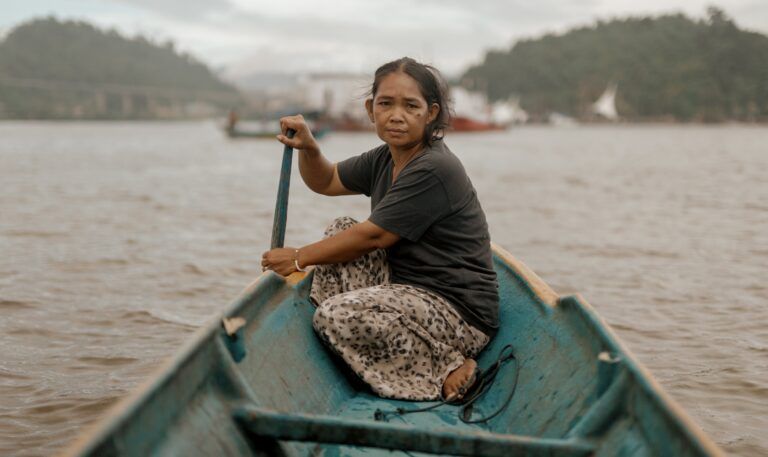
Esti, a mother and waste picker in Kurisa, Morowali Regency, Central Sulawesi, summed up the views of many women:
“People say: ‘You people must be rich now, you live next to the companies.’ I tell them, ‘If we could trade, we would trade villages. You live here, and feel what we feel.’”
Nurtina, a cook and activist in her 50’s who lives in Tapunggaya, Southeast Sulawesi, explained what life feels like to her and her community:
“The people are being intimidated over their own land. We can’t farm it—the company holds it. We can’t mine it. So how are the people supposed to eat? Are we supposed to starve to death?”
Recommendations
• The Indonesian government should urgently strengthen laws and regulations to minimize the impacts of nickel mining and refining on communities, including on Indigenous communities. The government should also immediately stop the permitting of all new coal plants, including captive coal plants used to power nickel industrial areas.
• The Ministry of Women Empowerment and Child Protection should immediately investigate the impacts of nickel mining and processing on the rights of women and children. It should also work with other ministries to safeguard women’s rights on the nickel frontier, including by ensuring women are fully able to participate in decision-making processes, improving access for maternal and child health programs in nickel communities, and investigating threats, harassment, and intimidation of women human rights defenders critical of the nickel industry.
• Nickel companies should take immediate steps to remedy water and air pollution caused by their operations, and properly dispose of mine tailings to minimize environmental pollution. Companies should fully and fairly compensate all community members, including Indigenous Peoples, for their land, and ensure they obtain free, prior, and informed consent (FPIC), as established by international human rights law.
• Electric vehicle and battery companies that source nickel from Indonesia should immediately use their leverage to ensure suppliers end and remedy rights abuses, clean up water and air pollution, and transition from coal to renewable sources of energy as soon as possible, Climate Rights International said. Electric vehicle companies should also increase transparency by providing public information about all companies in their transition mineral supply chains.
“The Indonesian government has failed to take meaningful action to curb pollution, prevent abuses, and protect communities,” said Shennum. “Battery, EV, and other companies benefiting from nickel mining have failed to adequately address the human rights and environmental harms, which are disproportionately impacting women.”
Photo: Esti, on her boat, prepares to collect plastic bottles in Kurisa. May 2026. Muhammad Fadli for Climate Rights International.