
(San Francisco, July 31, 2025) – President Luiz Inácio Lula da Silva should veto a bill that would remove many environmental licensing requirements and weaken Brazil’s ability to prevent environmental harms, including the destruction of the Amazon rainforest, Climate Rights International said today. If enacted, the bill would represent a devastating setback for the environment, climate change, and human rights in Brazil, just months before the country will host COP 30, the global UN climate conference, in the Amazonian city of Belém in Pará State.
Approved by Brazil’s Congress on July 17, Bill 2159/2021 would allow many high-impact projects to proceed without environmental assessments or public consultation. The bill excludes large portions of land from environmental review, including nearly a third of the lands claimed by Indigenous Peoples and more than 80 percent of land claimed by Afro-Brazilian communities formed by descendants of escaped enslaved people known as quilombolas, for which long-standing land claims have yet to be officially resolved. These communities would likely not have the ability to meaningfully challenge destructive projects before they begin, risking displacement and harms to livelihoods. The bill also would eliminate environmental reviews for the expansion of highways, which are often used to move heavy machinery to clear-cut rainforests in the Amazon. Following its approval by Congress, the President has fifteen working days, or until August 8, to veto the bill.
“While it seems inconceivable that President Lula would have proposed this ‘Devastation Bill,’ his silence before and since it passed through Congress is worrisome,” said Brad Adams, Executive Director at Climate Rights International. “Lula should make it clear that he will stand firm against this assault on Brazil’s capacity to protect its forests and people from potentially disastrous infrastructure and agricultural projects by vetoing this bill.”
Before the Senate vote in May, members of the Senate Brazil’s Ministry of Environment and Climate Change stated that the bill “significantly disrupts existing regulations on the topic and poses a risk to environmental and social security in the country. Furthermore, it directly violates the Federal Constitution, which, in Article 225, guarantees Brazilian citizens the right to an ecologically balanced environment, requiring a prior environmental impact study for the installation of any construction project or activity that could cause environmental damage.” Brazil’s Environment Minister, Marina Silva, said the bill would result in “the burial of environmental licensing.”
The response to the bill from Brazilian civil society has been swift. More than 300 organizations have condemned the bill, warning that it risks dismantling decades of environmental protection and puts vulnerable communities at even greater risk.
At the center of the legislation is a new mechanism known as the “License by Adhesion and Commitment,” which allows companies to obtain permits by self-declaring compliance through an online form. Under this model, many projects—classified as medium risk—could proceed without any requirement for environmental impact studies or public consultation. The World Wildlife Fund estimates that 80 percent of all projects in Brazil could qualify for this fast-track treatment.
The bill exempts so-called “strategic” infrastructure projects from licensing altogether. Projects would be determined to be “strategic” by the government and then would receive a “Special Environmental License.” This has led to concerns that the Amazon and other parts of the country could be opened up to new oil and gas production. According to the Senate’s website, “Some senators hope that this license, with its simplified procedure and the elimination of stages, will enable oil exploration in the Amazon.”
“This bill doesn’t just weaken environmental licensing requirements, in many cases it replaces them with a box-checking exercise,” said Adams. “The idea that a company can simply upload a form and receive a green light to carry out environmentally disastrous projects is ridiculous. If this becomes law, Brazil will be trading impact assessments for inbox confirmations, turning what should be environmental oversight into reckless destruction.”
The bill was passed two weeks after the Inter-American Court of Human Rights issued a landmark advisory opinion affirming that states have positive obligations to prevent environmental degradation that threaten human rights. The Court ruled that governments must not only refrain from causing harm, but also actively regulate, oversee, and prevent environmental damage by private actors, including companies. It emphasized the importance of access to information, public participation, and environmental impact assessments as essential components of the right to a healthy environment. On July 23, the International Court of Justice in The Hague released a landmark decision requiring states to protect people from the “urgent and existential threat” of climate change and finding that people have the right to a “clean, healthy and sustainable environment.”
President Lula has previously pledged to curb deforestation. Addressing COP27 in 2022, Lula stated, “There is no climate security for the world without a protected Amazon.” Since his inauguration in January 2023, Brazil has seen a sharp drop in Amazon deforestation rates, reaching a nine-year low. His administration also reactivated the Amazon Fund, securing more than $640 million in new international pledges.
“Allowing this bill to become law—and disregarding the urgent concerns of Brazilian environmental and human rights defenders who have called for a veto–would invite intense international scrutiny when Brazil hopes to showcase its climate and environmental leadership on the world stage at COP30,” said Adams. “Lula should know that Brazil can’t lead the climate fight with one hand and allow the destruction of the Amazon with the other.”
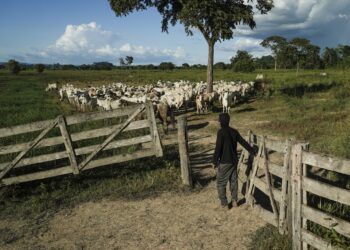
Photo: Deforestation in the Amazon. Photo by: luoman