
(New York, May 20, 2026) — The United Nations General Assembly’s (UNGA) adoption today of a resolution recognizing the landmark advisory opinion of the International Court of Justice (ICJ) on states’ obligations in respect of climate change is a welcome step, but the failure to agree on a strong accountability mandate for the UN Secretary-General makes clear that the battle for climate accountability will continue both inside and outside the UN, Climate Rights International said today. The resolution was adopted by 141-8 with 28 abstentions, with opposition led by major oil-producing states such as the United States, Saudi Arabia, and Russia.
The resolution affirms the importance of the ICJ’s unanimous opinion and calls on states to comply with their obligations. But Climate Rights International expressed concern that opponents watered down the follow-up mechanism established in the resolution by limiting the independence and institutional capacity of the UN Secretary-General to assess whether states are meeting the obligations the Court identified.
“The ICJ advisory opinion is a landmark legal achievement that should fundamentally change the landscape for climate accountability and justice,” said Lotte Leicht, advocacy director at Climate Rights International. “The Court made unmistakably clear that states have binding obligations under international law to protect the climate system and the rights of present and future generations. But the General Assembly resolution adopted today reflects continued resistance by major greenhouse gas-emitting states and the powerful fossil fuel industry to any process that advances compensation, accountability and justice.”
The ICJ advisory opinion followed a March 2023 request by the General Assembly that was the product of years of tireless advocacy led by Vanuatu, Pacific Island states, and the Pacific Islands Students Fighting Climate Change. In its opinion, the Court resolved two core questions: the obligations of states under international law to protect the climate system and environment for present and future generations, and the legal consequences that follow from breaches of those obligations.
The Court found that the applicable law governing states’ climate obligations extends well beyond the UN Framework Convention on Climate Change (UNFCCC) and Paris Agreement. It encompasses customary international law, including a stringent duty of due diligence to prevent significant transboundary harm, as well as international human rights law, the Convention on the Law of the Sea, and other bodies of international law. The Court further found that the legal consequences for breaches include the duty to cease wrongful conduct, provide guarantees of non-repetition, and make full reparation in the form of restitution and compensation. The Court also addressed attribution, finding that the collective nature of climate change does not preclude the identification of individual state responsibility, and that states may be held accountable for failing to regulate the greenhouse gas emissions of private actors, including through fossil fuel subsidies, exploration licenses, and production.
The resolution adopted today calls on states to act with the stringent standard of due diligence the Court identified, to cooperate in good faith to prevent significant harm to the climate system, and to respect and ensure human rights by taking necessary climate measures. It acknowledges that breaches of states’ obligations may constitute internationally wrongful acts triggering duties of cessation, non-repetition, and full reparation. It affirms the continuity of statehood for small island states in the face of sea-level rise, and recalls the Court’s finding that the principle of non-refoulement used to protect refugees and asylum seekers applies where climate impacts create a real risk of irreparable harm to the right to life.
Early drafts of the resolution had envisioned a robust follow-up process to the ICJ opinion, but those provisions did not survive the negotiations. Paragraph 10, the resolution’s operative follow-up paragraph, tasks the UN Secretary-General with reporting to the General Assembly at its eighty-second session, “taking into account the best available science and possible gaps in multilateral efforts to address the adverse effects of climate change in accordance with international law, without prejudice to the legal positions of States and without implying any determination of responsibility [emphasis added], while ensuring coordination, coherence and complementarity with existing mechanisms and procedures, including under the United Nations Framework Convention on Climate Change and the Paris Agreement.”
Paragraph 10 creates structural constraints that limit the scope of any report the Secretary-General may produce, said Climate Rights International. The phrase “without prejudice to the legal positions of States” is a standard term of art in UN drafting that precludes any finding that could be construed as questioning or settling a state’s own interpretation of its legal obligations. Applied to a report on compliance, this forecloses the kind of legal assessment the ICJ opinion itself performed. The clause “without implying any determination of responsibility” similarly removes from the mandate the question of whether any state has breached the obligations the Court identified. The instruction to ensure coordination and complementarity with the UNFCCC and Paris Agreement channels the Secretary-General’s work back through institutional frameworks whose compliance mechanisms are weak and facilitative rather than adjudicatory, and which were not designed to assess breaches of international human rights and customary international law. The requirement that the work be conducted “within existing resources” precludes the establishment of dedicated additional funding to do the work.
“The UN Secretary-General is being asked to write a report about an existential crisis for humanity but is prevented from saying who is responsible or who should pay to fix the problem,” said Leicht. “Each limiting clause in the resolution was inserted by countries who fear being called out for causing global warming and serious harms to people hit by rising sea levels, massive storms and flooding, or the extreme heat that is killing people all over the world.”
The distance between the first draft circulated months ago and the resolution as adopted reflects the opposition mounted by a significant number of greenhouse gas-emitting states during the New York negotiations, and not any failure of ambition or effort by climate-vulnerable states and their many civil society partners, said Climate Rights International.
“The fight for climate accountability and justice is only just beginning,” said Leicht. “It will continue in national, regional, and international courts; in parliaments and boardrooms; through activists, students, Indigenous and frontline communities, progressive businesses, and millions of people around the world demanding prevention, protection, accountability, reparations, restitution, and justice.”
For more on the ICJ Advisory Opinion, please see:
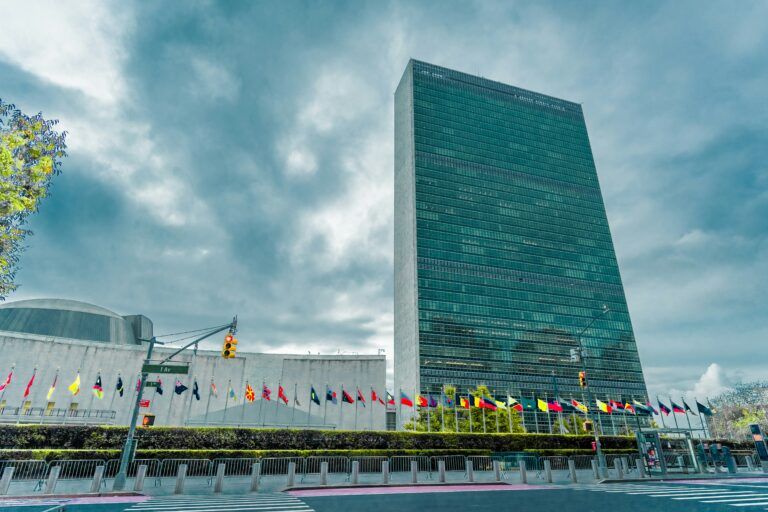
Photo: United Nations Headquarters in New York City, United States. Photo credits: Nils Huenerfuerst/ Unsplash


