An aerial view of the Indonesia Weda Bay Industrial Park (IWIP), including captive coal plants and nickel smelting operations. Credit: Muhammad Fadli for CRI.
“The seas are now more dangerous and rougher than before. I guess maybe it’s climate change. I don’t understand the seas anymore…We could compensate for rough weather because we could just fish nearby. Mining impacts us hard because we have to go farther out [because of the pollution]. It’s much harder now.” — Crisologo Anino, February 7, 2025, Ayoki Island, Surigao del Sur
“Some argue that mining helps with employment, but in reality it destroys fishing grounds, agricultural land, and water sources, the very things that sustain these communities long-term.”— Mavic Hilario, Conservation Specialist with Dinagat Communities for Conservation (C4C), January 20, 2025, Dinagat Island.
“Our land is being taken and shipped to other countries—that’s how they’re making money.”— Alberta Arnego Cuartero, January 14, 2025, Madrid, Surigao del Sur
As one of the countries most vulnerable to the climate crisis, people across the Philippines understand the urgency of climate action, as they are regularly experiencing extreme heat and more frequent and severe extreme weather events. Yet, some communities in the Philippines are not only suffering direct impacts from climate change, but are also experiencing serious consequences from efforts to address it. This is being felt most acutely in areas with significant deposits of transition minerals like nickel, which are being mined to build renewable energy technologies needed to power the global transition to renewable energy.
The Philippines is the second largest producer of nickel and the world’s leading exporter of raw nickel ore, a raw material in the renewable energy transition used in batteries for electric vehicles (EVs) and for energy storage. Demand for nickel is skyrocketing. In a scenario aligned with the Paris Agreement’s climate goals, global nickel demand is expected to increase roughly 60 percent by 2040.
This report documents the human rights, environmental, and climate impacts of nickel mining in Surigao del Sur and Dinagat Island in the Caraga Region of Mindanao, the heart of the Philippines mining industry. It follows Climate Rights International’s previous reporting on abuses in Indonesia’s nickel industry, electric vehicle supply chains, and energy transition minerals.1For example, see Climate Rights International, “Does Anyone Care?”: The Human, Environmental, and Climate Toll of Indonesia’s Nickel Industry, report, Oct. 2025, https://cri.org/reports/does-anyone-care/. Climate Rights International interviewed 57 residents and workers living near nickel mines in the Caraga Region who reported:
Multiple individuals, including a prominent anti-mining activist and a local politician, told Climate Rights International that they were informed that bounties had been put on their heads due to their anti-mining positions.
Most of the nickel mined in the Philippines is shipped as raw ore and is processed outside the country, with more than 90 percent of exports going to China. Nickel ore exports to Indonesia increased more than 4,000 percent from 2023 to 2024 because Indonesia smelters faced shortages of nickel.2UN Comtrade Database, “Trade Data,” https://comtradeplus.un.org/ (accessed July 31, 2025); Bloomberg, “Philippine Miner Sees Surge in Nickel Shipments to Indonesia,” https://www.bloomberg.com/news/articles/2025-07-11/philippine-miner-sees-surge-in-nickel-shipments-to-indonesia/ (accessed October 26, 2025).
Climate Rights International partnered with Empower, an independent corporate research and accountability firm, to seek information about nickel mining companies in the Caraga Region and the downstream supply chains of nickel ore mined in the region. By analyzing customs records for shipments of nickel ore, Empower was able to document 3,473 shipments of nickel ore to eight countries, 65 distinct exporters, and 110 importers from April 2020 to December 2024. Of these shipments, 92 percent were exported to China and 5.5 percent were sent to Indonesia. Empower also documented key trade relationships for specific nickel mining companies in Surigao del Sur and Dinagat Island.3The Empower research memo, with additional information about exporters and importers of Philippine nickel ore, can be found in Appendix III.
The global energy transition away from fossil fuels is critical to avoid the most catastrophic impacts of the climate crisis, but the rights of frontline mining communities in the Philippines and elsewhere—who bear no responsibility for the climate crisis—must be respected for this transition to be truly just. Low-income, rural frontline communities are being asked to pay a high price for climate solutions, like electric vehicles, that will largely benefit high-consuming economies, including those in the Global North. The Philippines government, nickel mining companies in the Philippines, and downstream users of nickel, including EV and battery companies, must prevent environmental degradation and human rights abuses, take responsibility when they occur, and put the health and welfare of local communities at the center of their agenda.
The Climate, Human, and Environmental Cost of Nickel
Nickel mining is making local communities more vulnerable to climate impacts, including extreme weather events. Nickel mining operations drive deforestation and the loss of species that provide climate resilience, such as terrestrial forests and mangrove forests. When deforestation occurs, carbon stored in both plant matter and soil may be released into the atmosphere, turning a carbon sink into a source of emissions. Residents in Tubajon on Dinagat Island in Mindanao described how the loss of forests and mangroves due to mining operations and mining-related pollution is makes their communities more exposed to storm surges, high winds, and flooding during extreme weather events like the devastating Super Typhoon Odette in 2021.
Climate change is projected to increase the frequency of heavy rainfall in the Philippines, increasing the likelihood of flooding events that will impact lives and livelihoods.4J Hong et al., “Changes of extreme precipitation in the Philippines, projected from the CMIP6 multi-model ensemble,” Weather and Climate Extremes 37 (2022), https://doi.org/10.1016/j.wace.2022.100480 (accessed July 31, 2025). The severity of the flooding is often exacerbated by failures by mining companies to effectively manage their waste, leading to rivers choked with sediment and logs. Residents in the towns of Cantilan, Madrid, and Carmen in Surigao del Sur told Climate Rights International that they are particularly concerned that flooding events are becoming more frequent and severe due to the combined impacts of mining and the climate crisis.
Nickel mining and related pollution have damaged the environment and threatened the rights of communities in multiple ways, including by destroying livelihoods, driving food insecurity, polluting water resources, threatening health, and impacting education. Local residents say that some mining companies have failed to fairly compensate people and communities for their land. Low-income, economically vulnerable, and natural resource dependent communities face even more acute threats to their rights.
For communities that have historically supported themselves through fishing, pollution from nickel mining is posing an existential threat to their way of life. Fish and shellfish are an important part of the local diet and provide a key source of protein. In Dinagat Island and Surigao del Sur, fisherfolk interviewed by Climate Rights International described how water pollution from mining areas has harmed fisheries and made it more difficult, if not impossible, for people to continue fishing. In almost all cases, people reported that their catch has decreased considerably since mining operations began. Some report having to go farther out to sea to catch fish, which is much more dangerous and costly. Leopoldo, a 69-year-old man from Ayoki Island in Surigao del Sur, noted that there have been cases where fisherfolk have gone missing at sea because the pollution from mining has destroyed nearshore fisheries:
There are incidents when people’s boats break and fishermen go missing. Someone went missing last week from Carrascal. Most of the time it happens when people are desperate to get fish and buy rice. They’re desperate to feed their families. This wouldn’t happen if the water nearby was clean.5Climate Rights International interview with Leopoldo Urquia, February 7, 2025, Cantilan, Surigao del Sur.
Farmers are facing similar challenges. Climate Rights International interviewed dozens of farmers and farm workers in the Caraga Region who grow rice, coconuts, root crops, and other fruits and vegetables. Across the region, farmers described how mining has made farming much more difficult, and in some cases impossible, due to the loss of their farmland, frequent flooding of fields from mining choked rivers, and dust and water pollution from nearby mining activities. Rice, the most important staple food of the region, is particularly affected because it is grown in lowland areas that are susceptible to flooding and siltation.

Poor mining practices in the Philippines are threatening the fundamental right to food. Pollution from nickel mining and the resulting negative impacts on livelihoods is making it difficult for many families to feed themselves. Multiple people interviewed by Climate Rights International in both Dinagat Island and Surigao del Sur reported that they frequently could not afford, grow, or otherwise access enough food. For example, Ann Julie, a 42-year-old fisherwoman and mother from Tubajon, said that she frequently doesn’t have enough food to feed her children because of lost income from low fish and crab catches. Ryan, a 44-year-old father of five from Ayoki Island, Surigao del Sur, described days on end where his family only can eat breadfruit due to the challenges in catching fish because of pollution. According to Analiza, a 46-year-old mother of four from Tubajon, Dinagat Island:
It is now hard to feed my family. We are hungry most of the time.6Climate Rights International interview with Analiza, January 28, 2025, Tubajon, Dinagat Island.
Nickel mining in the Caraga Region is also polluting important water sources that residents depend on for their drinking water. Residents in Dinagat Island describe how siltation and runoff from mining operations have polluted their drinking water. The drinking water for most individuals interviewed in Barangay Malinao in Tubajon originates from a mountain spring that is piped into homes. Because water is not treated, mining-related pollution can directly enter the pipes and homes of residents. People interviewed by Climate Rights International reported that nickel mining in their watersheds was negatively impacting the quantity and quality of drinking water, suggesting the mining companies are causing excessive pollution and the Philippines government is failing its obligations to fully enforce environmental laws.
Residents living near nickel mines in Dinagat Island and Surigao del Sur told Climate Rights International that they are concerned that recently developed health problems, including respiratory and skin ailments, are related to pollution from nearby mines. For many, health problems from dust from mining operations and hauling roads have become normal and are strongly correlated with the mining season and hot, summer weather. Others reported developing respiratory illnesses while working for mining companies that were so severe they had to stop working. Amerito, a 62-year-old farmer from Tubajon, said that both he and members of his immediate family now regularly get sick during the hot, summer season, which they attribute to dust from nearby mining operations:
During the hot season, I have coughing and a runny nose [due to the dust]. There’s no dust during the rainy season. If it gets worse, I go to the doctor for medicine. The doctor doesn’t tell us why we’re sick. We only have problems when it’s dusty. I complained to the barangay [village], but the doctor doesn’t ask about the dust.7Climate Rights International interview with Amerito Alinsunod, January 28, 2025, Tubajon, Dinagat Island.
The loss of income from fishing and farming has made it difficult, if not impossible, for some families to afford to send their children to school. Parents and other community members said that, in some cases, noise and dust from mining operations have had a negative impact on students’ education.
Nickel mining also threatens local flora and fauna, as well as important habitats like coral reefs and forests. Habitat destruction, including deforestation, destruction of mangroves, and mining-related pollution, poses serious threats to biodiversity and the survival of species, including endemic species to Dinagat Island. Coral reefs and other marine areas offshore of nickel mining operations are experiencing siltation from mining runoff, which can damage or kill corals and the many species of fish and marine invertebrates that depend on corals.
When mining companies arrived in the Caraga region, many of them promised good jobs to residents. Yet, for many, those promises have not been kept. Temporary mining workers and former mining workers report salaries below minimum wage, unreliable employment, unfulfilled commitments, and occupational health and safety hazards.
The Philippines is the most dangerous country in Asia to be a land and environmental defender. Between 2012 and 2023, at least 298 land and environmental defenders were killed in the country, more than any other country in Asia.8Global Witness, “Missing Voices,” September 2024, https://globalwitness.org/en/campaigns/land-and-environmental-defenders/missing-voices/#killed (accessed June 25, 2025). Multiple people interviewed by Climate Rights International reported knowing individuals whose killings they believe were linked to their anti-mining activities or who had experienced attacks themselves. Beyond physical violence and legal cases, people interviewed by Climate Rights International described intimidation tactics designed to deter them from continuing their activism. Some individuals in the Caraga Region and across the Philippines who have challenged mining companies have faced lawsuits that they believe are intended to silence their activism.
Red-tagging is a practice of publicly labeling activists as rebels, terrorists, or supporters of the communist insurgency. This tactic has been used for decades by the Philippines government, military, and police to silence journalists, Indigenous leaders, and human rights and environmental defenders.9Global Witness, “What is red-tagging, and how does it harm climate action?,” July 2025, https://globalwitness.org/en/campaigns/digital-threats/what-is-red-tagging-and-how-does-it-harm-climate-action/; and Human Rights Watch, “Philippines: Officials ‘Red-Tagging’ Indigenous Leaders, Activists,” January 2023, https://www.hrw.org/news/2023/01/26/philippines-officials-red-tagging-indigenous-leaders-activists (accessed August 27, 2025). In Surigao del Sur, Father Raymond Ambray, the Ecology Ministry director and head of the LGBTQIA+ apostolate in the Diocese of Tandag, and a prominent environmental and Indigenous Peoples’ rights activist, was red-tagged in 2020, which put him, members of his parish, and family members at risk.
Despite the wealth generated for mining companies by their nickel mining operations, some have failed to compensate residents for the use of their land. In some cases in Dinagat Island, local residents reported not receiving adequate compensation for the use of their land, destruction of their crops, or use of their homes and other structures.
A general lack of transparency by many mining companies impacts the ability of local governments and communities to actively participate in approving or monitoring mining impacts. Residents and local activists described being excluded from consultations about potential mining operations or consultations that were selectively held in pro-mining areas in order to exclude people who were concerned about the potential impacts.
Despite ongoing complaints from local communities, those directly impacted face a lack of accountability and remedies for the harms they have suffered. People interviewed by Climate Rights International reported that nickel mining is causing excessive pollution and that the Philippines government — in particular the Department of Environment and Natural Recourses and its Mines and Geosciences Bureau — is failing its obligations to fully enforce environmental laws. In both Dinagat Island and Surigao del Sur, community members believe that some of their elected politicians, including barangay captains, mayors, and governors, accepted bribes from mining companies to approve permits, and otherwise financially benefited from mining.
Corporate Responsibility
The Caraga Region has 26 operating metallic mines, more than any other region in the Philippines. 23 of these are nickel mines. Harms to local communities and the environment are being driven by the individual and cumulative activities of nickel mining projects. Many nickel mining companies in the Caraga Region have links to powerful actors in the Philippines, including active and former politicians, politically connected families, and wealthy businesspeople. Where a politician or their family members have ownership interests in a company, there is an inherent risk that the interests of the company may be placed ahead of the public interest.
Because of the large number of mining concessions located close to each other, it can be difficult to attribute impacts to specific companies. Nevertheless, residents in Dinagat Island and Surigao del Sur often highlighted the role of specific companies and the impacts of their mining operations on communities and the environment.
Of the ten active nickel mines in Dinagat Island, people interviewed by Climate Rights International consistently identified three mining projects, operated by San Roque Metals Inc. (SRMI), Oriental Vision Mining Philippines Corp. (OVMPC), and Libjo Mining Corp. (LMC), as problematic. Residents of Barangay Malinao in Tubajon live downstream of these three mining operations.
There are six active nickel mining projects in Surigao del Sur, covering a total of 17,614.25 hectares. While many residents interviewed by Climate Rights international expressed concern over many of the active and proposed nickel mines in Surigao del Sur, the most specific concerns were voiced about Marcventures Mining and Development Corp. (MMDC). Climate Rights International wrote to the companies highlighted by community members to ask about the issues they raised. As of the time of writing, only MMDC had responded, denying any responsibility for the harms. Copies of the correspondence can be found in Appendix I.
The transition to renewable energy is essential, but strong government regulation and oversight are necessary to ensure that the growing transition mineral industry does not replicate the appalling labor and environmental practices that have long characterized mining and other extractive industries in the Philippines and around the world.
The Philippines government should fully enforce and strengthen laws and regulations to minimize the impacts of nickel mining on communities. The government should urgently stop the permitting of new mines until the industry meets domestic and international environmental standards, including in the management of mining waste.
The Department of Environment and Natural Resources (DENR) should assess, monitor, and conduct independent and transparent investigations into pollution at and near nickel mining operations, including at all of the mining operations named in this report, and make the findings of those investigations publicly available and accessible. The Mines and Geosciences Bureau (MGB) should ensure that mining companies have environmentally and socially responsible operations that respect the environment and human rights.
Nickel companies should fully and fairly compensate all community members for the taking of, use, or degradation of their land. Nickel companies should properly dispose of mine waste to minimize environmental pollution and take immediate steps to prevent and remediate water and air pollution caused by their operations. All companies must ensure that Indigenous Peoples are able to provide full free, prior, and informed consent (FPIC) as established by international human rights law.
Global EV and battery manufacturing companies that directly or indirectly source nickel from the Philippines should immediately use their leverage to push suppliers to address harms to local communities and the environment and, if necessary, stop sourcing nickel from companies responsible for such abuses. EV companies should also increase transparency about their transition minerals supply chains by providing public information about all suppliers, including those involved in mineral mining, refining, smelting, and battery production. In addition, they should conduct regular, transparent, and genuinely independent audits of mines and facilities where transition minerals are mined and refined.
The urgency of the climate crisis should not be used as an excuse for the endless extraction of minerals like nickel and the serious impacts to frontline communities and ecosystems. High consuming economies, including countries in the Global North, should enact policies that curb demand for virgin raw materials and new mining projects, including by increasing access to public transit and ensuring that battery minerals are repurposed and recycled.
A full set of recommendations can be found at the end of this report. Specific key recommendations include:
To the Philippines government:
To nickel mining companies:
To electric vehicle and battery companies:
Barangay: a political subdivision of cities and municipalities
C4C: Dinagat Communities for Conservation
Carabao: a domesticated water buffalo
DENR: Department of Environment and Natural Resources
EIA: Environmental Impact Assessment
EIS: Environmental Impact Statement
EITI: Extractive Industries Transparency Initiative
EMB: Environmental Management Bureau
EV: electric vehicle
FPIC: free, prior, and informed consent
GHG: greenhouse gas
LGU: local government unit
LMC: Libjo Mining Corp.
MGB: Mines and Geosciences Bureau
MMDC: Marcventures Mining and Development Corp.
MPSA: Mineral Production Sharing Agreement – “An agreement wherein the Government grants to the Contractor the exclusive right to conduct mining operations within, but not title over, the contract area and shares in the production whether in kind or in value as owner of the minerals therein. The Contractor shall provide the necessary financing, technology, management and personnel.”10Administrative Order No. 2010-21, “Revised Implementing Rules and Regulations of R.A. 7942, otherwise known as the Philippine Mining Act of 1995,” https://www.pntr.gov.ph/wp-content/uploads/2021/04/AO-2110.pdf.
OFW: overseas Filipino worker
OVMPC: Oriental Vision Mining Philippines Corp.
PAGASA: Philippine Atmospheric, Geophysical and Astronomical Services Administration
Porok: a neighborhood or zone within a barangay
NPA: New People’s Army
Red-tagging: the practice of labeling an activist or journalist as a communist or terrorist
Sitio: a small, rural enclave within a barangay
SRMI: San Roque Metals Inc.
TB: tuberculosis
Transition minerals: mineral resources essential for clean energy technologies (also called critical minerals)
The report is based on information collected during field research to mining impacted communities in the Caraga Region between January and October 2025. In addition to interviews with impacted community members, Climate Rights International also spoke with NGO representatives, journalists, religious leaders, local government officials, and other experts in the Philippines.
Climate Rights International interviewed 57 individuals, including 30 men and 27 women, ranging from age 24 to 81. Nine individuals were current, former, or seasonal employees in the nickel industry. We did not interview any children. We interviewed three Indigenous Manobo people. All interviewees provided informed consent to participate in the interview. In some cases, we have given pseudonyms (identified using quotation marks) and withheld identifying information of interviewees to protect their identity because of the risk of retaliation. No financial incentives were provided to interviewees, although in some cases Climate Rights International reimbursed interviewees for travel expenses to the interview location and/or provided refreshments. Interviews were conducted in Cebuano and/or English.
While conducting field research, Climate Rights International also took photographs, videos, and drone footage of mining areas and mining-impacted areas.
We reviewed secondary resources, including peer reviewed literature, NGO reports, media reports, legal documents, and company reports. Climate Rights International also reviewed Philippine laws and regulations.
Research into mining companies’ trade data and downstream supply chains was conducted by the Mexico-based research group, Empower. A copy of their full research findings may be found in the report appendix.
Prior to the release of this report, Climate Rights International wrote to the following government agencies: Department of Environment and Natural Resources, Mines and Geosciences Bureau (national), Mines and Geosciences Bureau Region XIII, Environmental Management Bureau, Surigao del Sur Provincial Police Commission, and Department of Labor. We wrote to the following companies: Marcventures Mining and Development Corp., Oriental Vision Mining Phils. Corp., Libjo Mining Corp., San Roque Metals Inc., Vista Buena Mining Corp., Norweah Metals and Minerals Co. Inc., and East Coast Vulcan Mining Corp. Copies of correspondence may be found in the report appendix.

The world is undertaking a massive energy transition to decrease the greenhouse gas emissions that are causing the climate crisis. To do this, many governments and companies are making major investments to move away from fossil fuels to renewable energy. To power new energy systems, transition minerals—including nickel, lithium, copper, and cobalt—are needed to build new technologies, including batteries for electric vehicles and energy storage, solar panels, and onshore and offshore wind farms.11United States Department of the Interior, “2022 Final List of Critical Minerals,” February 22, 2022, https://d9-wret.s3.us-west-2.amazonaws.com/assets/palladium/production/s3fs-public/media/files/2022%20Final%20List%20of%20Critical%20Minerals%20Federal%20Register%20Notice_2222022-F.pdf (accessed March 27, 2023).
Historically, nickel’s primary use has been in the production of stainless steel, which continues to be the biggest user of nickel. But nickel is in increasing demand for its use in the production of solar infrastructure and rechargeable lithium-ion, nickel cadmium, and nickel metal hydride batteries. Nickel’s relative abundance, resistance to corrosion, high energy density, and large storage capacity make it particularly useful in batteries.
To meet the growing demand for EV batteries and other renewable energy technologies in a scenario aligned with the Paris Agreement goals, global nickel demand is expected to increase roughly 61 percent by 2040.12International Energy Agency, “The Role of Critical Minerals in Clean Energy Transitions,” May 2021, https://www.iea.org/reports/the-role-of-critical-minerals-in-clean-energy-transitions/executive-summary (accessed April 5, 2023). The auto industry is—and will continue to be—responsible for a significant portion of that increased demand for nickel, as an average electric vehicle requires 39.9 kilograms (almost 88 pounds) of nickel.13Ibid.
The Philippines has the fifth most minerals of any country in the world,14Chambers and Partners, “Mining 2025: Philippines,” January 23, 2025, https://practiceguides.chambers.com/practice-guides/mining-2025/philippines/trends-and-developments (accessed July 8, 2025). and is the world’s second largest producer of nickel, after Indonesia.15Statista, “Distribution of mine production of nickel worldwide in 2022, by country,” August 2024, https://www.statista.com/statistics/603621/global-distribution-of-nickel-mine-production-by-select-country/#statisticContainer (accessed July 29, 2025). It holds an estimated 4.8 million metric tons of nickel reserves, suggesting that the country will continue to be a major source of nickel.16Government of Canada, “Nickel facts,” January 2025, https://natural-resources.canada.ca/minerals-mining/mining-data-statistics-analysis/minerals-metals-facts/nickel-facts (accessed July 29, 2025). Since the Indonesian government banned the export of raw nickel ore in 2020 to build up its domestic mineral processing industry, the Philippines has risen to be the world’s largest exporter of raw nickel ore, exporting nearly 45 million metric tons of nickel ore in 2024.17UN Comtrade Database, “Trade Data,” https://comtradeplus.un.org/ (accessed July 31, 2025).
Like other countries located near the equator, the Philippines is home to significant laterite nickel ore deposits, which are generally lower quality and found closer to the surface than the nickel sulfide deposits found in temperate countries, including the U.S., Canada, and Russia. Because of its lower quality, laterite nickel ore is significantly more carbon intensive to process into high-quality nickel that can be used in the production of batteries. 18International Energy Agency, “GHG emissions intensity for class 1 nickel by resource type and processing route,” May 2021, https://www.iea.org/data-and-statistics/charts/ghg-emissions-intensity-for-class-1-nickel-by-resource-type-and-processing-route (accessed July 29, 2025). Laterite nickel deposits are accessed through surface mining, a process of extracting minerals by removing soil and rock over the deposit.
For decades, mining projects in the Philippines have faced opposition from community activists and environmental groups.19K Schneider, “The Philippines, a national rich in precious metals, encounters powerful opposition to mining,” Mongabay, June 2017, https://news.mongabay.com/2017/06/the-philippines-a-nation-rich-in-precious-metals-encounters-powerful-opposition-to-mining/ (accessed August 12, 2025). Mining projects, which disproportionately affect Indigenous Peoples in the Philippines, have also led to violations of their rights to Free, Prior and Informed Consent. In addition, they have led to disagreements among communities about whether to consent to mining projects, and about the allocation of resources from those projects. According to a report by the Legal Rights and Natural Resources Center (LRC), a Philippines environmental NGO, FPIC violations and conflicts regarding ancestral domains are the most frequent type of violation of Indigenous Peoples’ rights.20Legal Rights and Natural Resources Center, “State of Indigenous Peoples Address, 2024 Report,” December 2024, https://www.lrcksk.org/_files/ugd/dc2292_03550a9d18ed413da620508a14ee687a.pdf (accessed July 30, 2025). An analysis of the impacts of mining on the rights of Indigenous Peoples is, however, beyond the scope of this report.
Local advocacy efforts have pushed the Philippines government to take action to address the impacts of mining. In 2012, President Benigno Aquino III signed Executive Order No. 79, which imposed a moratorium on new mineral agreements and called for strict enforcement of environmental laws.21Executive Order No. 79 of 2012, https://faolex.fao.org/docs/pdf/phi115194.pdf (accessed August 12, 2025). In 2017, Department of Environment and Natural Resources (DENR) Secretary Gina Lopez ordered the closure of 23 metallic mines and the suspension of five additional mines, stating that the Philippines was “unfit for mining.”22ABS-CBN, “Philippines unfit for mining, says Gina Lopez,” February 2017, https://www.abs-cbn.com/business/02/06/17/philippines-unfit-for-mining-says-gina-lopez (accessed August 12, 2025). Fourteen of the mines ordered to be closed were located in the Caraga Region. Secretary Lopez further elaborated:
My issue here is not about mining. My issue here is social justice. If there are businesses and foreigners that go and utilize the resources of that area for their benefit and the people of the island suffer, that’s social injustice.23DENR, “Lopez Orders Closure of 23 Metallic Mines,” February 2017, https://denr.gov.ph/news-events/lopez-orders-closure-of-23-metallic-mines/ (accessed August 12, 2025).
In 2017, DENR also banned new open-pit copper, gold, silver, and nickel ore mining.24Keith Schneider, “Philippines bans new open-pit metal mines,” Mongabay, April 28, 2017 (accessed October 24, 2025).
However, these high-level decisions to rein in the impacts of mining were not long lived. In 2021, President Rodrigo Duterte rescinded the 2012 ban on new mining agreements, and his administration overturned the DENR ban on open-pit mining, reopening many of the closed mines.25Executive Order No. 130 of 2021, https://officialgazette.gov.ph/downloads/2021/04apr/20210414-EO-130-RRD.pdf (accessed August 16, 2025); Reuters, “Philippines ends open pit mining ban to reinvigorate industry,” December 2021, https://www.reuters.com/business/environment/philippines-lifts-four-year-old-ban-open-pit-mining-2021-12-28/ (accessed August 12, 2025).
The Caraga Region, or administrative Region XIII, is located in the northeast region of the island of Mindanao and is made up of five provinces: Agusan del Norte, Agusan del Sur, Dinagat Islands, Surigao del Norte, and Surigao del Sur.
The Caraga Region is the “nickel hub” of the country. It produced roughly sixty percent of all nickel mined in the Philippines in 2023, and has the most active mines of any of the country’s seventeen administrative regions.26Mines and Geosciences Bureau, “Mine Matters,” March 2024, https://www.mgb.gov.ph/attachments/article/1545/Metallic%20Production%20Value%20Sustains%20Growth.pdf (accessed December 19, 2024). According to the Mines and Geosciences Bureau (MGB), 7.29 percent of the total land area in the Caraga Region is covered by approved mining tenements, or licenses, more than any other region in the country.27Mines and Geosciences Bureau, “MSC: The Philippine Mineral Industry at A Glance,” July 1, 2025, https://mgb.gov.ph/2015-05-13-01-44-56/2015-05-13-01-47-51/23-industry-statistics/1336-msc-the-philippine-mineral-industry-at-a-glance#mineral-industry-at-a-glance (accessed July 8, 2025). Surigao del Sur currently has six active nickel mines, covering a total of 17,614.25 hectares, while Dinagat Island is currently home to ten active nickel mining concessions, covering a total of 24,221 hectares.
As of July 2025, the authorities have approved exploration permits for three additional nickel mines in the Caraga Region.28Mines and Geosciences Bureau, “Valid and Existing Exploration Permits,” July 2025, https://drive.google.com/file/d/15ccHXDZzH6oenbkLo5oJqnnmC912Ovfm/view (accessed August 26, 2025).
In 1939, during the U.S. colonization of the Philippines, the islands north of Mindanao were legally classified as “mineral land reservations” and put under the supervision of the Bureau of Mines, now called the Mines and Geosciences Bureau.29Presidential Proclamation No. 391, March 13, 1939, https://lawphil.net/executive/proc/proc1939/proc_391_1939.html (accessed July 8, 2025). According to the Philippines Mining Act of 1995, the president of the Philippines may establish mineral reservations, “when the national interest so requires, such as when there is a need to preserve strategic raw materials for industries critical to national development, or certain minerals for scientific, cultural or ecological value.” Philippines Mining Act of 1995, Section 5, March 3, 1995, https://lawphil.net/statutes/repacts/ra1995/ra_7942_1995.html (accessed July 8, 2025); and Department of Commerce and Labor, Bureau of the Census: 1904, Census of the Philippine Islands, Bulletin 1, Population of the Philippines, https://www2.census.gov/library/publications/decennial/island-areas/1903/philippine-bulletin-1-population.pdf. Much of this land, including Dinagat Island, is still classified as mineral land reservations.
The Philippines is one of the world’s most vulnerable countries to the climate crisis and will be disproportionately impacted by increasing extreme weather and slow onset events.30World Bank Group and Asian Development Bank, “Climate Risk Country Profile: Philippines,” 2021, https://www.adb.org/sites/default/files/publication/722241/climate-risk-country-profile-philippines.pdf (accessed March 7, 2025). Across the country, Filipinos are already facing increasing frequency and intensity of extreme weather events, flooding, drought, and sea level rise.31Ibid. Sea levels in the Philippines are rising roughly five to seven millimeters per year, faster than the global average sea level rise, threatening coastal communities in the archipelago with sea water inundation, greater storm surges, and possible forced relocation.32Oscar M Lopez Center, Department of Environment and Natural Resources, and Climate Change Commission, “2024 Philippine Climate Change Assessment: Working Group 1: The Physical Science Basis,” 2024, https://www.omlopezcenter.org/our-work/philcca-cycle2/ (accessed July 16, 2025).
The Philippines experiences more tropical cyclones, or typhoons, than anywhere else on earth, according to the Philippine Atmospheric, Geophysical and Astronomical Services Administration (PAGASA).33PAGASA, “Tropical Cyclone Information,” https://www.pagasa.dost.gov.ph/climate/tropical-cyclone-information (accessed July 16, 2025). Experts have found that the Philippines is nearly twice as likely to experience deadly typhoons, similar to the ones experienced in 2024, due to the impacts of climate change, as changes to the climate can fuel rainfall intensity, storm surge height, and wind speed.34World Weather Attribution, “Climate change supercharged late typhoon season in the Philippines, highlighting the need for resilience to consecutive events,” December 12, 2024, https://www.worldweatherattribution.org/climate-change-supercharged-late-typhoon-season-in-the-philippines-highlighting-the-need-for-resilience-to-consecutive-events/ (accessed March 7, 2025). Attribution studies, which evaluate the impact of climate change on extreme weather events, found that Typhoon Haiyan, locally known as Super Typhoon Yolanda, which claimed more than 6,000 lives in the Philippines in 2013, was more intense due to climate change.35World Weather Attribution, “10 years of rapidly disentangling drivers of extreme weather disasters,” October 31, 2024, https://www.worldweatherattribution.org/10-years-of-rapidly-disentangling-drivers-of-extreme-weather-disasters/ (accessed July 16, 2025); UN Office for Disaster Risk Reduction, “Ten years after Haiyan: Building back better in the Philippines,” November 8, 2023, https://www.undrr.org/news/ten-years-after-haiyan-building-back-better-philippines (accessed July 16, 2025).
Following Super Typhoon Yolanda, the Philippines Commission on Human Rights conducted a seven-year landmark National Inquiry on Climate Change, which documented the human rights impacts of the climate crisis on Filipinos, including survivors of the Super Typhoon.36Commission on Human Rights of the Philippines, “National Inquiry on Climate Change (NICC),” https://chr.gov.ph/about-us/nicc-2/ (accessed July 16, 2025). The National Inquiry also looked into the deception of the world’s largest oil companies, or Carbon Majors, and the broader fossil fuel industry, and found, “the Carbon Majors, directly by themselves or indirectly through others, singly and/or through concerted action, engaged in willful obfuscation of climate science, which has prejudiced the right of the public to make informed decisions about their products, concealing that their products posed significant harms to the environment and the climate system.”37Commission on Human Rights of the Philippines, “National Inquiry on Climate Change Report,” 2022, https://www.ciel.org/wp-content/uploads/2023/02/CHRP-NICC-Report-2022.pdf (accessed July 16, 2025).
In addition to the direct impacts of climate change on the rights of people in the Philippines, the climate crisis is a threat multiplier and will disproportionately impact communities already under external pressure by economic development projects, political or civil conflict, and other social and demographic factors.38UN News, “Climate change recognized as ‘threat multiplier’, UN Security Council debates its impact on peace,” January 25, 2019, https://news.un.org/en/story/2019/01/1031322 (accessed July 16, 2025). For instance, studies have documented a link between climate impacts on agricultural systems and conflict. For example, a 2018 peer reviewed study found that, “the predicted shift towards wetter wet seasons and drier dry seasons will lead to more civil conflict,”39B. Crost et al., “Climate change, agricultural production and civil conflict: Evidence from the Philippines,” 88:379-397, March 2018, https://doi.org/10.1016/j.jeem.2018.01.005 (accessed July 16, 2025). which is particularly concerning given the history of violence in and near many mining impacted communities.40For decades, Mindanao, including parts of the Caraga Region, has been the site of violent conflict and insurgency. The New People’s Army (NPA) is the armed militia of the Communist Party of the Philippines (CPP) and has been in conflict with the Philippines government since 1969.
Notably, the country is responsible for only 0.48 percent of global greenhouse gas emissions, although 79 percent of the country’s electricity is powered by fossil fuels and its emissions have been on the rise since 2020.41United Nations Development Programme, “Climate Promise: Philippines,” November 24, 2023, https://climatepromise.undp.org/what-we-do/where-we-work/philippines (accessed March 7, 2025); Ember, “The Philippines,” April 10, 2025, https://ember-energy.org/countries-and-regions/philippines-the/ (accessed July 18, 2025).
Through the destruction of natural climate solutions, like mangroves and forests, as well as intense environmental pollution, nickel mining is making communities in the Caraga Region more vulnerable to the impacts of the climate crisis, including exacerbating exposure to and recovery from extreme weather events.
There are three primary ways that mining is making people more vulnerable to the impacts of the climate crisis. First, mining operations drive deforestation and the loss of species that provide climate resilience, including both terrestrial forests and mangrove forests. Second, failures by mining companies to effectively manage their tailings and mining waste lead to increased siltation of river systems, and rivers choked with logs and mining tailings, which are more likely to overflow and flood nearby communities during heavy rain or other extreme weather events. Third, mining often poses negative economic impacts on local residents through the destruction of livelihoods, thus reducing people’s financial and economic capacity to prepare for and recover from climate events.
Destruction of Natural Climate Resilience
Mangroves are a species of trees and shrubs that grow in coastal or brackish waters and provide important ecosystem services.42Brackish waters are a mixture of freshwater and seawater. They filter water, provide critical habitat for wildlife, protect coastal communities from waves and high winds, and are key carbon sinks, absorbing more carbon than they release.43Food and Agricultural Organization of the United Nations, “Mangrove Management,” n.d., https://www.fao.org/forestry/mangrove/ecosystem-services/en (accessed July 8, 2025). Mangrove areas are deemed an ”environmentally critical area” under Philippine law, which bans the cutting and destruction of mangroves.44Presidential Proclamation No. 2146, December 14, 1981, https://lawphil.net/executive/proc/proc1981/proc_2146_1981.html (accessed July 8, 2025).
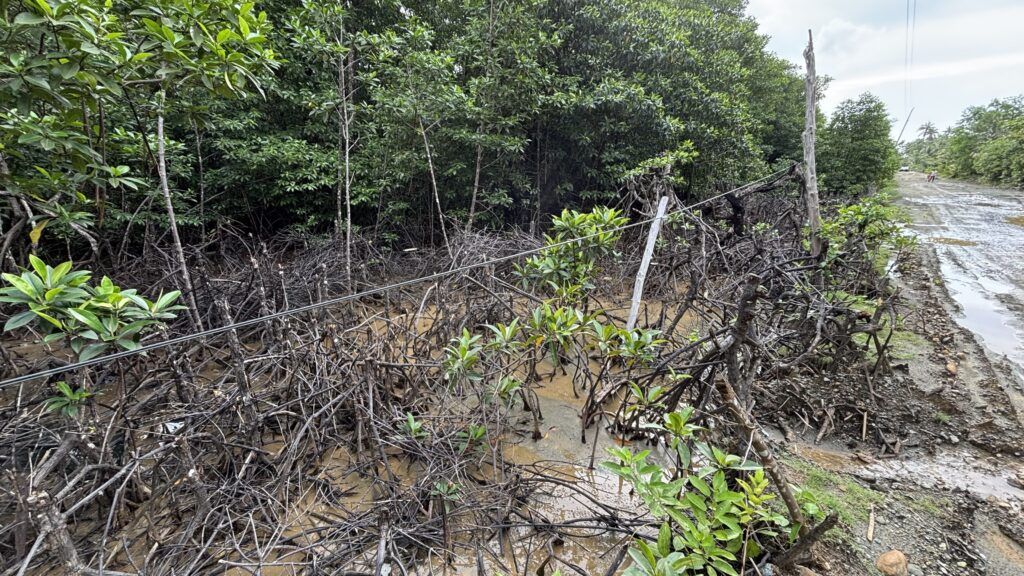
Despite that prohibition, Climate Rights International observed cases where mangroves near mining concessions were choked with pollution or otherwise disturbed. Multiple people interviewed also reported that mangroves, and the species that rely on them, have been negatively impacted by pollution from mining areas. For example, Alson, a 38-year-old fisherman from Barangay Malinao, Tubajon, described the impacts of mud on mangroves in the Malinao Inlet:
The mud poisons the mangroves, and some of the mangroves have died. They try to replant them, but they won’t grow. It’s all because of the mud, which sticks to the mangroves.45Climate Rights International interview with Alson.
Sonia, a 54-year-old fisherwoman, is from Barangay Malinao, Tubajon, a coastal inlet community on the east coast of Dinagat Island. Sonia told Climate Rights International how her community is now more vulnerable to extreme weather events due to deforestation and the loss of mangroves:
Before if there was a storm, the ocean water wouldn’t penetrate the river system, and the winds would be stopped by the trees. The forest cover was very thick, which protected us from storms. Now, big waves come in, and the flooding is more severe. Water runs down from the mines and brings mud, while stronger winds hit the village.46Climate Rights International interview with Sonia Delort, January 28, 2025, Tubajon, Dinagat Islands.
Mining is also a significant contributor to deforestation around the world, including in the Philippines. From 2001 to 2020, roughly 1.4 million hectares of trees were cut for mining and related activities, an area larger than the Philippines islands of Negros or Palawan.47World Resources Institute, “Mining Is Increasingly Pushing into Critical Rainforests and Protected Areas,” October 2024, https://www.wri.org/insights/how-mining-impacts-forests (accessed August 25, 2025). When deforestation occurs, carbon stored in both plant matter and soil may be released into the atmosphere, turning this carbon sink into a source of emissions. In total, 66,218 hectares of land in the Caraga Region are currently held by 23 active nickel mining projects.48Mines and Geosciences Bureau, “MSC: The Philippine Mineral Industry at A Glance,” July 1, 2025, https://mgb.gov.ph/2015-05-13-01-44-56/2015-05-13-01-47-51/23-industry-statistics/1336-msc-the-philippine-mineral-industry-at-a-glance#mineral-industry-at-a-glance (accessed July 8, 2025).

Increased Storm Intensity
In late 2021, Super Typhoon Odette, a Category 5 storm, rocked the Caraga and Southern Leyte regions of the Philippines, bringing torrential rain, landslides, and storm surges that killed more than 400 people and temporarily displaced hundreds of thousands.49Internationally, the storm was named Typhoon Rai but is recognized as Super Typhoon Odette in the Philippines. UNHCR, “Super Typhoon Rai (Odette),” n.d. https://www.unhcr.org/ph/super-typhoon-rai-odette (accessed March 7, 2025). A recent study found that both extreme rainfall and wind speeds in the Philippines due to storms like Odette have become significantly more likely and intense due to climate change.50In October 2025, survivors of Super Typhoon Odette sued Shell for damages linked to the storm and its role in contributing to the climate crisis. Greenpeace Philippines, “Filipino communities to sue Shell for damages linked to Super Typhoon Odette,” October 23, 2025, https://www.greenpeace.org/philippines/press/68662/filipino-communities-to-sue-shell-for-damages-linked-to-super-typhoon-odette/ (accessed October 2025); Clarke, B., Li, S., Toumi, R., and Sparks, N., “The influence of anthropogenic climate change on Super Typhoon Odette (Typhoon Rai) and its impacts in the Philippines, EGUsphere [preprint],” https://doi.org/10.5194/egusphere-2025-665, 2025, https://egusphere.copernicus.org/preprints/2025/egusphere-2025-665/. The study concluded that climate change has likely more than doubled the likelihood of compound events such as Typhoon Odette.
Dinagat Island, including Barangay Malinao in Tubajon, was directly hit by the storm, with some parts of the barangay facing a twenty-meter storm surge as well as landslides from the mining areas.51Climate Rights International interview with Mayor Fely Pedrablanca, January 27, 2025, Tubajon, Dinagat Island. The devastation was made worse by mining debris, and many in the region say they have never recovered from the storm. Tubajon Mayor Fely Pedrablanca told Climate Rights International that settling ponds were destroyed during the typhoon, spilling waste into creeks, rice land, and mangroves. She said that mining companies never admitted that settling ponds failed and did not compensate people for the impacts. She also said that DENR did not investigate the settling pond failures because the failure was due to a “natural disaster.”52Climate Rights International interview with Mayor Fely Pedrablanca, January 27, 2025, Tubajon, Dinagat Island.
Some people in Dinagat Island who were already experiencing reduced income from fishing and farming due to mining pollution before the storm told Climate Rights International that it has been difficult to recover from infrastructure damage and losses from Odette.53For more information on the impacts of mining on livelihoods, see Chapter III. For example, Jerry Esco told Climate Rights International that he has been unable to buy a new fishing boat after his was destroyed during the storm, making it more difficult to earn enough income to recover from the financial costs of rebuilding.54Climate Rights International interview with Jerry Esco, January 28, 2025, Tubajon, Dinagat Island.
Crisologo, a 75-year-old fisherman from Ayoki Island, near Cantilan, Surigao del Sur, told Climate Rights International that he believes climate change has made the seas less predictable and more dangerous. He described how pollution from mining areas have destroyed fisheries near Ayoki Island, requiring fisherfolk to go farther to sea, where they must risk their lives. He explained:
The seas are now more dangerous and rougher than before. I guess maybe it’s climate change. I don’t understand the seas anymore…We could compensate for rough weather because we could just fish nearby. Mining impacts us hard because we have to go farther out [because of the pollution]. It’s much harder now.55Climate Rights International interview with Crisologo Anino, February 7, 2025, Cantilan, Surigao del Sur.
Increased Flooding
Climate change is projected to increase the frequency of heavy rainfall, thus increasing the likelihood of flooding events that will impact lives and livelihoods.56J Hong et al., “Changes of extreme precipitation in the Philippines, projected from the CMIP6 multi-model ensemble,” Weather and Climate Extremes 37 (2022), https://doi.org/10.1016/j.wace.2022.100480 (accessed July 31, 2025). The severity of the flooding is often exacerbated by failures by mining companies to effectively manage their tailings and mining waste, leading to rivers choked with sediment, logs, and mining waste.
Many residents in Surigao del Sur described how flooding events are becoming more frequent and severe due to the combined impacts of mining and the climate crisis.
Clara, a member of the Madrid Irrigator’s Association in Surigao del Sur, described the increased frequency and severity of floods, which impact farmers and residents in the municipal city center:
There were never flash floods before. We would have eight days of rain but [the irrigation canals] never overflowed. Rice fields would never experience much flooding. Even the center of Madrid and other barangays have started to flood. Our basement in the center of the town turns into a river. This never happened before.57Climate Rights International interview with Clara, February 4, 2025, Madrid, Surigao del Sur.
Peter Olan, a farmer, businessman, and former president of the Madrid Irrigator’s Association, told Climate Rights International that runoff from mining areas has made the Carac-an River shallower and more prone to flooding:
When it rained, the water would be muddy and red. That water would go to the rice lands. It was a slippery, oily mud, and it clogged the irrigation system. I noticed now that floods are bigger, and we’re more prone to flooding than before. The river is getter more shallow. Before mining, there would be storms during rainy season, but floods weren’t common. Now, there’s flooding every year.58Climate Rights International interview with Peter Olan, February 5, 2025, Madrid, Surigao del Sur.
In addition to increased siltation of rivers, improper disposal of logs cut in mining areas can also contribute to the severity of flooding events. When flooding events occur, improperly managed settling ponds can burst, releasing a flood of toxic mining waste, polluted water, and illegally deposited logs into watersheds and downstream communities. The results can be disastrous.
In 2020, during Tropical Depression Vicky, a flash flood raced through farmland in Madrid, Surigao del Sur. While attempting to retrieve his cattle so they did not get swept away by flood waters, Nilo Lagura was pulled into the flood waters, killing him. Nilo’s widow, Corazon Lagura, described the flood to Climate Rights International and its impacts on her life, family, and livelihood.

When the storm came, the floodwaters swept everything away. My husband got caught in it because he was trying to retrieve the cattle. But the winds were already strong, and he lost his life. That was the first time I ever saw flooding that high and that bad with the water level reaching twice my height.
From what I heard, they opened up something in the mines near Cabangahan, so the water came rushing down straight to us. The water coming out was orange, even red. The mud was thick. The runoff came from the mines.
It was a natural disaster, but the mines made it worse. The mud-soaked flood waters came straight from the mines. You see, whenever it rains, they open up those mining sites in Cabangahan, so the water rushes down to us.59Climate Rights International interview with Carazon Lagura, January 15, 2025, Madrid, Surigao del Sur.
In 2018, a flash flood impacted Madrid, Surigao del Sur, destroying homes and farms. Vicky Teves, 69, told Climate Rights International that when she was ten years old, she was assaulted by a relative, then sent away from her family’s homeland near the sea between Cantilan and Madrid, Surigao del Sur. After spending most of her life away from her homeland as an overseas Filipina worker (OFW), Vicky returned to her family’s home in 2017 to heal from her childhood trauma and start a coconut farm, where she employed local relatives and residents and produced various coconut-based products. But in December 2018, a flash flood—unlike anything her family or neighbors had experienced before—tore through her property, destroying the farm, buildings, and almost sweeping Vicky away. She described the flood, and her survival, to Climate Rights International:
At first, I didn’t notice the water level rising until the dogs started barking. When I started going towards my sister, the water started coming hard, and I had to hold onto the leaves of a coconut tree to avoid getting swept away…The two rivers surged together. The water surge was only 30 minutes but there was so much damage…No one had experienced such a flood, it was so intense and so short…
I dug the soil back up six months later [that was deposited during the flood]. The color of the soil was orange, I think from the chemicals from mining.60Climate Rights International Interview with Vicky Teves, February 5, 2025, Cantilan and Madrid, Surigao del Sur.
Vicky explained that, years later, during the 2024 election season, officials told her the cause of the flood was changes to a sandbar, which was then backhoed in an attempt solve “the problem.” But Vicky believes that the flash flood waters came from the Carac-an River due to the color of the flood waters.
Barangay Babuyan
In February 2018, a heavy rainfall event triggered by Tropical Storm Basyang caused a serious flood that destroyed a sitio, a small rural enclave, in Barangay Babuyan, Carrascal, Surigao del Sur. Multiple people interviewed by Climate Rights International claim that nickel mining played an important factor in the severity of the flood, in which cut trees slammed into the community along with water and mud.

“Mark,” who at the time was working as private security for Marcventures Mining and Development Corporation (MMDC), one of the mining companies operating above the sitio, told Climate Rights International,
The settling ponds were in a mining area in the mountain above Babuyan. Everything, mud, trees, logs that were buried in the settling pond, flooded and covered the sitio.61“Mark” is a pseudonym. Climate Rights International interview with “Mark,” February 2025, Surigao del Sur.
Chito Trillanes, a volunteer staff member with the ecology ministry, Diocese of Tandag, and an anti-mining activist, closely following the case of Barangay Babuyan. He told Climate Rights International:
Tropical Storm Basyang was traumatic for us…The siltation ponds exploded and trees that were illegally cut [came down with the flood waters]. It wasn’t raining when the flood happened.62Climate Rights International interview with Chito Trillanes, February 6, 2025, Surigao del Sur.
Residents say that security guards for MMDC limited access to the area after the disaster. “Mark” told Climate Rights International that he had been stationed at the road leading to Babuyan and was instructed to not let anyone, including relatives of Babuyan residents or journalists, pass. He explained:
All of us security were asked to block the road for a media blackout… We guarded the area for more than a month, so people didn’t see or go out. Not even the families of victims were allowed in. We didn’t have to give a reason why we didn’t let them in.63Climate Rights International interview with “Mark,” February 2025, Surigao del Sur.

Climate Rights International wrote to MMDC to request documentation related to the incident, including information explaining why MMDC security guards were instructed to not allow people to enter the road. In its response, MMDC stated:
This is fake news! We vehemently and categorically deny (a) the said report regarding MMDC’s road blockage as a result of Tropical Storm Basyang, and (b) prohibition to the public or media to enter the Barangay Babuyan Road.64Marcventures Mining and Development Corporation email to Climate Rights International, October 21, 2025, see Appendix I.
While media and official reporting only documented five deaths in Barangay Babuyan, people familiar with the disaster, including “Mark,” believe that many more people were killed in the landslides.65Climate Rights International also accessed academic literature on redeveloping Barangay Babuyan, which found, “in 2018, this barangay encountered an expand. However, in 2018, this barangay encountered a series of challenges and calamities. These events prompted the researchers to engage in interviews with local residents. According to one interviewee, the recent conditions in barangay Babuyan are far from safe, particularly during the rainy season, when landslides and mud floods disrupt the area. The adverse impacts of these natural events have led to sleep disturbances and other safety concerns.” MC Solloso, “Creating an Innovative Blueprint for Barangay Development,” IJARSCT 3(2), 2023, DOI: 10.48175/IJARSCT-12344 (accessed August 29, 2025). PAGASA, “DOST-PAGASA Annual Report on Philippine Tropical Cyclones,” 2018, https://pubfiles.pagasa.dost.gov.ph/pagasaweb/files/tamss/weather/tcsummary/ARTC2018.pdf; Philippine Daily Inquirer, “’Basyang’ death toll climbs to 14,” February 15, 2018, https://newsinfo.inquirer.net/968878/basyang-death-toll-climbs-to-14 (accessed August 29, 2025).
Following the disaster, and in response from a letter from Bishop Nereo Odchimar of the diocese of Tandag, DENR committed to undertake an investigation into the role of mining in the floods.66Erwin Mascariñas, “Act of God or act of man? DENR probes Surigao del Sur calamity,” ABS-CBN, March 10, 2018, updated Nov. 14, 2018, https://www.abs-cbn.com/focus/03/10/18/act-of-god-or-act-of-man-denr-probes-surigao-del-sur-calamity (accessed August 29, 2015). It is our understanding that DENR has never made public the results of that investigation. Climate Rights International wrote to DENR seeking a copy of the results of the investigation. We had not received a response as of the time of publication.
There has never been a full accounting of the role that mining and specific mining companies played in the disaster. As discussed in more detail in the section on lack of accountability, a group of residents sued MMDC in 2010 asserting, among other claims, that the logs that destroyed houses came from MMDC’s operations, and that its siltation pond had given way. Fifteen years later, in August 2025, the trial court ruled that the plaintiffs had not proven that it was MMDC’s operations that caused the disaster.67Republic of the Philippines, Regional Trial Court, 11th Judicial Region, Branch 41, Jaime “Datu Dagsaan” Bat-ao, Liquisa Irrigators Association, Represented by Peter William Olan, Nagkahugpong Managatay Para sa Kalambuan Nan Ayoke (NAGMAKAAYO), hereby Represented By Crisologo E. Anino, Sr., Lydia L. Lascano and Nick Matthew Q. Iriberri, a minor represented by his Father, Vicente Cirilo Iriberri vs. Marcventures Mining and Development Corporation, Civil Case C-224, Decision, Aug. 5, 2025, p. 69-70. Copy on file with Climate Rights International. The plaintiffs plan to appeal.
Nickel mining and related pollution have damaged the environment and threatened the rights of communities in multiple ways, including by destroying livelihoods, failing to fairly compensate people for their lands, driving food insecurity, polluting water resources, threatening health, and impacting education.
For many farmers and fisherfolk living near nickel mining operations, their ability to continue this traditional way of life has been seriously eroded.
Mavic Hilario, a Conservation Specialist with Dinagat Communities for Conservation (C4C), a Dinagat Island-based environmental group, works to support communities in their fight for sustainable conservation and biodiversity protection. She described a paradox with the mining industry: although it promises employment, it threatens other livelihoods. Mavic explained:
Some argue that mining helps with employment, but in reality it destroys fishing grounds, agricultural land, and water sources, the very things that sustain these communities long-term.68Climate Rights International with Mavic Hilario, January 20, 2025, Dinagat Island.
Jorry, 51, grew up in Tubajon, Dinagat Island. While he used to farm dragon fruit, he has taken to working as a tailor in Surigao City and seasonal labor at mining companies. Jorry explained to Climate Rights International how mining has impacted local livelihoods:
It’s sad. Before, we had large virgin forests, but they’re now gone. The water in the ocean is murky. Work in the mines is only seasonal, and we can’t go back to our traditional livelihoods because of environmental destruction. Unlike before, you could just sit in the bay and catch fish. There was always something to eat. Now it’s hard to catch a single fish.
I fear one day will come that the mining will end and the village is destroyed. Where will we go? A lot of people live in a hard way. It’s good for a few who established businesses, but life is hard for most.69Climate Rights International interview with Jorry Monte, January 29, 2025, Tubajon, Dinagat Island.
For communities that have historically supported themselves through fishing and farming, environmental pollution from nickel mining has threatened their way of life.

Fishing
For many coastal communities in the Philippines, fish and shellfish are an important part of the local diet and provide a key source of protein. Fishing has long sustained communities and provided an important source of livelihoods. But pollution of rivers, estuaries, and the marine environment has changed this.
In Dinagat Island and Surigao del Sur, fisherfolk interviewed by Climate Rights International described how water pollution from mining areas has harmed fisheries and made it more difficult, if not impossible, for people to continue fishing. In almost all cases, people reported that their catch has decreased considerably since mining operations began. In addition, some fisherfolk reported having to go farther out to sea to catch fish, which is much more dangerous and costly.

Leopoldo, 69, and Crisolgo, 75, are friends who have both supported themselves and their families through fishing. Around 1990, both men moved their families to Ayoki Island, roughly 45 minutes by boat to Cantilan, Surigao del Sur in good weather, for lucrative fishing opportunities. Typically, they would catch around 200 kilograms of fish, delivering it to fish markets in Cantilan daily. Since mining operations began onshore in Surigao del Sur, they say that the fisheries near Ayoki have been destroyed by pollution that they believe is from mining. Crisolgo offered his explanation:
Before we could fish in front of the village using nets because there were so many fish. Sometimes we used a pole. It’s a variety of fish, all sizes. When [nickel mining] started, it all changed. The water got murky and turned brownish. The usual color of green and blue water is all gone. Especially during rainy season, the mud is carried to our area.70Climate Rights International interview with Crisologo Anino, February 7, 2025, Cantilan, Surigao del Sur.
Leopoldo elaborated how polluted waters and degraded fisheries force fisherfolk to go out farther to sea, which can be extremely dangerous and even deadly:
There are incidents when people’s boats break and fishermen go missing. Someone went missing last week from Carrascal. Most of the time it happens when people are desperate to get fish and buy rice. They’re desperate to feed their families. This wouldn’t happen if the water nearby was clean.71Climate Rights International interview with Leopoldo Urquia, February 7, 2025, Cantilan, Surigao del Sur.
Ryan, 44, was born and raised on Ayoki Island, where he still lives with his wife and five children. As with many others on the small island, Ryan is dependent on fishing for his livelihood. He shared with Climate Rights International what life was like as a fisherfolk prior to mining, and how pollution from onshore mining operations has threatened his livelihood:
It’s now unlike before when there was so much fish. We’d play with the fish in the very shallow water. You could just take a few steps and spearfish. Now the sea is murky, it looks like Milo [a chocolate malt beverage].
Before in the evening, my big brother and I would catch cuttle fish with a flashlight. We could get 20 kilos, also octopus and squid. Now we can barely catch five kilos, and sometimes we catch nothing. You can’t see anymore.
There were no days with zero catch before. Now the shore is covered with mud. To survive, we must gamble with our lives.72Climate Rights International interview with Ryan Savitisas, February 7, 2025, Cantilan, Surigao del Sur.
Because fisherfolk in Ayoki Island now travel farther to sea to catch fish due to pollution of their local fisheries, they must compete with commercial fishing vessels, mining barges, and dangerous ocean conditions. Aileen Macamay, 36, the president of the Ayoki Fishermen Association, told Climate Rights International that she worried for the safety of family members who are forced to go far out to sea to catch fish. She described what life is now like for Ayoki Island fisherfolk:
I remember as a child, my dad would put a net at the beach, and I’d hold one side. We can’t do this anymore [because of the pollution]. Another problem for our boats that have to go farther out is that they have to compete with commercial trawlers. Those take most of the fish.
Fisherfolk will leave Ayoki around 2 a.m. and sometimes don’t return until 9 p.m. It’s almost like we’re living our whole life out in the open ocean. We fear when the boats are still gone at 9 p.m. Most fisherfolk won’t come back until they catch fish.73Climate Rights International interview with Aileen Macamay, February 7, 2025, Cantilan, Surigao del Sur.
Sonia, 54, is a fisherwoman from Barangay Malinao, like her parents and grandparents. Mud and silt pollution from mining has made it difficult for Sonia and her husband to continue their livelihood:
We used to catch about 20 kg of fish per day and wouldn’t have to go far. Now, mining pollutes the ocean. It’s more dangerous to fish because we have to go out farther to sea, around 3 or 4 hours. My husband will leave at 3 or 4 a.m. and come home around 5 p.m. Sometimes he doesn’t catch enough fish to cover the fuel costs, which can be 70 to 85 pesos [USD$1.19 to $1.45].74Climate Rights International interview with Sonia Delort, January 28, 2025, Tubajon, Dinagat Islands.
In addition to fishing at sea, Sonia and her husband used to catch crabs, tiger prawns, and lobster near Barangay Malinao. But siltation of the rivers and estuaries has impacted the quality and quality of crabs that they can catch. Sonia explains:
All of the crabs are smaller, and their bodies are full of orange mud.75Climate Rights International interview with Sonia Delort, January 28, 2025, Tubajon, Dinagat Island.


Farming
Climate Rights International interviewed dozens of farmers and farm workers in the Caraga Region who grow rice, coconuts, root crops, and other fruits and vegetables. Across the region, farmers described how mining has made farming much more difficult, and in some cases impossible, due to the loss of their farmlands, frequent flooding of fields from mining choked rivers, and dust and water pollution from nearby mining activities. Rice, the most important staple food, is particularly affected because it is grown in lowland areas that are susceptible to flooding and siltation.
Analiza, 46, and her family are rice farmers in Barangay Malinao in Tubajon, Dinagat Island, where they would harvest about 120 sacks of rice kernels per year, earning 75,000 pesos (USD$1,275) annually and growing enough to feed the family and still have some to sell for additional income. But since San Roque Metals Inc. (SRMI) and other nickel mining companies began operations, her farmland has been inundated with mud from the mining area. Analiza explained:
It was after [Typhoon] Odette, by the next February, when SRMI came. Since then, there has been mud in our land. We have the tax declaration [a document confirming payment of property tax], but we can’t plant anything due to the mud from mining. The mud is up to our knees. To plant, we’d have to remove the mud…It’s not fair. We were earning money every year, but now we can’t grow rice. We would have two plantings per year, and now we haven’t planted for the last five or six seasons.
Our rights have been trampled because of the loss of our livelihood. We were happy with our farm.76Climate Rights International interview with Analiza, January 28, 2025, Tubajon, Dinagat Island.
Peter Olan, a 47-year-old farmer, businessman, and former president of the Madrid Irrigator’s Association in Surigao del Sur, told Climate Rights International how increased flood events, which he believes are linked to mining, and changes in the natural water cycle, are negatively impacting farmers:
The floods slow the growth of rice and sometimes drown the rice crops. Before, the flood would drain through the irrigation system, not into the fields. Most famers now have to take a loan to grow rice, then they struggle to pay back the loan. Some farmers here have to sell all the rice that they grow…A few farmers have insurance but it’s usually too expensive. I guess that maybe only two percent of the farmers here have insurance.77Climate Rights International interview with Peter Olan, February 5, 2025, Madrid, Surigao del Sur.
Alberta Arnego Cuartero, a 65-year-old tenant farmer from Madrid, Surigao del Sur, works the land, growing corn, rice, string beans, and okra, as well as tending to other people’s livestock. As tenants, her family’s income depends on what they can plant and harvest. Her farmland is located directly downhill from a nickel mine, close enough that she can see the headlights from the mining trucks. In 2018, a flood, the worst she had ever seen, inundated her farmland, killing crops and livestock. Alberta explained:
The water had a rusty, dark orange color, thick with mud. That time, our farm got covered in mud. We couldn’t dig out our sweet potatoes anymore. The mud was knee-deep in some areas. Our corn got buried, and we had to salvage what we could. Our cattle and carabaos, we moved them to higher ground, but some still died. Three cows disappeared. We found two carabaos, but they were already dead. In total, five animals died.
After a few days since the flood, more animals died. Five more cows died. They got weak and probably got poisoned by the toxicity of the flood waters. Their noses started running, and their eyes teared up. That’s when people started saying that the acidic toxic flood waters might have poisoned them. They told us not to slaughter them because the meat might be harmful.78Climate Rights International interview with Alberta Arnego Cuartero, January 14, 2025, Madrid, Surigao del Sur.
The financial losses for Alberta have been devastating. As the livestock that died in the floods belonged to other people, she has been responsible for paying the owners the cost of the animals. She is still paying nearly seven years later.
“Carlos,” a farmworker in Cantilan who has labored on rice farms for more than fifty years, told Climate Rights International that he has only seen issues with siltation on farms since the mining industry began operations.79“Carlos” is a pseudonym. He elaborated:
The impact on us is enormous because we don’t own any land, we just get paid for the land we are able to toil, plant rice, and help during harvest. But how can we work on the rice fields when most of them are already infected by the mining silt?
It is hard for the rice to grow and on some occasions, the silt would come when the rice is halfway through its growth. It is a huge loss to the owner of the rice field, and this will also affect us because some of us are tasked with maintaining the farm.
The mud has also made working in the rice field harder as it is different from ordinary mud; they are stickier and there are times that it is also very itchy, and irritating.80Climate Rights International interview with “Carlos,” January 15, 2025, Cantilan, Surigao del Sur.
According to Wenefredo, a 70-year-old farmer from Barangay Malinao whose family has lived on Dinagat Island for generations, the loss of his farmland and ability to fish means more than just income:
We are also losing the history of our family. I’m worried because there’s nothing I can leave behind for my children. There’s nowhere to farm or fish. We’re hopeless and we have nowhere else to go back to.81Climate Rights International interview with Wenefredo, January 28, 2025, Tubajon, Dinagat Island.

Failure of Mining Jobs to Offset Livelihood Losses
When mining companies arrived in the Caraga region, many of them promised good jobs to residents prior to the development of mines. Yet, those promises have not necessarily been kept. Temporary mining workers and former mining workers reported salaries below minimum wage, unreliable employment, unfulfilled commitments, and occupational health and safety hazards.
Mining in the Caraga Region takes roughly a four month pause for rainy season, typically November through February, due to high levels of precipitation and challenging weather conditions. But because of temporary or unofficial employment status, many workers are left without income during this months-long period. This period of unemployment is extremely difficult for many, as pollution from mining has made it difficult to fish and farm during the mining off-season.
Mavic Hilario with Dinagat Communities for Conservation (C4C) described the situation:
Even though mining companies claim that they provide economic benefits through jobs, the reality is that mining jobs are seasonal. For example, during the rainy season, mining operations halt for about four months, so workers lose their income.82Climate Rights International with Mavic Hilario, January 20, 2025, Dinagat Island.
“Ricardo,” 59, used to fish and farm rice in Malinao, Tubajon, but has been unable to do so for the past three years as his fishing boat was destroyed during Super Typhoon Odette and his rice fields have been submerged with mud from upstream mining companies.83“Ricardo” is a pseudonym. He now works as a day laborer or as a seasonal worker for mining companies. As Ricardo explained to Climate Rights International, he has not been able to fully provide for his family with a seasonal mining job because he was paid below the legally mandated minimum wage:
Even if you work in mining, the salary isn’t enough. Last year, I worked for OVMPC until the offseason started… I worked eight hours per day. They paid less than minimum wage. I was paid 370 pesos [USD$6.34] per day, but I’ve heard that minimum wage in Caraga is now over 400 pesos [USD$6.86] per day.84Minimum wage in the Caraga region in 2024 was 385 pesos per day, and it increased on January 2, 2025 to 415 pesos and on May 1, 2025 to 435 pesos per day. Philippine News Agency, “Caraga wage board Oks pay hike for private, domestic workers,” December 16, 2024, https://www.pna.gov.ph/articles/1240063 (accessed July 10, 2025). Climate Rights International interview with “Ricardo,” January 2025, Tubajon, Dinagat Island.
Analiza, a 46-year-old resident in Barangay Malinao, told Climate Rights International that her husband was promised a good mining job by San Roque Metals Inc. (SRMI) when the company arrived in Tubajon, but the company didn’t follow through on its commitment for his permanent hire:
In 2021, SRMI said my husband had a priority job because we were landowners, and promised him work in the offseason. But he was laid off [for the rainy season] and told he would be rehired, but he wasn’t.85Climate Rights International interview with Analiza, January 28, 2025, Tubajon, Dinagat Island.
Occupational Health and Safety Hazards
Workers and residents reported to Climate Rights International that mining was often a dangerous job, with workers frequently exposed to environmental and occupational health and safety hazards.
“Mark” told Climate Rights International that he was forced to quit his job as a mining company security guard in Surigao del Sur due to the negative health impacts he developed at work. He elaborated:
I got sick because of the dust. It almost felt like pneumonia. There was no other way I could have gotten sick. The mining company doctor said it was normal from the weather, but I don’t believe this. I know of others who got [active] TB because of the pollution. I quit because of the health impacts.86“Mark” is a pseudonym. Climate Rights International interview with “Mark,” February 2025, Surigao del Sur.
“Jomari,” a 38-year-old fisher and farmer from Barangay Malinao, worked for Wellex Mining Corp., a former mining company in Tubajon, Dinagat Island. He also left his job due to negative health impacts that he developed due to exposure to dust at work. Jomari explained:
I used to work with Wellex and I think I developed breathing problems from working there. It’s hard to catch my breath, and I have to use an inhaler. I told Wellex about this, but they didn’t have any health services. I worked at Wellex for one season but stopped because of the health impacts. My job was to spray dust with water, so I was exposed to dust.87“Jomari” is a pseudonym. Climate Rights International interview with “Jomari,” January 28, 2025, Tubajon, Dinagat Island.

In Loreto, Dinagat Island, multiple former mining workers told Climate Rights International that accidents were pervasive, ranging from minor injuries to deaths. Despite how commonly workplace accidents occurred, workers claimed that the mining companies were woefully unprepared to treat injured workers. One former worker described an incident that he witnessed on the job:
There is no medical clinic for workers…The doctors are just for show. Someone got cut, and they had to take them to the barangay clinic because there was no medical equipment at the mining health clinic. They only had a blood pressure cuff. This is true for almost all of the companies.88Climate Rights International group interview with “Manuel,” Loreto, Dinagat Island, January 30, 2025. “Manuel” is a pseudonym.
“Manuel” has worked for multiple nickel mining companies in Dinagat Island, including SRMI and OVMPC. He told CRI about witnessing multiple workplace accidents:
In the past, there were other accidents with trucks where workers were killed. At SRMI, I saw two incidents where a truck went over a cliff. The drivers survived, but they could no longer work. They weren’t from Dinagat Island.89Climate Rights International group interview with “Manuel,” Loreto, Dinagat Island, January 30, 2025.
The Municipality of Carrascal, Surigao del Sur, is home to multiple nickel and other mining communities. A majority of the municipality’s residents reportedly work in the mining industry or have close relatives in the mining industry. Because of how economically dependent residents are on mining, many are fearful to speak publicly about negative health impacts or accidents. One Carrascal resident, “Maria,” told Climate Rights International:
Every third Sunday, there is a meeting in the barangay hall on all issues, but there isn’t much talk on mining. People don’t talk about it publicly, only secretly. Even if we hear of an accident or crash in the mining area, people wouldn’t talk about it publicly. I hear rumors of accidents often. [We don’t speak out because] we’re afraid our relatives would lose their jobs.90“Maria” is a pseudonym. Climate Rights International interview with “Maria,” February 5, 2025, Cantilan, Surigao del Sur.
Poor mining practices in the Philippines are threatening the fundamental right to food. Environmental pollution from nickel mining, and the resulting negative impacts on livelihoods, is making it difficult for many families to feed themselves, and multiple people interviewed by Climate Rights International in the Caraga region reported that they frequently could not afford, grow, or otherwise access enough food.
After mud from mining areas inundated her rice fields in Barangay Malinao, Analiza, a 46-year-old mother of four, and her husband have almost no income and have struggled to afford basic needs, including enough food for their family. Analiza told Climate Rights International:
It is now hard to feed my family. We are hungry most of the time…We’ll run out of food, so we’ll have to go to the store and buy food using debt.91Climate Rights International interview with Analiza, January 28, 2025, Tubajon, Dinagat Island.
Unable to earn enough from her farm to afford food and support her children’s education, Analiza says she asked a nearby mining company if she could take scrap metal laying on the ground near the mining offices. Representatives from the company shooed her away, leaving her with nothing.
Ever since Super Typhoon Odette, Jerry, a 59-year-old fisher and farmer from Barangay Malinao, has been struggling to make ends meet. During the storm, his fishing boat was destroyed and his half-hectare rice field filled with mud from a nearby mining company. The loss of his fishing and farming livelihood has made it challenging for Jerry to afford enough food for his family, often relying on his adult children who live in Manila to send money for rice. Jerry explained:
Maybe once a week I’ll have a hard time affording rice and will feel helpless in finding ways to make money. Especially during rainy season, there’s fewer jobs.92Climate Rights International interview with Jerry Esco, January 29, 2025, Tubajon, Dinagat Island.
Ann Julie, 42, and her husband are fisherfolk in Malinao. Their small fishing boat was destroyed during Super Typhoon Odette, so their primary income is now though trapping crabs. But because of siltation and environmental pollution from nickel mining that negatively impacts the natural habitat of crabs, their catch is little to nothing, and they now struggle to pay for basic necessities, including food. Ann Julie explained:
If we don’t catch anything to sell, then we ask the store owners to loan us food like rice and sardines and that we’ll pay back when we have a catch. We’ve learned to manage rice so it can last us for three days, so we don’t fall into deep debt. Luckily, our children don’t eat that much yet because they’re still young.
It was much better before mining was here. There was such a better livelihood. We never worried about having enough food to feed our kids. There are times we run out of food… It’s painful. Our kids will ask for a snack but there’s nothing we can give them.
We pray to God that the government would react to our complaints. We would be grateful so we can eat properly.93Climate Rights International interview with Ann Julie Monte, January 29, 2025, Tubajon, Dinagat Island.
Climate Rights International spoke with four fisherfolk who live on Ayoki Island, near Cantilan, Surigao del Sur. All four reported having difficulties feeding themselves and their families regularly, and most acutely during rainy season, when it is dangerous to go far out to sea to fish. Pollution from onshore nickel mining has polluted the sea near Ayoki and destroyed local fisheries, requiring fisherfolk to go farther out to catch fish. If seas are too dangerous to fish or when there is little catch, then there is no fish to eat or money to buy rice or other staple foods. For example, Crisologo, 75, described the precarious situation on Ayoki Island:
There are days that we don’t know where to get food because we can’t go out during rough seas. Rainy season is November to February supposedly. It’s the hardest to fish and feed our families…Every rainy season we struggle to get enough food.94Climate Rights International interview with Crisologo Anino, February 7, 2025, Cantilan, Surigao del Sur.
Ryan, a 44-year-old fisherman and father of five, described how limited his family’s diet has become due to impacts of mining pollution on the fisheries near Ayoki Island. When the seas are too dangerous to go fishing further from shore, which frequently happens during rainy season, Ryan explained:
We have breadfruit trees, sometimes they’re our only source of food. We’ll chop up the fruit and mix with rice to make it look like we have more food. There are times we only have breadfruit to eat.
When there is not fish, we come to Cantilan without money to see if someone would loan us rice. The debts are piling. My kids complain because we’re eating breadfruit every day. My children are crying because they’re hungry.95Climate Rights International interview with Ryan Savitisas, February 7, 2025, Cantilan, Surigao del Sur.
Nickel mining in the Caraga Region is causing pollution that threatens local communities’ right to safe, clean drinking water. Deforestation in mining areas has also been linked to the degradation of freshwater resources, as forests filter water, reduce erosion, regulate rainfall, rechange groundwater tables, and buffer against the impacts of droughts and floods.
Residents in Dinagat Island told Climate Rights International that siltation and runoff from mining operations have polluted their drinking water resources, threatening their right to water. The drinking water for most individuals interviewed in Barangay Malinao, Tubajon, originates from a mountain spring that is piped into homes. Because water is not treated, mining-related pollution can directly enter the pipes and homes of residents.

According to Tubajon Mayor Fely Pedrablanca, mining operations are threatening local watersheds and impacting the quality of water available for residents’ use. Amerito, a 62-year-old farmer from Barangay Malinao explained how his family’s drinking water source is contaminated from runoff from the mining areas:
There are days with heavy rain that the mining company’s settling ponds overflow into our creek, which then goes into the water tank. Our drinking water changes color. Then we are forced to buy mineral water. We’ll let the water settle for three days for the dirt in the water to settle, since we can’t afford to buy more water.96Climate Rights International interview with Amerito Alinsunod, January 28, 2025, Malinao, Tubajon, Dinagat Island.
Rowena, a 49-year-old farmer and mother of two, also described the impacts of mining in Malinao’s watershed:
There is also mining by OVMPC near our watershed. Sometimes our water gets murky during the rainy season…We stock up on water from the pipe when it is clear. We don’t buy mineral water. We prepare so we always have enough water. If the water gets murky, we let it flow through the pipes until it runs clear.97Climate Rights International interview with Rowena Patot, January 28, 2025, Tubajon, Dinagat Island.
Tubajon Mayor Pedrablanca told Climate Right International that mining operations are also affecting the quantity of water available to residents in the area. According to the mayor, water use by mining companies whose concessions are within important watershed areas, coupled with the loss of forest coverage in mining concessions and the influx of mining workers from other parts of the Philippines and China, has led to periods where there is not enough water to support basic household needs.98Climate Rights International interview with Mayor Fely Pedrablanca, January 27, 2025, Tubajon, Dinagat Island. Prior to the arrival of mining companies, there were no documented issues with access to water, she said.
Mayor Pedrablanca also reported that mining companies do not report basic information about water quality to the municipality, and only report to DENR if that information is requested. In her view, there is no responsible or sustainable mining in Dinagat Island:
I always feel that all of the mining operators that are not compliant are assigned in Dinagat Island.99Ibid.

The lack of transparency by mining companies and poor mining operations practices are leaving residents of Dinagat Island with deep concern over the safety of their drinking water supply.
Joel Mahinay, President of the Quirino Farmers Association, maintains a small plot of farmland where he grows bananas and sweet potatoes in Loreto. His farmland and their local water source have been affected by dust and particulate pollution from mining operations. He explained to Climate Rights International:
We can’t drink our water anymore. The stockpile is near our watershed. Almost all of us have to buy water. If we drank the water from the watershed, we’d get sick.100Climate Rights International group interview with Joel Mahinay, February 4, 2025, Loreto, Dinagat Island.
While some mining companies in Dinagat Island have made commitments to provide access to clean drinking water for local communities, those promises have not always been kept. Mavic Hilario, a Conservation Specialist with Dinagat Communities for Conservation (C4C), told Climate Rights International that some sources of drinking water that were promised to local communities by mining companies were ineffective due to the impact of mining activities:
At first, the barangay captain told us that the mining companies promised them a groundwater supply as compensation for the damage to their watershed. But of course, that didn’t work. If you destroy the forest, you deplete the water sources, both surface and underground. Eventually, even the mining companies admitted that providing an alternative wasn’t feasible because of the high cost.101Climate Rights International with Mavic Hilario, January 20, 2025, Dinagat Island.
In Surigao del Sur, the drinking water for many municipalities is sourced from watersheds and river systems that are directly within or downstream of nickel mining concessions.
The Municipality of Cantilan, Surigao del Sur, historically sourced its drinking water from Buntalid, Cantilan, but in recent years has paid a private company for bulk water supply sourced from the Carac-an River to meet increased demand. According to Vincent Cirilo Arreza Iriberri, General Manager of Cantilan Water District, pollution and sedimentation of the Carac-an River is having a negative impact on drinking water. When sedimentation levels, or turbidity, are too high, the Cantilan Water District is forced to stop operations. He explained:
If the turbidity level gets too high, no amount of chemicals can treat it—we have to stop the water supply. If it’s still manageable, we can use chemicals to control the turbidity. According to the Philippine National Standard for Drinking Water, the acceptable turbidity level should be at 5 NTU. But if the water gets extremely murky, the system won’t be able to process it.
From the Carac-an River, the water passes through Integ, undergoes filtration, then sedimentation, and is stored in a large tank before being filtered again. If the system can no longer handle it, like last December, there was a time when we had to stop operations for a day because the turbidity was just too high. The water was too murky, so we had to shut it down.
If turbid water enters the system, we don’t have the technology to flush out the pipes completely. Our only method is high-pressure flushing at the endpoints, unlike larger water districts with midway flushing systems. Big water districts shut down their water supply for a day every year to flush out sediments and keep their system clean. But for us? We don’t have that capacity.
Right now, almost 90% of Cantilan’s water comes from the Carac-an River. If this continues unchecked, we will suffer in the long run.102Climate Rights International interview with Vincent Cirilo Arreza Iriberri, January 14, 2025, Cantilan, Surigao del Sur.

A whistleblower who we are calling “Mark” told Climate Rights International about his time working for Marcventures Mining and Development Corporation (MMDC).103“Mark is a pseudonym. He described how mining waste was poorly managed and how settling ponds, which are meant to permanently store hazardous mining waste, often overflowed into the Carac-an River. Mark explained:
I felt conscious of what I saw. There was so much destruction. I saw silt, dust, and mud come from the mines towards the Carac-an river. There was no attempt to clean it. There were settling ponds, but they lacked the ability to manage the waste because every time it rained hard the ponds would burst and go downhill to the river.104Climate Rights International with “Mark,” February , 2025, Carmen, Surigao del Sur.
Marcventures Holding Inc., the parent company of MMDC, the main nickel mine operating above the Carac-an River, states on its website that its environmental protection measures mean that there is no pollution of the Carac-an River, although the company does not provide any data or information on its website about regular water quality monitoring.
The bodies of water within and around Marcventures’ mine are clean. Children continue to play in the clear waters of Carac-an River, while fishermen fish and live off its bounty – proofs that the company’s extensive water quality management efforts are nurturing and sustaining the bodies of water within and around the mine.105Marcventures Holding Inc., “Bringing Back Nature,” n.d., https://marcventuresholdings.com.ph/bringing-back-nature/ (accessed September 6, 2025).
Climate Rights International wrote to MMDC to seek information about its siltation control measures and water quality monitoring, including how frequently water samples are taken, where samples are collected, and what pollutants are tested for. In its response, MMDC stated:
MMDC monitors air and water quality quarterly through a third party in compliance with the condition under MMDC’s Environmental Compliance Certificate (“ECC”) and reported to Environmental Management Bureau (“EMB”) & Mines and Geosciences Bureau (“MGB”). Further, in-house air & water quality is determined and monitored monthly and reported to the EMB and MGB. If we could direct you to please get sample results from either the EMB or MGB.106Marcventures Mining and Development Corporation email to Climate Rights International, October 21, 2025. For MMDC’s full response, see Appendix I.
In addition to the impacts on drinking water, local residents say they do not have access to clear information about whether water is safe for other uses, including for agriculture. For example, Peter Olan, a farmer and businessman from Madrid, Surigao del Sur, told Climate Rights that farmers have little information about the quality of water they use to irrigate their crops. He elaborated:
The [mining companies] never shared any info about water quality with farmers. They should be monitoring water quality weekly. I’m concerned about the water quality.107Climate Rights International interview with Peter Olan, February 5, 2025, Madrid, Surigao del Sur.
Legal Protection for Watersheds
Under Philippine law, watersheds can receive legal protection from development, including mining, that could negatively impact access to and quality of drinking water.108Republic Act No. 7586, July 1991, https://lawphil.net/statutes/repacts/ra1992/ra_7586_1992.html. Legal protection can be granted at local level through municipal ordinances or the national level through DENR policies or presidential decrees. Communities in both Surigao del Sur and Dinagat Island have advocated for the legal protection of their watersheds to protect against mining pollution.
Following years of community activism, in 2009 President Gloria Macapagal-Arroyo declared 43,601 hectares near the Alamio River, Buyaan River, Carac-an River, Panikian River, and Sipangpang Falls as critical watershed forest reserves.109Presidential Proclamation No. 1747, March 2009, https://lawphil.net/executive/proc/proc2009/proc_1747_2009.html. The designated watershed forest reserves are in the muncipalities of Carrascal, Cantilan, and Madrid, in Surigao del Sur, and the municipalities of Jabonga, Santiago, and Cabadbaran, in Agusan del Norte. The watershed forest reserve overlaps with the mining concession of Marcventures Mining and Development Corp., but the company was allowed to continue operations due to pre-existing rights.
In Dinagat Island, some communities and local government units (LGUs) have worked together to advance local declarations of watershed areas. In Tubajon, local conservation areas have been declared by the LGU for the watershed area for all nine barangays, covering roughly 6,200 hectares.110Dinagat Communities for Conservation (C4C), “Objectives & Key Accomplishments,” Facebook, October 2024, https://www.facebook.com/photo.php?fbid=480796905109516&set=a.110936338762243&type=3 (accessed August 28, 2025). In the neighboring Municipality of Libjo, more than 7,400 hectares of watershed areas have been designed as local conservation areas. By declaring a protected watershed at the local government level, LGUs are able to help ensure that new mining projects aren’t proposed in areas that could potentially impact access and quality to drinking water.
Mavic Hilario, a Conservation Specialist with Dinagat Communities for Conservation (C4C), is working with LGUs to protect watershed areas. She explained that watershed declarations have become a key tool to protect biodiversity and local communities from the negative impacts of mining, which is particularly timely with an increase in new mining projects:
We’re essentially racing against time to delineate and protect these areas. Because mining is expanding rapidly. What might still be untouched this week could be cleared for mining by next week once a new application is approved.111Climate Rights International with Mavic Hilario, January 20, 2025, Dinagat Island.
Residents living near nickel mines in Dinagat Island and Surigao del Sur are concerned that recently developed health problems, including respiratory and skin ailments, are related to pollution from nearby mines. Although we are not aware of public health studies that attribute individual health problems in the area to nickel mining in the Caraga Region, the types of health impacts reported are consistent with what research suggests may be expected from exposure to mining pollution.112Tracy Glynn, “Community-Based Research on the Environmental and Human Health Impacts of a Laterite Nickel Mine and Smelter in Sorowako, Indonesia,” January 2006, accessed January 26, 2023.
Despite nickel’s common usage in commercial and industrial products, direct exposure to nickel is harmful for human health. Studies have found that exposure to nickel is linked to increased rates of cancer, respiratory illnesses, and allergic contact dermatitis.113Barbara Zambelli, Vladimir N Uversky and Stefano Ciurli, “Nickel impact on human health: An intrinsic disorder perspective,” Biochimica et Biophysica Acta 1864 (2016): 1714-1731, accessed January 26, 2023, https://doi.org/10.1016/j.bbapap.2016.09.008; Jurgen Buekers et al., “Assessment of human exposure to environmental sources of nickel in Europe: Inhalation exposure,” Science of The Total Environment 521-522 (2015): 359-371, accessed March 29, 2023, https://doi.org/10.1016/j.scitotenv.2015.02.092. In addition to the health hazards posed by nickel itself, air, water, and soil pollution from nickel mining operations can threaten human health. Dust and other particulate matter are released during mine blasting and crushing operations, from dirt mining roads, and when ore is transported or loaded onto ships. Exposure to particulate matter is linked with serious health problems, including asthma, heart attacks, decreased lung function, and premature death.114U.S. Environmental Protection Agency, “Health and Environmental Effects of Particulate Matter (PM),” August 23, 2023, https://www.epa.gov/pm-pollution/health-and-environmental-effects-particulate-matter-pm (accessed July 8, 2025).
For many people interviewed by Climate Rights International, health problems from the dust have become normal and are strongly correlated with the mining season and hot, summer weather. Others reported developing respiratory illnesses while working for mining companies that were so severe they had to stop working.
Amerito, a 62-year-old farmer from Barangay Malinao in Tubajon, told Climate Rights International that both he and members of his immediate family now regularly get sick during the hot, summer season, which they attribute to dust from nearby mining operations:
During the hot season, I have coughing and a runny nose [due to the dust]. There’s no dust during the rainy season. If it gets worse, I go to the doctor for medicine. The doctor doesn’t tell us why we’re sick. We only have problems when it’s dusty. I complained to the barangay, but the doctor doesn’t ask about the dust.
If the winds come from the mining areas, then the dust reaches the schools. The children will be coughing and have running noses during the hot months.115Climate Rights International interview with Amerito Alinsunod, January 28, 2025, Tubajon, Dinagat Island.
Felix, a 62-year-old carpenter and farmer from Barangay Malinao, developed tuberculosis (TB) in 2024. Studies have found that exposure to air pollution, including particulate matter, can increase the risk of developing active TB from latent TB and may also increase the severity of the infection.116S Bhargava et al., “Environmental pollution, particulates and pulmonary TB: An unseen connection,” https://doi.org/10.1016/j.ijtb.2025.07.001; A Cohen and S Mehta, “Pollution and Tuberculosis: Outdoor Sources,” doi: 10.1371/journal.pmed.0040142; Rutgers Global Health Institute, “Air Pollution and TB: Exploring the Connections,” November 2019, https://globalhealth.rutgers.edu/news/air-pollution-and-tb (accessed July 11, 2025). Felix told Climate Rights International that he believes his case of TB is directly related to exposure to mining air pollution. He explained:
I think I developed TB from the dust from mining, and I fear that the TB might return when the dust comes back during mining season. I had to go to a doctor in Surigao [more than four hours by car and ferry from Malinao]. He told me to stay away from dust and wear a mask. I now worry that my kids will get respiratory diseases.117Climate Rights International interview with Felix Monte, January 29, 2025, Tubajon, Dinagat Island.
Aileen Macamay lives on Ayoki Island near Cantilan in Surigao del Sur with her husband and children. She explained how dust from onshore nickel mining operations pollutes Ayoki Island and is contributing to negative health impacts:
There is silt everywhere. The roofs even have dust, especially in the summer time. We have high cases of coughing, colds, and asthma during the summer because of the dust. The skies are orange. We don’t ever go to a doctor, we just take medicine.118Climate Rights International interview with Aileen Macamay, February 7, 2025, Cantilan, Surigao del Sur.
Filipinos have a constitutional right to “quality education at all levels.”1191987 Constitution of the Philippines, Article XIV, Sec. 1, https://www.constituteproject.org/constitution/Philippines_1987. Yet, multiple people told Climate Rights International that primary, secondary, and higher education has been negatively impacted by mining operations and pollution.
The loss of income from fishing and farming has made it difficult, if not impossible, for some families to be able to afford to send their children to school.
Climate Rights International did not directly interview any children about the impacts of mining on their studies, and we are not aware of any cases where mining companies directly prevented students from attending school. However, parents and other community members said that, in some cases, noise and dust from mining operations have had a negative impact on students’ education.
Ann Julie is a 42-year-old mother and crab-trapper living in Barangay Malinao, Tubajon. Her two young children, ages 4 and 5, often suffer from respiratory and other health impacts due to dust from mining, which she says is impacting their education:
My older kid goes to kindergarten and the younger one is in nursery school. There are times that my kids complain that the dust is too much, so they don’t go to school.
As a parent, it’s painful to see things getting worse. I’m worried about what will happen if it continues to get worse, especially since my kids are so young.120Climate Rights International interview with Ann Julie Monte, January 29, 2025, Tubajon, Dinagat Island.
In Barangay Panamaon, Loreto, Dinagat Island, a nickel ore stockpile is located directly near a primary school. Local residents told Climate Rights International that students’ school uniforms are tinted with dust from the mining operations and said that “everyone” in their community has health problems, including coughing and eye irritation. Joel, a local resident, explained how issues with dust impacted children’s willingness to attend school:
Some of the kids don’t go to school. They’ll start walking there then return home [because they are embarrassed by the dust on their uniforms].121Climate Rights International group interview with Joel, January 30, 2025, Loreto, Dinagat Island.
Jerry Esco, a father of five from Barangay Malinao, Tubajon, told Climate Rights International that he was able to afford to send his oldest four children to college with his income as a fisherman and rice farmer. But due to mining-related pollution and his subsequent loss of income, he is concerned that he won’t be able to send his youngest daughter, currently in ninth grade, to college. The family’s newly developed financial problems may also be impacting her current schooling:
I feel like our life is harder with mining. We can’t get fish near the shore, only far at sea, but I don’t have a boat anymore. If there’s nothing growing in the farm than I could have gone fishing…
We just try to get by but there are times when we’re hungry. We’ll have to ask our adult kids to help, but they can’t always help us….
I’m sad because we can’t always give [our youngest daughter] food to bring to school. Sometimes her classmates will share food with her.122Climate Rights International interview with Jerry Esco, January 29, 2025, Tubajon, Dinagat Island.
For multiple people, one of their greatest concerns was not being able to afford to send their children to college or university, something they were historically able to do using their income from fishing or farming. Many families believed that higher education would enable their children to get good jobs and escape a life of poverty and environmental degradation. While tuition and school fees in state universities and colleges are free in the Philippines, under the 2016 Universal Access to Quality Tertiary Education Act, additional expenses, including housing, food, and for other needs are not provided, with students or families often covering those expenses.123Republic Act No. 10931, July 25, 2016, https://lawphil.net/statutes/repacts/ra2017/ra_10931_2017.html. Because of the loss of income related to mining pollution, some families are now unable to afford those additional costs.
For example, Rona Fredo, a 38-year-old farmer and mother of two, said that their rice crop has suffered from siltation from mining areas. Because of the resulting drop in income, her family was not able to continue financing the living expenses for their eldest child in college, resulting in him dropping out of school:
Even my child had to stop schooling. He was supposed to be in 3rd year college now, but he only reached 2nd year. He studied in Surigao City, but now he’s no longer enrolled. I fear that our child might end up just like us [without education]. We want him to finish school and get a good job.124Climate Rights International interview with Rona Fredo, January 20, 2025, Tubajon, Dinagat Island.
Nickel mining also threatens local flora and fauna, as well as important habitats like coral reefs and forests. The Province of Dinagat Islands is home to endemic species, including the Dinagat bushy-tailed cloud rat, that are found nowhere else on Earth, as well as 432 native plant species and 246 bird species.125GG Villancio et al., “An annotated checklist of birds of the Dinagat Islands, Philippines,” Check List, 18 (5): 1147-1164, 2022, https://doi.org/10.15560/18.5.1147; EP Lillo et al., “Plant diversity and structure of forest habitat types on Dinagat Island, Philippines,” Journal of Asia-Pacific Biodiversity, 12 (1):83-105, 2019, https://doi.org/10.1016/j.japb.2018.07.003; Jeremy Hance, “Two-foot-long cloud rat rediscovered after missing for forty years in the Philippines,” Mongabay, April 2012, https://news.mongabay.com/2012/04/two-foot-long-cloud-rat-rediscovered-after-missing-for-forty-years-in-the-philippines/ (accessed August 21, 2025). Habitat destruction, including deforestation and destruction of mangroves, and mining-related pollution, poses serious threats to the survival of species and threatens biodiversity.

Mavic Hilario, a Conservation Specialist with Dinagat Communities for Conservation (C4C), a Dinagat Island-based environmental group, is working with local communities and LGUs to protect the unique biodiversity of Dinagat Island, which was declared a Key Biodiversity Area by the local government in the 1990s. She described the risks to local biodiversity from mining and related pollution:
Last year, we hired experts from MSU-IIT and the Philippine Biodiversity Conservation Foundation to conduct biodiversity research in this area. Their work is still ongoing, but they have already discovered many unidentified species, particularly in flora. This means there could still be many new, undocumented species of flora and fauna in Dinagat. If mining continues, they could be wiped out entirely. Mining companies remove entire layers of soil, and while they promise reforestation, they usually only plant one or two species—such as Aguho—which are not native trees. That’s why, once an area is mined, no matter how much restoration is done, it will never return to its original state. Endemic species thrive in this specific environment due to factors like soil composition and ecological relationships with other species. Once that balance is disturbed, it’s unlikely to be restored.126Climate Rights International interview with Mavic Hilario, January 20, 2025, Dinagat Island.
Open-pit nickel mining operations intrinsically have significant impacts on local ecosystems. To access minerals, mining companies must remove vegetation and topsoil, thereby causing significant and long-term impacts on the native environment. The disturbance and destruction of both mangroves and tropical forests in the Caraga Region by mining is particularly concerning.
Laws intended to protect the environment can sometimes have unexpected negative impacts. For example, prior to cutting trees within their mining concession, mining companies are required to obtain a Special Tree Cutting Permit from DENR, which requires companies to conduct a tally and inventory of all the trees that will be cut and to pay a fine based on the number of cut trees.127DENR Administrative Order No. 2021-11, https://forestry.denr.gov.ph/fmb_web/wp-content/uploads/2023/05/DAO-2021-11.pdf. Companies are also required to replant, revegetate, and rehabilitate mining areas, including planting one hundred seedlings for every tree cut.128Philippines Mining Act of 1995, Section 69, March 3, 1995, https://lawphil.net/statutes/repacts/ra1995/ra_7942_1995.html.
In theory, these requirements are meant to minimize the long-term impacts of mining on the environment. Yet, multiple people interviewed by Climate Rights International said they believed companies did not accurately report tree cutting to DENR and instead buried cut trees to avoid paying penalties or other fees. For example, Mayor Fely Pedrablanca estimated that mining companies only report ten percent of the total trees they cut to DENR, with the rest buried for use as dikes in settling ponds.129Climate Rights International interview with Mayor Fely Pedrablanca, January 27, 2025, Tubajon, Dinagat Island. She said that only a few truckloads of tree trucks will be seen leaving a mining concession, despite the cutting of thousands of trees.

In at least one case, a mining company allegedly cut trees prior to applying for a DENR Special Tree Cutting Permit. On December 16, 2024, Marcventures Mining and Development Corporation sent a letter to Cantilan Mayor Philip Pichay requesting that the city provide a Certificate of No Objection, which would permit the company to move forward with its permit to clear and grub 31.48 hectares.130Letter dated December 16, 2024, on file with Climate Rights International. In a letter dated January 2, 2025, the LGU responded that it was hesitant to issue the certificate because:
MMDC’s letter in response assured the authorities that the trees were still standing.132Letter dated January 10, 2025, on file with Climate Rights International. Climate Rights International wrote to MMDC to inquire about the case. In its response to Climate Rights International, MMDC stated,
MMDC would like direct you to please get the information and data from the CENRO office at Cantilan. MMDC maintains its unsullied reputation of protecting the environment; it will never perform any tree cutting activity without an approved Special Tree Cutting Permit.133Marcventures Mining and Development Corporation email to Climate Rights International, October 21, 2025, see Appendix I.
Environmental harms to biodiversity from mining are not limited to terrestrial ecosystems and waterways. Coral reefs and other marine areas offshore of nickel mining operations are experiencing siltation from mining runoff, which can damage or kill corals and the many species of fish and marine invertebrates that depend on corals.
Residents of Ayoki Island, near Cantilan, Surigao del Sur, started a marine sanctuary in 1998, and formally established it in 2005, to conserve the marine ecosystem.134Coastal Conservation and Education Foundation, “Ayoke Marine Protected Area,” February 2019, https://www.coast.ph/mpa-database/02/ayoke-marine-protected-area/ (accessed August 6, 2025). Crisologo and Leopoldo, Ayoki Island fisherman who have volunteered for decades to support the marine sanctuary, told Climate Rights International that the sanctuary is being destroyed by pollution from the mining areas:
The most painful part now is that the marine sanctuary is the victim of siltation. The corals in the sanctuary are covered in silt.135Climate Rights International interview with Leopoldo Urquia and Crisologo Anino, February 7, 2025, Cantilan, Surigao del Sur.
The Philippines is consistently ranked as one of the most dangerous countries in which to be an environmental defender. Between 2012 and 2023, at least 298 land and environmental defenders were killed in the country, more than any other country in Asia.136Global Witness, “Missing Voices,” September 2024, https://globalwitness.org/en/campaigns/land-and-environmental-defenders/missing-voices/#killed (accessed June 25, 2025). According to data gathered by Rappler, a Philippine media outlet, between 2001 and 2022, mining was the industry linked to the greatest number of killings of environmental defenders.137Rappler, “Deadliest regions in the Philippines for environmental defenders,” September 9, 2023, https://www.rappler.com/newsbreak/data-documents/deadliest-regions-philippines-environmental-defenders/ (accessed September 2, 2025).
Multiple people interviewed by Climate Rights International reported knowing individuals whose killings they believe were linked to their anti-mining activities, or who had experienced attacks themselves.
One such killing took place in Surigao del Sur last year. On September 22, 2024, Alberto Cuartero, Barangay Captain of Puyat, Carmen, was gunned down in the nearby municipality of Madrid.138Rappler, “Local officials, groups condemn killing of anti-mining advocate in Surigao del Sur,” September 2024, https://www.rappler.com/philippines/mindanao/local-officials-groups-condemn-killing-anti-mining-advocate/ (accessed August 25, 2025).
Multiple people interviewed by Climate Rights International believe that his killing was linked to mining. According to a local community official, a small mining company, Tribu Manobo Mining Corporation, owned by Manobo Indigenous Peoples, started drilling and exploration activities in Barangays Esperanza and Puyat without conducting consultations in the barangays. Several local officials interviewed by Climate Rights International alleged that the signatures of Puyat Barangay Captain Alberto Cuartero, Esperanza Barangay Captain Jeffrey Suazo, and Mayor Jane Valeroso-Plaza were forged on key documents, including falsified barangay resolutions that endorsed the mining application to MGB.139Climate Rights International interview with Mayor Jane Valeroso-Plaza, February 7, 2025, Carmen, Surigao del Sur; Climate Rights International interview with Jeffrey Suazo, February 4, 2025, Carmen, Surigao del Sur.
A legal case regarding the alleged falsifications is ongoing.140Ibid. According to multiple people knowledgeable about the case, Alberto Cuartero was scheduled to testify regarding the allegedly falsified documents one week after his killing. In November 2024, murder charges were brought against 24-year-old Nelson Tomian Martinez.141Letter from Surigao del Sur Provincial Police Colonel, November 11, 2024, http://tsppaperless.net/source/SCANNED%20DOC%20119TH%20RS%20NOVEMBER%2026%202024/1ST%20ENDO%20DOMINGO.pdf (accessed August 26, 2025).
A full investigation into Cuatero’s killing has not been made public as of the time of publication of this report. Climate Rights International wrote to the Surigao del Sur Provincial Police Commission to inquire about the investigation, but we did not receive a response, and there have been no public updates on the status of the murder case.
Chito Trillanes is Volunteer Staff in the Ecology Ministry, Diocese of Tandag, and a long-time anti-mining and environmental advocate. In 2013, Chito helped organize a rally outside of the MGB office in Surigao City to demand that a nickel mining company implement a court order requiring the stoppage of mining activities. He believes that his activism threatened local politicians and mining companies. Shortly after the rally, Chito explained that he experienced digital attacks, including hacking of his email and what he believes was wiretapping of his phone, following by notifications from trusted sources that he would be killed. Taking this threat seriously, Chito went into hiding, narrowly avoiding a violent attack. He explained:
Armed men entered my house in Cantilan and my mother was awakened. There were six people with long-arms and side arms.142Climate Rights International interview with Chito Trillanes, February 6, 2025, Surigao del Sur.
Other individuals, including a prominent anti-mining activist and a local politician, told Climate Rights that they were informed that bounties had been put on their heads due to their anti-mining positions. For example, Mayor Jane Valeroso-Plaza of Carmen, Surigao del Sur, described violent threats she received during previous mayoral election campaigns. Mayor Valeroso-Plaza explained:
I had threats during the elections in 2019 and 2022— there was 1 million [pesos] put on my head. My permanent address is in Butuan [the regional capital city] and there were suspicious guys seen near my house in Butuan, watching the movements of my son.143Climate Rights International interview with Mayor Jane Valeroso-Plaza, February 7, 2025, Carmen, Surigao del Sur.
Local government officials – including both mayors and barangay captains – play an important role in deciding whether or not a proposed mining project will be approved, suggesting a plausible link to the mining industry
Some individuals in the Caraga Region and across the Philippines who have challenged mining companies have faced lawsuits filed by companies intended to silence their activism. A Strategic Litigation Against Public Participation (SLAPP) is a legal action, usually filed by a corporation, that seeks to misuse or abuse the legal process to prevent, inhibit, restrict, or penalize the exercise of free speech and public participation on matters of public interest, including climate change, environmental harm, and climate justice.144For more information about SLAPPs, see: Climate Rights International, “Q&A: Strategic Litigation Against Public Participation (SLAPP),” July 2025, https://cri.org/qa-strategic-litigation-against-public-participation/. It may entail the misuse or abuse of all types of legal claims including, but not limited to, defamation, insult, invasion of privacy, conspiracy, breach of intellectual property rights, economic interference, or infliction of emotional harm. However, defamation is the most common claim in SLAPP suits.
Vicente Cirilo Iriberri is the General Manager of the Cantilan Water District and a long-time anti-mining activist from Cantilan, Surigao del Sur. Since the 1990s, Vincente has been working to advance environmental protections in Cantilan, including the protection of Lanuza Bay. His work to combat the impacts of mining started in the mid-2000s when he began filing petitions against mining operations and collaborating with other environmental activists in the area. He described the legal retaliation he and other anti-mining activists have faced:
Those of us leading the struggle against mining also faced cases. But these were mainly harassment cases, the type known as Strategic Lawsuit Against Public Participation [SLAPP]. At first, we didn’t even know that cases had been filed against us. For example, we later found out we had a case at the Quezon City Fiscal Prosecutor’s Office, but luckily, it was dismissed. Then there were cases filed against us in Davao and Butuan, all related to mining civil actions. Most of them were damage suits filed against myself and others. We had to travel to Davao just to attend hearings. Fortunately, we had the support of NGOs like Saligan, Balaod Mindanaw, and other alternative law groups. We also have FPE [Foundation for the Philippine Environment], which helped us in defending these environmental cases. Otherwise, how could we possibly face these powerful mining companies? These were clearly harassment suits meant to silence us and stop us from pushing forward. But we did not back down.145Climate Rights International interview with Vincent Cirilo Arreza Iriberri, January 14, 2025, Cantilan, Surigao del Sur.

According to Tubajon Mayor Fely Pedrablanca, mining companies have repeatedly threatened to sue the local government for speaking out against mining activities and for publicly disclosing information about their tax payments.146Climate Rights International interview with Mayor Fely Pedrablanca, January 27, 2025, Tubajon, Dinagat Island. While the Municipality of Tubajon has never actually been sued by a mining company, residents say that nickel mining companies have continued to threaten to file cases against both the local government unit (LGU) and local farmers.
Red-tagging is a practice of labeling activists as rebels, terrorists, or supporters of the communist insurgency. It has been used for decades by the Philippines government, military, and police to silence journalists, Indigenous leaders, and human rights and environmental defenders.147Global Witness, “What is red-tagging, and how does it harm climate action?,” July 2025, https://globalwitness.org/en/campaigns/digital-threats/what-is-red-tagging-and-how-does-it-harm-climate-action/; Human Rights Watch, “Philippines: Officials ‘Red-Tagging’ Indigenous Leaders, Activists,” January 2023, https://www.hrw.org/news/2023/01/26/philippines-officials-red-tagging-indigenous-leaders-activists (accessed August 27, 2025). Being red-tagged is often a precursor to physical threats and violence.148Reporters Without Borders, “Philippine army ‘red-tagging’ leads to threats, violence against journalists,” August 2019, https://rsf.org/en/philippine-army-red-tagging-leads-threats-violence-against-journalists (accessed August 27, 2025).
Father Raymond Ambray, the Ecology Ministry director and head of the LGBTQIA+ apostolate in the Diocese of Tandag in the southern Philippines, is a staunch environmental and Indigenous Peoples’ rights activist in additional to his role within the Catholic Church. In response to his activism on mining and Indigenous rights, Father Ambray was red-tagged in 2020, which put him, members of his parish, and family members at risk. He explained:
The red-tagging against me started around May 2020 and continued until 2021. My profile photo was published in SNMI [TV network]…I considered myself dead already [when I was red-tagged]. There was no security in the parish. The best thing was to get myself ready for death. Six months later, someone took photos of me with my family. My niece, who was 8 years old at the time, asked me if this meant that she was a member of the NPA [New People’s Army]. It was a low blow. It became personal for me, so I keep working.
Last year, there were two mysterious guys looking for me at the parish… I think it was related to my work [for Indigenous Peoples’ rights]… So they called me a communist, they always like to take the low blow.149Climate Rights International interview with Father Raymond Ambray, February 8, 2025, Tandag, Surigao del Sur. The New People’s Army is the armed wing of the Communist Party of the Philippines.
Beyond physical violence and legal cases, people interviewed by Climate Rights International described intimidation tactics designed to deter them from continuing their activism. In some cases, people who spoke out received visits from intimidating strangers, which they believed could be a precursor to killings and violent attacks.
For example, Fidel Arreza, captain of Barangay Linibonan, Madrid, represented local farmers in a legal complaint filed against Marcventures Mineral Development Corporation in 2015 while he was president of a regional irrigator’s association. He told Climate Rights International that unidentifiable, suspicious men on motorcycles parked in front of his house on at least three occasions after he joined the legal complaint, in an act he believes was intended to intimidate him.150Climate Rights International group interview with Fidel Arreza, February 4, 2025, Madrid, Surigao del Sur.
In a separate case, Mayor Jane Valeroso-Plaza of Carmen, Surigao del Sur, told Climate Rights International that barangay officials received intimidating visits around 2024 after raising awareness of allegations of falsified documents by a mining company.151For more information on this case, see previous section “Killings and Attacks.” Mayor Valeroso-Plaza explained:
For the people who stood against them, for example, the barangay officials, they were harassed for a while, especially during the start of the hearing. Some of the barangay captains had to hide in their houses and could not go out because the goons of the applicants were there surrounding their house.152Climate Rights International interview with Mayor Jane Valeroso-Plaza, February 7, 2025, Carmen, Surigao del Sur. Climate Rights International interview with Amerito Alinsunod, January 28, 2025, Tubajon, Dinagat Island.
Emma Hotchkiss, an anti-mining activist from Cantilan, told Climate Rights International that she was able to stay safe while being outspoken against the impacts of mining due to her family’s position: two of her brothers are retired generals in the Philippines military. Nevertheless, Hotchkiss said she experienced verbal harassment from local politicians with mining interests, who she believes aimed to intimidate her to end her activism. Emma was also frequently targeted on radio programs, had mysterious vehicles slowly drive by her home, received violent threats, and was named in civil lawsuits (described above by Vicente Cirilo Iriberri).

In some cases, mining companies have allegedly used uniformed guards or soldiers in an attempt to intimidate activists. Amerito, a farmer from Barangay Malinao, says he built a blockade on his land to try to prevent a mining company, SRMI, from using the land as a causeway and to store ore without offering compensation. According to Amerito, the peaceful blockade was violently dismantled by the mining company’s security guards.
In 2023, we put a blockade [on our land] but the mining security dismantled it. Fully armed security guards harassed us and destroyed the blockade even though we have the authority to block our own land. They threw the blockade into the sea.
There were five people sleeping in the blockade. It felt like there was an earthquake and the structure was crumbling. But it was being dismantled by at least 20 private security guards plus four members of the military…I asked them what’s happening. I didn’t expect it to get violent.153Climate Rights International interview with Amerito Alinsunod, January 28, 2025, Tubajon, Dinagat Island.
Climate Rights International wrote to San Roque Minerals Inc. to inquire about its use of security guards, including whether SRMI retains its own private security, and if and when it has worked with members of the military or police regarding security matters. SRMI had not responded at time of publication.
The following section documents failures by mining companies to fairly and properly compensate local residents for their lands, inadequate consultations prior to beginning operations, and insufficient access to information for frontline communities.
Despite the wealth generated for mining companies by their nickel mining operations, some have failed to compensate residents for the use of their lands. According to the Philippines Mining Law of 1995, companies with mining permits have authority to access private lands within their concession, provided that, “any damage done to the property of the surface owner, occupant, or concessionaire as a consequence of such operations” is properly compensated.154Philippines Mining Act of 1995, Section 76, March 3, 1995, https://lawphil.net/statutes/repacts/ra1995/ra_7942_1995.html.
Yet, some individuals interviewed by Climate Rights International reported not receiving proper compensation for the use of their land, destruction of their crops, or use of their homes and other structures. Multiple people from Barangay Malinao, Tubajon, Dinagat Island, reported that San Roque Metals Inc. (SRMI) has not properly compensated them for the ongoing use of their lands. SRMI took over operations of a 3,696-hectare nickel mine in Libjo, Tubajon, and Loreto municipalities in Dinagat Island from Wellex Mining Corp. in June 2022.155MGB, Mining Tenements Management Division, “Valid and Existing Mineral Production Sharing Agreement (MPSA),” June 2025, https://drive.google.com/file/d/188ihcHfzV2OIImboEKAcuEzyb5NyXVBF/view (accessed August 12, 2025); John Paolo Bencito, “Mining ban still in effect, says Roque,” Manila Standard, November 2017, https://manilastandard.net/?p=252182 (accessed August 12, 2025).
Amerito, a 62-year-old farmer from Barangay Malinao, told Climate Rights International that he does not receive compensation for the use of his land by SRMI, which uses the land as a private causeway and for stockpile storage.156See ‘Background on Mining in the Philippines’ for more information about the suspension of mine operations by Former DENR Secretary Gina Lopez. DENR, “Lopez Orders Closure of 23 Metallic Mines,” February 2017, https://denr.gov.ph/news-events/lopez-orders-closure-of-23-metallic-mines/ (accessed August 12, 2025). He explained:
It was better with Wellex [than SRMI] because they were paying. For years, we received 10,000 pesos per month [USD$170] from Wellex. Around 2021, SRMI started and won’t honor any agreement. Initially, SRMI paid 60,000 PHP [USD$1,021] for the plants and cleared coconut trees. I can’t make any income from the land anymore.
I feel there’s no justice. I can’t use my land to generate income. But also the mining companies before were willing to pay, so I don’t understand why SRMI won’t compensate us. I feel cheated and more. It’s unfair because every meeting is with a different person from the mining company. They’ll make promises, then it will be a new person. This has happened about five times. It feels like they don’t respect us.157Climate Rights International interview with Amerito Alinsunod, January 28, 2025, Tubajon, Dinagat Island.
Rowena, a 49-year-old farmer, was born on Dinagat Island. Her family moved to the island in the 1960s, where they fished and farmed pineapples, bananas, root crops, and calamansi fruit. Her family home in Barangay Malinao was damaged during Super Typhoon Odette in 2021, and shortly after that she says the land was taken by representatives of SRMI without compensation. Rowena explained:
The land of my mother, where I used to plant crops, became an office of SRMI after Odette in 2021. They didn’t pay me for the crops or the land. Our house was occupied by the workers and my husband’s fishpond was taken. We had a tree on the land there that we wanted to use to rebuild our house. SRMI took the tree.158Climate Rights International interview with Rowena Patot, January 28, 2025, Tubajon, Dinagat Island.
Despite Rowena’s efforts to regain access to her family’s customary lands, including with the backing of local government officials, she still does not have access to her family’s land or any compensation for SRMI’s use of her lands or house:
In December 2024, we went back but we weren’t allowed on our own land. So I asked the mayor for help. We brought equipment to fix our house, and the mayor sent the police to protect us. We had two carpenters and all the equipment that we needed. But security personnel wouldn’t let us go and said that we were no longer welcome to come back. The community relations officer of Tubajon told the security personnel to come to the mayor’s office the following day and the mayor also requested that they come to meet, but they didn’t respect this request and didn’t come.159Ibid.
Analiza, a 46-year-old farmer who is also from Malinao, told Climate Rights International that SRMI promised her family compensation for damages to her land from mining activities, including a permanent job for her husband and scholarships for her children, but has failed to follow through on those commitments. According to Analiza, representatives from SRMI told her and her family to take the company to the courts for damages the land, a flippant suggestion as the family can no longer afford enough food due to the loss of their rice crops from mining-related pollution.160Climate Rights International interview with Analiza, January 28, 2025, Tubajon, Dinagat Island.
Wenefredo is a 70-year-old farmer from Barangay Malinao, who farmed the same lands that his parents and grandparents cultivated for decades. That farmland is now used by SRMI as a stockpile for nickel ore. Wenefredo told Climate Rights International:
I have had a tax declaration since my parents’ time. Wellex paid a rental fee, so I could still afford to pay the tax. That land is now a stockpile for ore. It was 10,000 pesos per month [US$170] and [Wellex] always paid. SRMI hasn’t paid anything. They initially paid me 76,000 [USD$1,293] for the crops. But when SRMI came, they never paid us a cent and they’re still using it as a stockpile. We talked to SRMI, but they didn’t honor the commitment from Wellex. They said we won’t pay rent. Until now, I’m still paying the tax declaration [for the land used by SRMI], so I’m losing my livelihood and more.161Climate Rights International interview with Wenefredo Ahimsanod, January 28, 2025, Tubajon, Dinagat Island.
Even though many people interviewed by Climate Rights International in Dinagat Island are second, third, or fourth generation residents, some do not have legal title to their land despite paying property tax and having a tax declaration—a possible legacy of Dinagat Island’s designation as a mineral reservation. According to Tubajon Mayor Fely Pedrablanca, many people who have tax declarations within mining concessions have held the tax declaration in their families since the 1920s.162Climate Rights International interview with Mayor Fely Pedrablanca, January 27, 2025, Tubajon, Dinagat Island.
Climate Rights International wrote to SRMI to inquire about its compensation to local residents, but did not receive a response as of the time of publication.
Philippine law mandates that mining companies must conduct consultations and provide space for public participation throughout the project lifecycle, including before a mining project begins. Yet, multiple people interviewed by Climate Rights International said they were not able to participate in consultations or that consultations were selectively held in pro-mining areas in order to exclude people who were concerned about the potential impacts.

Alberta Arnego Cuartero, 65, is a farmer from Madrid who works the land, growing corn, rice, and vegetables like string beans and okra. Alberta told Climate Rights International that she was not provided with any information about proposed mining before operations began. Now, her farmland has suffered from siltation from upstream mining operations, and floods – which she believes were linked to mining – have killed her cows and carabaos. According to Alberta:
When they started mining near our place, we did not know about it beforehand, they didn’t inform us. The mining site is very close to us, it’s just uphill. We’re the nearest ones. And we can see the mining site from our farm if the weather is good, we can even see the lights from the trucks.163Climate Rights International interview with Alberta Arnego Cuatero, January 14, 2025, Madrid, Surigao del Sur.
Maria Filomena Arreza Ayado, 58, owns a dental clinic in Madrid and has been involved in anti-mining activism for more than a decade. She told Climate Rights International that community members in Madrid were not consulted about proposed mining operations in neighboring Cantilan, even though Madrid residents were geographically closer and more downstream of the mining operations than those in Cantilan:
Madrid was never consulted before the mining started, it seemed like only Cantilan was involved in the consultations. Nothing was done here, even though we were closer to the mining operations. They were the ones doing the mining, but we were the ones suffering from its effects as it is much closer to Madrid.164Climate Rights International interview with Maria Filomena Arreza Ayado, January 14, 2025, Madrid, Surigao del Sur.
Peter Olan is a farmer and businessman from Madrid and a former president of the Madrid Irrigator’s Association. He reiterated Maria Filomena’s allegations that community members were not consulted by a nickel mining company now located directly upstream of their municipality, despite being heavily impacted. He elaborated:
The mining company said they did consultations, but they didn’t. The fisherfolks and farmers, we didn’t know. Only in a faraway barangay in Cantilan were they consulted. They didn’t consult with us because they knew we’re anti-mining.165Climate Rights International interview with Peter Olan, February 5, 2025, Madrid, Surigao del Sur.
Others interviewed by Climate Rights International said that companies intimidated community members to discourage them from participating in consultations. For example, Chito Trillanes, an environmental activist from Surigao del Sur, described tactics taken by mining companies to that he believes are designed to limit public participation:
I haven’t seen a valid consultation. Public hearings are held in places friendly to the mining companies. They’re hostile to others, for example setting checkpoints. We can’t access the EIA [environmental impact assessment]. The secretary will post the meeting for participation but is only looking to minimally involve people. The posting notice is too late to prepare. These [tactics] are designed to prevent communities from actively participating.166Climate Rights International interview with Chito Trillanes, February 6, 2025, Surigao del Sur.
In addition, a general lack of transparency by mining companies impacts the ability of LGUs and communities to actively participate in monitoring mining impacts. In some cases, LGUs are not made fully aware of what steps, if any, companies are taking to address local impacts. According to Tubajon Mayor Fely Pedrablanca, mining companies shared the environmental impact assessment with the municipality during the initial consultation period, but no company has provided a physical copy for the municipality to keep on file. She also described how official information provided to the LGU by mining companies, for example regarding pollution control measures, does not accurately reflect the firsthand experiences of local residents. In addition, Mayor Pedrablanca told Climate Rights International that both mining companies and national DENR often fail to provide responses to the LGU when it requests basic information about mining operations, assessments of mining companies, and tax information.167Climate Rights International interview with Mayor Fely Pedrablanca, January 27, 2025, Tubajon, Dinagat Island.
Emma Hotchkiss (mentioned in the previous chapter) says there have long been significant issues accessing basic information and limits to public participation. Emma described a public hearing held with the Mining and Geosciences Bureau (MGB) and the Bishop of Tandag about MMDC. When the opportunity for public comments opened, the MGB first refused to accept comments from Emma and others who were opposed to mining. Emma explained:
I knew right away what was going on. Our hands were up, but no one would call on us. So what I did, while the person they called was speaking, I went right behind that person and made a line to declare I was next. Then everyone who wanted to talk went behind me. We made our own line. You have to assert your right.168Climate Rights International interview with Emma Hotchkiss, February 4, 2025, Cantilan, Surigao del Sur.
Prior to any mining activity, the mining company must obtain a permit from the Mines and Geosciences Bureau (MGB). When a mining project is first proposed, the company must obtain a two-year exploration permit from MGB, which requires the company to report basic project information and demonstrate technical competence. Companies can also enter into Mineral Production Sharing Agreements (MPSAs), where the government, as owner of the minerals, grants the right to mine and maintains shares in the production of the mine. To obtain an MPSA, the company must provide detailed corporation information, a three-year work program, survey of the project areas, and publicize the project to the local community.169DENR Administrative Order No. 82, November 20, 1990, https://elibrary.judiciary.gov.ph/thebookshelf/showdocs/10/48033. Financial or Technical Assistance Agreements (FTAAs) are contracts requiring financial or technical assistance for large-scale mineral projects. Both MPSAs and FTAAs can be issued during the exploration period. However, under both types of agreements, the company must complete an Environmental Impact Assessment and obtain an Environmental Clearance Certificate before actual mining operations can begin. The EIA process requires public consultation on the proposed environmental and social impacts of the project.
Table 1 provides examples of the types of information required in the application for exploration permits and MPSAs, which are common active nickel mining permits in the Caraga Region.

Mining companies must also comply with DENR environmental requirements, including obtaining relevant permits, including a tree cutting permit and a water discharge permit, and develop a Social Development and Management Plan (SDMP) in consultation with the community. Under the Philippine Mining Act of 1995, mining contractors must allocate at least 1.5 percent of their operating costs to community development, aiming to improve living standards in host communities.170Philippines Mining Act of 1995, March 3, 1995, https://lawphil.net/statutes/repacts/ra1995/ra_7942_1995.html. For more information on laws governing mining in the Philippines, see Chapter VIII.
For a mining permit to be approved, two of three levels of governance – barangay, municipality, and provincial government – must approve of the project. Because of this structure, individual politicians can face pressure from mining companies to approve the permits. Some community members interviewed by Climate Rights International said that they believed some of their elected politicians, including barangay captains, mayors, and governors, accepted bribes from mining companies to approve permits, and otherwise financially benefited from mining.
Residents in both Surigao del Sur and Dinagat Island also claimed that mining companies have become heavily involved in local and regional campaigns, donating sizeable amounts of money to pro-mining candidates, purchasing votes, and allegedly pushing non-local workers to vote in local elections.
Mining companies are regularly subjected to inspections and monitoring for environmental, labor, and operational compliance. The Mines and Geosciences Bureau (MGB) is responsible for monitoring compliance with work programs, including the “Environmental Protection and Enhancement Program and Final Mine Rehabilitation/Decommissioning Plan.”171Philippines Mining Act of 1995, March 3, 1995, https://lawphil.net/statutes/repacts/ra1995/ra_7942_1995.html. The Environmental Management Bureau (EMB) leads inspections monitoring compliance with environmental laws and the Environmental Compliance Certificate.172DENR Administrative Order No. 2015-02. Both MGB and EMB are agencies within the Department of Environment and Natural Resources (DENR), making DENR ultimately responsible for mining companies’ compliance with mining and environmental laws and regulations.
The Department of Labor and Employment is responsible for conducting labor inspections and ensuring compliance with occupational health and safety regulations.173Labor Code of the Philippines, May 1, 1974, https://elibrary.judiciary.gov.ph/thebookshelf/showdocs/26/25306; Republic Act No. 11058, enacted July 24, 2017, https://lawphil.net/statutes/repacts/ra2018/ra_11058_2018.html.
Despite these clear mandates to ensure that mines are in compliance with Philippine laws and regulations, high levels of visible pollution, negative impacts on local people and ecosystems, and the first-hand experiences of former mining workers suggests that these laws are not being effectively enforced.
According to the Philippines Mining Law of 1995, mining should not impact water rights that have been, “already granted or vested through long use, recognized and acknowledged by local customs, laws, and decisions of courts.”174Philippines Mining Act of 1995, Section 73, March 3, 1995, https://lawphil.net/statutes/repacts/ra1995/ra_7942_1995.html (accessed July 8, 2025). Yet, people interviewed by Climate Rights International reported that nickel mining in their watersheds was negatively impacting the quantity and quality of drinking water, suggesting the mining companies are causing excessive pollution and the Philippines government — in particular DENR and MGB — is failing its obligations to fully enforce environmental laws, including the Clean Water Act, and protect the right to water.
Several people interviewed expressed a conviction that the agencies involved intentionally avoided finding evidence of non-compliance. For example, “Jerald,” a former mining worker from Loreto, Dinagat Island, told Climate Rights International that MGB avoided taking samples of obviously polluted water:
MGB and DENR claim they’re here to investigate but they don’t do anything. For example, my father had a boat that MGB rented to take water samples. But they only took samples from clear water. They said they didn’t want samples from other areas because the water was dark and murky.175“Jerald” is a pseudonym. Climate Rights International group interview with “Jerald,” January 30, 2025, Loreto, Dinagat Island.
“Mariano” has worked for multiple mining and subcontracting companies in Loreto, Dinagat Island. He told Climate Rights International that he believed the inspection process by MGB was plagued by bribes:
In one case as a contractor, my team made a settling pond in a canal. The Chinese [boss] told me when MGB inspection comes, we’ll just pay them off no problem. We heard rumors that MGB, the mayor, and others are taking bribes.176“Mariano” is a pseudonym. Climate Rights International group interview with “Mariano,” January 30, 2025, Loreto, Dinagat Island.
“Rolando” worked for a subcontractor of AAM-PHIL Mining in Dinagat Island. He explained that inspections by MGB were pre-announced, so that mining companies could take measures, like require workers to wear PPE or reduce operations, to better perform in the inspection:
Until now, there’s still no PPE. Workers only wear helmets when the inspectors come. The inspections are scheduled by MGB and DENR. The inspectors are driven around in the mining company’s vehicles. The management will say, “okay everyone stop working because there are inspections,” so there is no dust. Some other workers would go to the beach [during the inspection].177“Rolando” is a pseudonym. Climate Rights International group interview with “Rolando,” January 30, 2025, Loreto, Dinagat Island.
Climate Rights International wrote to EMB and DENR to inquire about its policies and practices for inspecting nickel mines, including what steps each bureau takes to ensure independence and transparency. Neither had responded at time of writing.
In November 2010, a coalition of farmers, fisherfolk, Indigenous Peoples, and other activists in Surigao del Sur filed a case seeking to secure an Environmental Protection Order [TEPO] against the mining operations of MMDC, citing the impacts of mining on the environment and their livelihoods.178Republic of the Philippines, Regional Trial Court, 11th Judicial Region, Branch 41, Jaime “Datu Dagsaan” Bat-ao, Liquisa Irrigators Association, Represented by Peter William Olan, Nagkahugpong Managatay Para sa Kalambuan Nan Ayoke (NAGMAKAAYO), hereby Represented By Crisologo E. Anino, Sr., Lydia L. Lascano and Nick Matthew Q. Iriberri, a minor represented by his Father, Vicente Cirilo Iriberri vs. Marcventures Mining and Development Corporation, Civil Case, C-224. It took nearly 15 years to get a court decision in the case, with the trial court issuing a decision on August 5, 2025.
179Republic of the Philippines, Regional Trial Court, 11th Judicial Region, Branch 41, Jaime “Datu Dagsaan” Bat-ao, Liquisa Irrigators Association, Represented by Peter William Olan, Nagkahugpong Managatay Para sa Kalambuan Nan Ayoke (NAGMAKAAYO), hereby Represented By Crisologo E. Anino, Sr., Lydia L. Lascano and Nick Matthew Q. Iriberri, a minor represented by his Father, Vicente Cirilo Iriberri vs. Marcventures Mining and Development Corporation, Civil Case C-224, Decision, Aug. 5, 2025. Copy on file with Climate Rights International. During the long duration of the case, multiple judges have been assigned, then recused themselves, in at least one case because a family member was working for MMDC’s lawyers.180Ibid, p. 8. According to anti-mining activist Emma Hotchkiss, one judge recused themself from the case because they were threatened and concerned for their family’s welfare. As Emma told Climate Rights International,
It is an absolute injustice to have a lawsuit take 16 [sic] years. There is really no justice for the poor.181Climate Rights International interview with Emma Hotchkiss, February 4, 2025, Cantilan, Surigao del Sur.
In 2015, the court appointed six commissioners to “conduct a Scientific Study on the Impacts of Mining on Carac-an River Watershed and Community.”182Republic of the Philippines, Regional Trial Court, 11th Judicial Region, Branch 41, Jaime ”Datu Daagsan” Bat-Ao, Liquisa Irrigator’s Association, et al. Vs Marcventures Mining and Development Corporation, Civil Case C-224, Decision, Aug. 5, 2025, p. 10. The commission provided its report to the court in November 2018. The report makes clear that there has been significant environmental and other damage in the area. Among other findings, the commission found that:
The study concluded with the following paragraph:
This study was conducted in a span of one year with four sampling visits. Data and data trends together with actual field observations form a basis for the above conclusions. Therefore, it requires action to protect the remaining forest and other natural resources and rehabilitate the damaged areas to sustain the goods and services provided by these ecosystems for human survival and improved quality of life of people especially the marginal ones.184Ibid, p. 58.
While the evidence of damage was clear, the court ultimately ruled that the plaintiffs had failed to prove with certainty that it was MMDC’s mining operations that caused the damage, given the presence of other legal and illegal mining and logging operations in the area.185Ibid, p. 60. The plaintiffs plan to appeal, but in the meantime remain without any remedy for the documented devastation of their land and livelihoods. It is critical that the Philippine government take action to determine liability for the damage and provide remediation and assistance to the affected communities.
The Caraga Region has 26 operating metallic mines, more than any other region in the Philippines. 23 of the mines are nickel mines.186See Appendix II for a full list of operating nickel mines in the Caraga Region. MGB, “Mine Matters: Metallic Production Continues to Drive Growth,” March 2025, https://mgb.gov.ph/2015-05-13-02-02-11/mgb-news/1654-metallic-production-continues-to-drive-growth (accessed August 20, 2025); MGB, “Philippines Nickel Production, 2024,” http://databaseportal.mgb.gov.ph/mgb-public/api/attachments/download?key=xmGJw5wD5FjxBZ3tPp63aw0ypk1V2qLVqS4R3KIMaR6SKNTMmY1FkvGm2nIKYrzH (accessed August 20, 2025). The following section provides details about nickel mining companies in Dinagat Island and Surigao del Sur, as well as the downstream supply chain of nickel ore mined in the Caraga Region.
Because of the large number of mining concessions located close to each other, it can be difficult to attribute impacts to specific companies. Nevertheless, residents in Dinagat Island and Surigao del Sur often highlighted the role of specific companies and the impacts of their mining operations on communities and the environment. The cumulative impact of multiple active nickel and other metallic mines in the Caraga Region likely exacerbates local impacts.
Many nickel mining companies in the Caraga Region have links to powerful actors in the Philippines, including active and former politicians, politically connected families, and wealthy business people.187For instance, in addition to the examples below, CTP Construction and Mining Corp., one of the largest nickel mining companies in the Caraga Region that operates three separate mining projects in Carrascal, Surigao del Sur, is headed by Clarence J. Pimental Jr. The Pimental Family is a prominent political family from Surigao del Sur that includes three current and former governors of Surigao del Sur (Johnny Pimental, Alexander Pimental, and Vincent Pimental). MGB, “Directory of Operating Metallic Mines in the Philippines,” February 2024, https://mgb.gov.ph/images/Mineral_Statistics/2024/Operating-Metallic-Mines-in-the-Philippines-59-Feb-2024.pdf (accessed September 5, 2025). Where a politician or their family members have ownership interests in a company, there is an inherent risk that the interests of the company may be placed ahead of the public interest. Many people interviewed by Climate Rights International expressed this concern or accused politicians and companies of engaging in corruption.
Dinagat Island
Dinagat Island is home to ten active nickel mining concessions, covering a total of 24,221 hectares. Table 2 provides basic information about these mining concessions. As discussed in Chapter I, Dinagat Island is designated as a mineral reservation, which gives the government a powerful role in either directly engaging in mining projects or opening mining projects to private persons or contractors. The recently enacted Enhanced Fiscal Regime for Large-Scale Metallic Mining Act also requires mines operating within a mineral reservation to pay up to a five percent royalty of their gross outputs to the government.188Republic Act No. 12253, September 4, 2025, https://lawphil.net/statutes/repacts/ra2025/ra_12253_2025.html.

Of the ten active nickel mines in Dinagat Island, people interviewed by Climate Rights International consistently identified three mining projects, operated by SRMI, OVMPC, and LMC, as problematic. Residents of Barangay Malinao, Tubajon live downstream of these three mining operations.189Additional mining companies in Dinagat Islands province were also discussed by residents in Dinagat Island who were concerned about the potential impacts of those mining projects but were not themselves directly impacted. Residents claimed that these mines are causing serious environmental pollution and infringing on their rights, and failing to provide access to information. In addition, some residents claimed that SRMI is failing to provide proper compensation for use or degradation of their land.
San Roque Metals Inc. (SRMI)
SRMI took over operation of a 3,696-hectare nickel concession in Libjo, Tubajon, and Loreto municipalities in Dinagat Island in June 2022.190MGB, Mining Tenements Management Division, “Valid and Existing Mineral Production Sharing Agreement (MPSA),” June 2025, https://drive.google.com/file/d/188ihcHfzV2OIImboEKAcuEzyb5NyXVBF/view (accessed August 12, 2025); John Paolo Bencito, “Mining ban still in effect, says Roque,” Manila Standard, November 2017, https://manilastandard.net/?p=252182 (accessed August 12, 2025). The mineral production sharing agreement (MPSA) was previously granted to Wellex Mining Corp, which operated the mine until 2016, when its operations were suspended by DENR Secretary Gina Lopez for failing to take environmental measures and failing audits.191Rappler, “20 mining firms recommended for suspension – DENR,” September 27, 2016, https://www.rappler.com/philippines/147439-result-mining-firms-audit-denr/ (accessed September 6, 2025).
SRMI is 100 percent Filipino owned.192MGB, “SR Metals Inc. Quick Facts,” 2022, https://www.mgbr13.ph/wp-content/uploads/VBMC-SRMI-PDI-2022.pdf (accessed September 6, 2025). According to the Philippines Extractive Industries Transparency Initiative (EITI), a government-led, multi-stakeholder initiative, Miguel Alberto Vazquez Gutierrez, a relative of Filipino billionaire Eric Gutierrez, directly owns 30 percent of the voting rights.193Philippines EITI, “Beneficial Ownership Registry,” https://pheiti.dof.gov.ph/boregistry/# (accessed September 6, 2025). In addition to its Dinagat Island nickel mining operations, SRMI also operates a nickel mine in Tubay, Agusan del Sur, and holds a 24 percent equity stake in SRMI Bougainville Limited, a Papua New Guinea registered joint venture.194Empower (see Appendix III); MGB, “59 Operating Metallic Mines in the Philippines,” June 2024, https://mgb.gov.ph/images/Mineral_Statistics/2024/OPERATING-METALLIC-MINES-IN-THE-PHILS-AS-OF-JUNE-2024.pdf (accessed September 6, 2025). SRMI fully owns three subsidiary companies: Asian Nickel Corporation, San Roque Construction, and SR Metals Resources Corporation; SR Metals Resources Corporation holds two additional entities: SR Resources Development Corporation and SR Transportation Services Corporation.195Empower (see Appendix III). Additional members of the Gutierrez family are listed as holding senior roles across many of these subsidiaries.196Ibid.
Under the MPSA, SRMI operates the mine, while Vista Buena Mining Corporation is listed as the project contractor.197MGB, “59 Operating Metallic Mines in the Philippines,” June 2024, https://mgb.gov.ph/images/Mineral_Statistics/2024/OPERATING-METALLIC-MINES-IN-THE-PHILS-AS-OF-JUNE-2024.pdf (accessed September 6, 2025).
Climate Rights International wrote to SRMI and Vista Buena Mining Corporation regarding alleged environmental pollution from their Dinagat Island nickel mine, failure to properly compensate residents for their lands, and to clarify the governance of the mining concession. As of the time of writing, Climate Rights International had not received a response from either company.
Oriental Vision Mining Philippines Corp. (OVMPC)
OVMPC operates a 2,314-hectare nickel concession in Tubajon, Libjo, and Cagdianao municipalities in Dinagat Island. The mine was permitted in 2007, with the permit expiring in 2032. MGB lists the company as having 61 percent Filipino and 39 percent Chinese ownership.198MGB, “Oriental Vision Mining Philippines Corporation Quick Facts,” 2022, https://www.mgbr13.ph/wp-content/uploads/NMMCI-OVMPC-PDI-2022.pdf (accessed September 5, 2025).
Fernando Selim Borja holds 29 percent of the voting rights of OVMPC, according to data collected by Philippines EITI.199Philippines EITI, “Beneficial Ownership Registry,” https://pheiti.dof.gov.ph/boregistry/# (accessed September 6, 2025). From 2016 to 2019, Borja served as Special Envoy to China.200The Bohol Chronicle, “Boholano bizman named China envoy,” October 23, 2016, https://www.boholchronicle.com.ph/2016/10/23/boholono-bizman-named-china-envoy/; Business World, “Duterte appoints new PSG chief, 68 others,” May 29, 2018, https://www.bworldonline.com/the-nation/2018/05/29/162016/duterte-appoints-new-psg-chief-68-others/ Research by the Philippine Center for Investigative Journalism (PCIJ), published in 2021, lists the following stockholders of OVMPC: Eminent Fame International Ltd., Ferdinand S. Borja, Adnama Mining Resources, Inc., Carmen Lorenzana, Allan L. Crisologo, Ulfredo A. Tuyac, and Chen Fang.201PCIJ, “Mine profile: Oriental Vision Mining Philippines Corp.,” March 31, 2021, https://pcij.org/2021/03/31/mine-profile-oriental-vision-mining-philippines-corp-2/ (accessed March 15, 2025). Fernando Borja is also listed as the President of Adnama Mining Resources, Inc., which operates a 7,017-hectare nickel mine in Claver, Surigao del Norte.202MGB, “Directory of Operating Metallic Mines in the Philippines,” February 2024, https://mgb.gov.ph/images/Mineral_Statistics/2024/Operating-Metallic-Mines-in-the-Philippines-59-Feb-2024.pdf (accessed September 5, 2025).
Under the MPSA, OVMPC works in partnership with Norweah Metals and Minerals Co., which is listed on the MPSA as the project contractor. Norweah Metals and Minerals Co. is chaired by Hilario G. Pagauitan, and its president is Fernando Borja.203Empower Research Memo (see Appendix); MGB, “Directory of Operating Metallic Mines in the Philippines,” February 2024, https://mgb.gov.ph/images/Mineral_Statistics/2024/Operating-Metallic-Mines-in-the-Philippines-59-Feb-2024.pdf (accessed September 5, 2025).
Climate Rights International wrote to OVMPC and Norweah Metals and Minerals Co. regarding alleged environmental pollution from their Dinagat Island nickel mine and to clarify the governance of the mining concession. As of the time of writing, Climate Rights International had not received a response from either company.
Libjo Mining Corporation (LMC)
LMC operates a 4,226-hectare nickel concession in the Municipality of Libjo, Dinagat Island. The mining permit was granted in 2007, operations began in 2014, and the permit will expire in 2032.204MGB, “Historical Background on Libjo Mining Corporation,” 2016, https://caraga.emb.gov.ph/wp-content/uploads/2016/08/Historical-Background-of-LMC.pdf?appgw_azwaf_jsc=s7DWf5G0raeGLJ2hTITn7-Q5-Eadt85TlBP88-49yYw (accessed September 6, 2025). The company is 60 percent Filipino owned and 40 percent Chinese owned.205MGB, “Libjo Mining Corporation Quick Facts,” 2023, https://www.mgbr13.ph/wp-content/uploads/MGB-ROXIII-2023-LMC-Quick-Facts.pdf (accessed September 6, 2025).
Salvador B. Zamora II owns 55 percent of LMC according to beneficial ownership data gathered by Philippines EITI.206Philippines EITI, “Beneficial Ownership Registry,” https://pheiti.dof.gov.ph/boregistry/# (accessed September 6, 2025). Salvador B. Zamora II has significant ties to the mining, energy, agriculture, and real estate sectors; he founded Nickel Asia Corporation, the largest producer of nickel laterite in the country, and previously led Hinatuan Mining Corporation, Taganito Mining Corporation, and Cagdianao Mining Corporation.207Philippine Telegraph and Telephone Corporation, “Board of Directors,” n.d., https://ptt.com.ph/about-us/our-people/; MarketScreener, “Salvador Zamora,” n.d., https://www.marketscreener.com/insider/SALVADOR-ZAMORA-A310NE/ (accessed September 6, 2025). The Philippine Center for Investigative Journalism lists the stockholders of LMC as: Salvador B. Zamora II, Juan Fernando Merris Borra, Salvador T. Zamora III, East Coast Mineral Resources Co. Inc., Hilario G. Pagauitan, Hong Kong Yichen International Mining Ltd., Wuquing Zhao, Yinghu Yang, and Shuling Bi.208PCIJ, “Mine profile: Libjo Mining Corp.,” March 31, 2021, https://pcij.org/2021/03/31/mine-profile-libjo-mining-corp/ (accessed September 6, 2025).
The MPSA was initially granted to East Coast Mineral Resources Co. Inc., which is led by Hilario G. Pagauitan and is listed as the contractor on the permit, while LMC joined the project as an operator in 2012.209MGB, “Historical Background on Libjo Mining Corporation,” 2016, https://caraga.emb.gov.ph/wp-content/uploads/2016/08/Historical-Background-of-LMC.pdf?appgw_azwaf_jsc=s7DWf5G0raeGLJ2hTITn7-Q5-Eadt85TlBP88-49yYw (accessed September 6, 2025). In 2021, East Coast Mineral Resources Co. Inc. acquired Vulcan Industrial and Mining Corp. The company has been renamed East Coast Vulcan Corp. and is still led by Hilario G. Pagauitan.210Philippine Daily Inquirer, “BIZ BUZZ: ‘New and improved’ Vulcan,” November 17, 2021, https://business.inquirer.net/334521/biz-buzz-new-and-improved-vulcan; The Philippine Star, “East Coast mineral listing via backdoor,” June 26, 2023, https://www.philstar.com/business/2023/06/26/2276509/east-coast-mineral-listing-backdoor (accessed September 6, 2025).
Climate Rights International wrote to LMC and East Coast Vulcan Corp. regarding alleged environmental pollution from its Dinagat Island nickel mine and to clarify the governance of the mining concession. As of the time of writing, Climate Rights International had not received a response from either company.
Surigao del Sur
There are six active nickel mining projects in Surigao del Sur, covering a total of 17,614.25 hectares. Table 3 provides basic information on these six mining projects. While all six active nickel mines are primarily located in the Municipality of Carrascal, the mountainous geography and proximity of these mines to other nearby municipalities, including Cantilan, Madrid, and Carmen, means that Carrascal-based mining projects have serious impacts on downstream communities and ecosystems.
While many residents interviewed by Climate Rights international expressed concern over many of the active and proposed nickel mines in Carrascal, the most specific concerns related to Marcventures Mining and Development Corp.
MMDC operates a 4,799-hectare nickel concession in Carrascal and Cantilan, Surigao del Sur. According to MGB, the MMDC mine produced 932,384 MT of ore in 2024, with a content of 7,840 dry MT nickel. MMDC is a wholly-owned subsidiary of Marcventures Holdings Inc. (MHI), a publicly listed company on the Philippine Stock Exchange.211Marcventures Holdings Inc., “Conglomerate Map,” December 31, 2013, https://marcventuresholdings.com.ph/conglomerate-map/ (accessed September 7, 2025). MHI is also the parent company of BrightGreen Resources Corp., a nickel mining company that holds an MPSA covering 4,860 hectares adjacent to the MMDC mining concession.212Marcventures Holdings Inc., “Brightgreen Resources (Nickel),” n.d., https://marcventuresholdings.com.ph/brightgreen-resources-nickel/ (accessed September 7, 2025). Although BrightGreen Resources Corp. received its MPSA in 1993, it has not begun mining operations. Local residents told Climate Rights International that they believed it may do so in the near future.

Andrew Julian K. Romualdez, the son of former Speaker of the House Martin Romualdez, served as a director of MHI from 2022 to 2025, joining the board at the age of 21.213MarketScreener, “Andrew Julian Romualdez,” https://www.marketscreener.com/insider/ANDREW-JULIAN-ROMUALDEZ-A3M11J/network/; Bilyonaryo, “From farming to mining: Martin Romualdez’s Gen Z son Andrew Julian takes a seat on Marcventures board,” July 2022, https://bilyonaryo.com/2022/07/07/from-farming-to-mining-martin-romualdezs-gen-z-son-andrew-julian-takes-a-seat-on-marcventures-board/business/; MarketScreener, “Marcventures Holdings, Inc. Announces Resignation of Mr. Andrew Julian K. Romualdez as Director, Effective May 19, 2025,” May 19, 2025, https://www.marketscreener.com/quote/stock/MARCVENTURES-HOLDINGS-INC-20703537/news/Marcventures-Holdings-Inc-Announces-Resignation-of-Mr-Andrew-Julian-K-Romualdez-as-Director-Eff-50257096/ (accessed September 7, 2025).
The current board of directors of MMDC are listed as: Cesar C. Zalamea, Anthony M. Te, Daniel Oliver T. Dy, Arturo L. Tiu, and Rolando S. Santos. Eduardo M. Francisco is MMDC’s President and Mine Operations Head.214Marcventures Holding Inc., “Board of Directors and Officers,” n.d., https://marcventuresholdings.com.ph/board-of-directors-and-officers-2/ (accessed September 7, 2025).
The 25-year MPSA for MMDC was initially granted on January 7, 1993.215MGB, “Marcventures Mining & Development Corporation Quick Facts,” 2023, https://www.mgbr13.ph/wp-content/uploads/MGB-ROXIII-2023-MMDC-Quick-Facts-1.pdf (accessed September 7, 2025). It was extended for nine years, and it is now set to expire on January 7, 2027.216Ibid. Some of the land in the MMDC MPSA was declared as a watershed protection area by a presidential proclamation in 2009. The proclamation gives MMDC prior rights, although it is unclear whether MMDC would be able to extend its MPSA for an additional 25 years after January 2027 given the watershed protection status.
According to its website, “Marcventures Holdings Inc. operates in a manner that advances sustainable development and respects human dignity. While we pursue our goals that seek to enhance shareholder value, we also strive to meet the expectations of society as regards our responsibility to improve the quality of life in our host communities and to mitigate the impact of our operations on the environment. Through our Corporate Social Responsibility (CSR) projects, our contributions to society oftentimes go way beyond compliance with government-mandated requirements on social development.”217Marcventures Holding Inc., “Corporate Social Responsibility,” https://marcventuresholdings.com.ph/corporate-social-responsibility/ (accessed September 7, 2025).
Climate Rights International wrote to MMDC regarding alleged environmental pollution from its Surigao del Sur nickel mine. A copy of MMDC’s response may be found in Appendix I and is also reflected elsewhere in this report.
Transition mineral supply chains are notoriously difficult to track, and the downstream supply chains of Philippine nickel are no exception. While it may be difficult to map minerals from a mine to any specific end user, the Philippines’ significant global share of nickel production and national and corporate trade data provide key insights into its nickel ore supply chains.
Most mines operate in tandem with multiple subcontracting companies, which may engage in mining activities, haul ore from the mine to the coastal area, or load ore on boats for transnational shipment. In addition, many nickel mining companies in the Caraga Region use a private causeway or port where ore is loaded onto boats, meaning there is no centralized location where ore is processed for export. According to an anonymous businessperson in the nickel mining industry, ore is typically loaded onto a small barge with a 2,000-ton capacity at a causeway and then travels to a larger vessel docked offshore with a 55,000-ton capacity.218Climate Rights International interview with anonymous, February 2025, Surigao del Sur. The businessperson told Climate Rights International that most of these large vessels are foreign owned.

Most of the nickel mined in the Philippines is shipped as raw ore and is processed outside of the country, with more than 90 percent of exports going to China. Table 4 provides nickel ore export data from the Philippines to top importers in 2023 and 2024, with exports rising by more than four million metric tons in just one year.219UN Comtrade Database, data for HS code 2604, https://comtradeplus.un.org/ (accessed October 24, 2025).
Notably, nickel ore exports from the Philippines to Indonesia increased from 215,000 metric tons in 2023 to 9,549,120 metric tons in 2024, more than a four thousand percent increase.

Despite the amount of nickel mined in the Philippines, the country has limited capacity to process nickel ore.
Claver, Surigao del Norte, is home to the region’s only major nickel processing facility, run by the Taganito HPAL Nickel Corporation. Taganito HPAL Nickel Corporation is jointly owned by Japan-based Sumitomo Metal Mining Co. (75 percent), Japan-based Mitsui & Co. Ltd. (15 percent), and Philippines-based Nickel Asia Corporation (10 percent).220Sumitomo Metal Mining, “HPAL Technology for Nickel Recovery,” n.d., https://www.smm.co.jp/en/sustainability/activity_highlights/article_12/ (accessed August 29, 2025).
The facility uses high-pressure acid leach technology to process nickel ore, which it sources from the nearby Taganito Mine, into a mixed nickel-cobalt sulfide.221Ibid. The refined nickel-cobalt sulfide is then shipped to Japan, where it is further processed into high-quality, battery grade nickel at Sumitomo Metal Mining Co.’s Harima Refinery or its Niihama Nickel Refinery.222Ibid. Sumitomo reportedly supplies battery grade minerals to Panasonic, a major battery manufacturer that produces batteries for Tesla, and to automaker Toyota Motor Corp.223Reuters, “Sumitomo Metal Mining looks to boost battery materials output, possibly in US,” November 16, 2023, https://www.reuters.com/markets/commodities/sumitomo-metal-mining-looks-boost-battery-materials-output-possibly-us-2023-11-16/; AL Circle, “Sumitomo expands battery plant capacity with plans to explore USA’s Electric Vehicle market,” November 17, 2023, https://www.alcircle.com/news/sumitomo-expands-battery-plant-capacity-with-plans-to-explore-usas-electric-vehicle-market-102964?srsltid=AfmBOop7K5kEF1PQ3w4H1X8flsRPmNvnb1jM374iHTxovB6jUWFN91DP; Reuters, “Japan’s Sumitomo to focus on battery material supply to Panasonic, Toyota,” September 13, 2018, https://www.reuters.com/article/business/japans-sumitomo-to-focus-on-battery-material-supply-to-panasonic-toyota-idUSKCN1LT2QA/ (accessed February 21, 2025).
Climate Rights International partnered with Empower, an independent corporate research and accountability firm, to seek information about nickel mining companies in the Caraga Region and the downstream supply chains of nickel ore mined in the region. By analyzing customs records in Panjiva for shipments of nickel ore, Empower was able to document 3,473 shipments of nickel ore from the region to eight countries, 65 distinct exporters, and 110 importers from April 2020 to December 2024.224Empower, Appendix III; data on file with Climate Rights International. Of these shipments, 92 percent were exported to China and 5.5 percent were sent to Indonesia.


Empower documented key trade relationships for the four nickel mining companies discussed above, as well as additional mining companies in Surigao del Sur and Dinagat Island. The Empower research memo, with additional information about exporters and importers of Philippine nickel ore, can be found in Appendix III.
For San Roque Metals Inc., Empower documented 184 nickel ore shipments:
Between April 2020 and December 2024, San Roque Metals Inc. (SRMI) executed 184 bulk nickel-ore shipments totaling 10,086,000,000 kg and valued at USD 195,430,150. These were consigned by the following companies in China: Anncore Resources Pte. Ltd., China JK International Trading Co., Fortune Metals Inc., Hua Lu Holdings Pte. Ltd., Land Sea Maritime Co. Ltd., Ningbo Lygend Wisdom Co. Ltd., Pacific Infinity Resources, Spring Treasure Global Ltd., Tantong Resources Co. Ltd., Transamine Far East Ltd., Transamine S.A., United Metal and Resources Co., Wu Hua Holding Ltd., and Wuchan International Trade. Notably, Hongkong Lyxin International received shipments to both China and Indonesia.
For Oriental Vision Mining Philippines Corp., Empower found 15 shipments of nickel ore:
Between June 2020 and October 2024, Oriental Vision Mining Philippines Corp. (OVMP) made 15 nickel ore shipments to Pacific Infinity Resources in China. These shipments weighed a total of 810,000,000 kg and were valued at 20,357,000 USD.
For Libjo Mining Corp., Empower documented 47 shipments of nickel ore exports, 44 of which were exported to China and three to Indonesia:
Between May 2020 and October 2024, Libjo Mining Corp. made 47 shipments of nickel ore in bulk totaling 2,585,000,000 kg and valued at 75,572,250 USD. These shipments were consigned to nine companies: Big Wave Resources Co. Ltd., China JK International Trading Co., Fortune Metals Inc., Hongkong Lyxin International, Spring Treasure Global Ltd., Tian Fang Hongkong Holdings Ltd., Vanhui Resources Co. Ltd., Wu Hua Holding Ltd., and Yuantuo Resources Pte. Ltd. All shipments were delivered to China, except for three shipments to Yuantuo Resources Pte. Ltd. in Indonesia.
For Marcventures Mining and Development Corp., Empower found 161 shipment of nickel ore, all of which were exported to China:
Between April 2020 and October 2024, MMDC made a total of 161 shipments of nickel ore to 12 companies: Big Wave Resources Co., Ltd., Bright Point Trading Pte. Ltd., Dingchuang Groups Ltd., Fortune Metals Inc., Hongkong Topway Trading Co. Ltd., Ningbo Lygend Wisdom Co. Ltd., Regent Sound Ltd., Spring Treasure Global Ltd., Transamine Far East Ltd., Vanhui Resources Co. Ltd., Wu Hua Holding Ltd., and Yuantuo Resources Pte. Ltd. These shipments amounted to 8,598,150,000 kg in weight with a value of 483,067,250 USD.
Chinese companies that sourced nickel from MMDC have been documented in electric vehicle supply chains. For example, MMDC exported nickel ore to Hongkong Topway Trading Co., Ltd., which exported five Li-ion Battery Pack HV assemblies to Octillion Power Systems India Private Ltd. in India, which later supplied lithium-ion battery packs to JSW MG Motor India Private Ltd. for its Windsor EV and Comet EV models.225Empower, Appendix III.
In other cases, nickel ore exported to China was processed into nickel sulfate, a high-quality nickel often used in EV batteries, and ferronickel, used in the production of stainless steel, then re-exported to third countries, including Brazil and India.226Ibid.
In addition, Tsingshan Holding Group, a major private Chinese nickel and stainless-steel company, has received roughly 3,000 follow-on shipments in Indonesia of nickel ore initially exported from the Philippines to China. Climate Rights International has conducted in-depth investigations into Tsingshan Holding Group’s nickel mining and processing operations at the Indonesia Weda Bay Industrial Park and PT Weda Bay Nickel.227Climate Rights International, “Nickel Unearthed: The Human and Climate Costs of Indonesia’s Nickel Industry,” January 2024, https://cri.org/reports/nickel-unearthed/; Climate Rights International, “Ongoing Harms, Limited Accountability: Climate, Environmental, and Human Rights Violations in the Indonesian Nickel Industry,” June 2025, https://cri.org/reports/ongoing-harms-limited-accountability/.

Due to the significant role of Chinese companies in transition mineral processing and EV battery production, all EV battery manufacturers that use nickel in their batteries and all global EV companies that use batteries containing nickel should investigate their supply chains to ensure that they are not using nickel in their batteries or vehicles that is contributing to serious human rights and environmental violations, as documented in this report.
The Philippines government has obligations under international law to respect and protect human rights and the environment, including by regulating third parties such as mining companies. This section will discuss some of the domestic laws that seek to address those obligations, and the range of internationally protected human rights that are threatened by nickel mining.
The Philippines has a range of laws and regulations intended to regulate the mining industry, protect the environment, and ensure public participation. A few of these laws and regulations are discussed below.
Mining Act of 1995
The Mining Act of 1995 states that:
All mineral resources in public and private lands within the territory and exclusive economic zone of the Republic of the Philippines are owned by the State. It shall be the responsibility of the State to promote their rational exploration, development, utilization and conservation through the combined efforts of government and the private sector in order to enhance national growth in a way that effectively safeguards the environment and protect the rights of affected communities.228Republic Act 7942: An Act Instituting a New System of Mineral Resources Exploration, Development, Utilization and Conservation, March 3, 1995, https://lawphil.net/statutes/repacts/ra1995/ra_7942_1995.html.
The law requires that an application for a mining permit must include in its work program an environmental protection and enhancement program covering the period of the mineral agreement or permit. The work program must include not only plans relative to mining operations but also to rehabilitation, regeneration, revegetation and reforestation of mineralized areas, slope stabilization of mined-out and tailings covered areas, aquaculture, watershed development and water conservation; and socioeconomic development.229Ibid. sec. 69.
Except during the exploration period, a mining permit also requires an environmental clearance certificate, which based on an environmental impact assessment and procedures under the Philippine Environmental Impact Assessment System, which requires “prior consultation with the local government units, non-governmental and people’s organizations and other concerned sectors of the community.”230Ibid. sec. 70. The law further states that “[p]eople’s organizations and non-governmental organizations shall be allowed and encouraged to participate in ensuring that contractors/permittees shall observe all the requirements of environmental protection.”231Ibid.
Mining companies are also required to “technically and biologically rehabilitate the excavated, mined-out, tailings covered and disturbed areas to the condition of environmental safety.”232Ibid., sect. 71.
DENR Administrative Order 2015-02
DENR Administrative Order No. 02 of 2015 requires regular monitoring of a mining project to ensure that mining companies are in compliance with environmental law.233DENR Administrative Order No. 02 of 2015, https://eia.emb.gov.ph/wp-content/uploads/2016/06/dao-2015-02-harmonization-mgb-emb.pdf. Together, EMB and MGB are responsible for ensuring that mining companies are in compliance, sharing monitoring reports with interested stakeholders, and receiving complaints about the mining projects. The order is largely dependent on companies self-monitoring and reporting to the Environmental Management Bureau (EMB) regional office.234Ibid. sec. 5. However, guidelines issued by DENR in 2017 provide for public participation in monitoring company compliance.235DENR Administrative Order 2017-15, “Guidelines on Public Participation under the Philippine Environmental Impact Assessment System,” May 2, 2017, https://eia.emb.gov.ph/wp-content/uploads/2017/06/2-May-2017-DAO-2017-15.pdf, Art. IV.
Enhanced Fiscal Regime for the Mining Industry Act
On September 4, 2025, the Philippines enacted the Enhanced Fiscal Regime for the Mining Industry Act, which updates and simplifies revenue collected from mining companies in the country, including nickel mining companies.236Republic Act 12253, “An Act Enhancing the Fiscal Regime for the Large-Scale Metallic Mining Industry,” Sept. 5, 2025, https://lawphil.net/statutes/repacts/ra2025/ra_12253_2025.html. The law applies to all large-scale metallic mining operations in the Philippines, both within and outside mineral reservations.
The law primarily makes amendments to the tax code relating to royalties and taxes paid by the mining companies. The law provides financial incentives for companies to comply with environmental obligations and pay for training of local communities by allowing them to deduce the costs of such activities from their gross income for purposes of determining royalties owed to the government.
Laws Governing Environmental Impact Assessments
In the Philippines, all national government agencies and instrumentalities, including government-owned and controlled corporations as well as private corporations, firms and entities, are required to conduct an Environmental Impact Assessment for any project or activity that may significantly affect the quality of the environment.237Presidential Decree No. 1151, “Philippine Environmental Policy,” June 6, 1979, https://lawphil.net/statutes/presdecs/pd1977/pd_1151_1977.html, sec. 4. The statement must cover: (a) the environmental impact of the proposed action, project or undertaking; (b) any adverse environmental effect which cannot be avoided should the proposal be implemented; (c) alternative to the proposed action; (d) a determination that the short-term uses of the resources of the environment are consistent with the maintenance and enhancement of the long-term productivity of the same; and (e) whenever a proposal involve the use of depletable or non-renewable resources, a finding must be made that such use and commitment are warranted.238Presidential Decree No. 1151, “Philippine Environmental Policy,” June 6, 1979, https://lawphil.net/statutes/presdecs/pd1977/pd_1151_1977.html, sec. 4.
To facilitate this process, President Ferdinand Marcos established an Environmental Impact Statement System in 1979.239Presidential Decree No. 1586, “Establishing an Environmental Impact Statement System, including other Environmental Management Related Measures and for Other Purposes,” June 11, 1978. All Environmental Impact Statements (EIS) must be submitted to the National Environmental Protection Council for Evaluation and Review.240Presidential Decree No. 1586, “Establishing an Environmental Impact Statement System, including other Environmental Management Related Measures and for Other Purposes,” June 11, 1978.
In 2017, DENR issued guidelines on public participation under the Philippine Environmental Impact Statement System.241DENR Administrative Order 2017-15, “Guidelines on Public Participation under the Philippine Environmental Impact Assessment System,” May 2, 2017, https://eia.emb.gov.ph/wp-content/uploads/2017/06/2-May-2017-DAO-2017-15.pdf. The guidelines make clear that “public participation under the Philippine EIS system shall be required for the entire EIA Process from social preparation prior to scoping to impact management and monitoring during project implementation/abandonment.”242Ibid., sec. 3. Stakeholder involvement must be initiated early—before scoping for the EIA—through information and education campaigns.
The guidelines provide detailed guidance for determination of stakeholders, content of information campaigns, and public participation during scoping and during the preparation of the EIA. Among other things, the order states that:
Participatory methods such as consultations, focused group discussions, group meetings among others may be used. The participation of identified stakeholders shall be the priority but shall also be open to relevant concerns from the general public. The participatory method to be used should be adapted to the social organization of the format:
To ensure broad public participation in the review of the EIA once drafting is completed, the company is to prepare an EIS Summary for the public in English and in Filipino with clear and understandable information about the project and its projected impacts.244Ibid, sec. 12.1. The company is also required to widely publicize hearings on the EIA:
Notices shall likewise be posted in conspicuous places in the municipality and barangay where the project is proposed to be located at least 15 days prior to the scheduled hearing and distribution of flyers shall be done especially in places where the reading of newspapers is not a common practice.
If there are identified primary stakeholders who have no access to written means of information, the project proponent shall, in addition, disseminate information through non-written means such as radio, public address system or other similar means for two (2) consecutive days at least seven (7) days before the public hearing.245Ibid., sec. 12.4-12.5.
The guidelines also provide for public monitoring of the company’s compliance with its commitments, and of the environmental impacts of the mining.246Ibid, Art. IV.
Clean Water Act
The Philippine Clean Water Act of 2004 (Republic Act No. 9275) aims to protect the country’s water bodies from pollution from land-based sources (industries and commercial establishments, agriculture and community/household activities).
The act prohibits discharge of pollutants without a permit, the unauthorized dumping of hazardous materials, and the operation of facilities in violation of water quality standards. Water pollutants include any substance that contaminates water bodies from land-based sources, such as untreated sewage, industrial and agricultural waste, and certain toxic chemicals and hazardous and nuclear waste.
The Department of Environment and Natural Resources (DENR), in coordination with the National Water Resources Board, is responsible for protecting water bodies in the Philippines from pollution and maintaining water bodies.247Republic Act No. 9275, Philippine Clean Water Act of 2004, https://lawphil.net/statutes/repacts/ra2004/ra_9275_2004.html.
Protection Against SLAPPs
While there is no law in the Philippines to protect against SLAPP suits, the Philippines Supreme Court has introduced protection against SLAPPs in its “Rules of Procedure for Environmental Cases.”248Supreme Court of the Philippines, “Rules of Procedure for Environmental Cases,” eff. April 29, 2010, https://sc.judiciary.gov.ph/rules-of-procedure-for-environmental-cases/. The court has stated that:
In including an anti-SLAPP provision, this Court recognized the egregious reality that SLAPP suits are present in Philippine environmental law litigation and that these frivolous cases are being used to financially burden petitioning parties. Our anti-SLAPP remedy in the Rules aims to encourage public participation to forward environmental law as well as to deter the chilling effect of SLAPP litigation.249Supreme Court of the Philippines, FCF Minerals Corp, v. Joseph Lunag et. al., 896 Phil. 806; 119 OG No. 36, 6997 (September 4, 2023), https://elibrary.judiciary.gov.ph/thebookshelf/showdocs/1/67292.
Under the rules, the defendant may raise SLAPP as an affirmative defense, and the court will hear and rule on the defense in a summary hearing.250Rules of Procedure for Environmental Cases, Rule 6, sec. 2. To deter parties from filing SLAPP suits, the rules allow the award of compensatory and punitive damages, reasonable costs, and attorney’s fees to defendants.
Laws Relating to Climate Change
The Philippines government has taken steps to understand and to address the impacts of climate change. For example, the Climate Change Act of 2009 established the Climate Change Commission, which is responsible for coordinating, monitoring, and evaluating government programs regarding climate change.251Republic Act No. 9729, October 23, 2009, https://climate.emb.gov.ph/?page_id=68 (accessed July 16, 2025).
The Philippines’ Nationally Determined Contribution (NDC) to the Paris Agreement, issued in 2021, commits to reduce and avoid 75 percent of greenhouse gas emissions for the period of 2020 to 2023, covering the agriculture, waste, industry, transport, and energy sectors.252Republic of the Philippines, Nationally Determined Contributed Communicated to the UNFCCC, April 15, 2021, https://unfccc.int/sites/default/files/NDC/2022-06/Philippines%20-%20NDC.pdf. The NDC also commits to take adaptation measures to reduce loss and damage. At time of writing, the Philippines had not yet submitted its updated 2025 NDC.
This section discusses some of the internationally protected rights that may be affected by nickel mining, and the obligations of the government and businesses with regard to those rights.
International Court of Justice Advisory Opinion
On July 23, 2025, the International Court of Justice issued an advisory opinion on the obligation of states with respect to climate change. The ICJ underscored states’ legal obligation to protect the climate system and the rights of present and future generations. The opinion affirmed, among other things, that:
Under the Paris Agreement, parties incur binding obligations to provide financial assistance, technology transfer and capacity-building to vulnerable states.
The Right to Water
The human right to water, enshrined under international law, entitles everyone to sufficient, safe, physically accessible, and affordable water for personal and domestic use.253UN Committee on Economic, Social and Cultural Rights, “General Comment No. 15: The Right to Water,” https://www.refworld.org/pdfid/4538838d11.pdf, para. 2; UN General Assembly, The human rights to safe drinking water and sanitation, Resolution 70/169, U.N. Doc. A/RES/70/169, December 17, 2015, para 2, https://documents-dds-ny.un.org/doc/UNDOC/GEN/N15/442/72/PDF/N1544272.pdf?OpenElement (accessed October 3, 2023); Inter-American Court of Human Rights, Lhaka v. Argentina, Judgment of February 6, 2020, Inter-Am.Ct.H.R., paras. 222-30, https://www.corteidh.or.cr/docs/casos/articulos/seriec_400_ing.pdf (accessed October 3, 2023). Personal and domestic uses “ordinarily include drinking, personal sanitation, washing of clothes, food preparation, personal and household hygiene.”254UN CESCR, General Comment No. 15, para 12(a). The costs and charges associated with securing water must not compromise or threaten the realization of other human rights,255Ibid., para. 12(c)(2). including the right to an adequate standard of living, from which the right to water is derived.256UN General Assembly, The human rights to safe drinking water and sanitation, preamble.
While the adequacy of water varies according to conditions, the UN Special Rapporteur on the Human Right to Water and Sanitation has stated that to “ensure the full realization of the right, States should aim for at least 50 to 100 liters per person per day.”257UN Special Rapporteur on the Human Right to Safe Drinking Water and Sanitation, “Frequently Asked Questions,” https://sr-watersanitation.ohchr.org/en/rightstowater_5.html (accessed July 12, 2023). A 2020 report by the World Health Organization (WHO) defined “optimal access” to water—which carries “low” levels of health concern—as having more than 100 liters per person per day, supplied to the home through multiple taps and continuously available. It defined “intermediate access”—with a “medium” level of health concern—as an average quantity of about 50 liters per person per day, supplied through one tap on the plot of land, or within 100 meters or 5 minutes total of collection time. It defined “basic access”—carrying “high” levels of health concern—as an average quantity unlikely to exceed 20 liters per person per day, with 100-1000 meters in distance or 5 to 30 minutes in collection time. Guy Howard et al., “Domestic water quantity, service level and health,” World Health Organization, 2020 (second edition), https://www.globalwaters.org/resources/assets/domestic-water-quantity-service-level-and-health p. x (accessed July 12, 2023).
In addition to water for personal and domestic use, the UN Committee on Economic, Social and Cultural Rights has said that States should ensure that “there is adequate access to water for subsistence farming and for securing the livelihoods of indigenous peoples.”258UN CESCR, General Comment No. 15, para 7; Inter-American Court of Human Rights, Lhaka v. Argentina, Judgment of February 6, 2020, para. 228 (quoting UN CESCR, General Comment No. 15).
States have an obligation to protect the right to water, including by ensuring access to the minimum essential amount of water, “equitable distribution of all available water facilities and services,” and facilitating “improved and sustainable access to water, particularly in rural and deprived urban areas.”259UN CESCR, General Comment No. 15, paras 26 and 37(e). States also must prevent third parties—such as individuals, groups, or corporations—from interfering with the enjoyment of the right to water, including by adopting necessary and effective measures to restrain third parties from “polluting and inequitably extracting from water resources.”260Ibid., para. 23; UN Commission on Human Rights, Report of the Special Rapporteur on the human right to safe drinking water and sanitation, Catarina de Albuquerque, Common violations of the human rights to water and sanitation, A/HRC/27/55, June 30, 2014, para. 29, https://documents-dds-ny.un.org/doc/UNDOC/GEN/G14/069/10/PDF/G1406910.pdf?OpenElement (accessed October 3, 2023).
Individuals and groups also have a right “to participate in decision-making processes that may affect their right to water.”261UN CESCR, General Comment No. 15, para. 48. States must take reasonable steps to facilitate “active, free and meaningful” participation.262UN Commission on Human Rights, Report of the Special Rapporteur on the human right to safe drinking water and sanitation, Catarina de Albuquerque, Common violations of the human rights to water and sanitation, para. 68.
A failure by the State to take necessary and feasible steps towards the realization of the right to water—including by failing to create and enforce laws against contamination of water supplies —constitutes a violation of the right.263UN CESCR, General Comment No. 15, para. 40. Anyone denied their right to water must have access to effective judicial or other appropriate remedies.264Ibid. para. 55.
In addition to States’ obligations to prevent third parties from impinging on the right to water, businesses also have independent human rights responsibilities to “exercise due diligence to avoid any action which would result in human rights abuses in the scope of their operations, including their supply chains,” including on the human right to water.265UN Commission on Human Rights, Report of the Special Rapporteur on the human right to safe drinking water and sanitation, Catarina de Albuquerque, Common violations of the human rights to water and sanitation, para. 32. See also Special Representative of the Secretary-General on the issue of human rights and transnational corporations and other business enterprises, “Guiding Principles on Business and Human Rights: Implementing the United Nations ‘Protect, Respect and Remedy’ Framework”; OECD, “OECD Guidelines for Multinational Enterprises on Responsible Business Conduct,” 2023.
The Right to a Clean, Healthy and Sustainable Environment
The International Court of Justice recently found, in a landmark advisory opinion, that all people have the right to a clean, healthy and sustainable environment.266International Court of Justice, Advisory Opinion of 23 July 2025, https://www.icj-cij.org/case/187, para. 373.
The opinion confirms what was a growing consensus. In 2022, the UN General Assembly adopted a resolution declaring access to a clean, healthy, and sustainable environment to be a universal human right. The resolution highlighted the way in which a healthy environment is critical to the enjoyment of numerous other human rights.267UN General Assembly, The human right to a clean, healthy and sustainable environment, A/RES/76/300, adopted July 28, 2022, https://docs.un.org/en/A/RES/76/300. The Philippines voted in favor of the resolution. The UN Human Rights Council has also called on all member states to take steps to “respect, protect, and fulfil” the right to a healthy environment.268UN Human Rights Council, The human right to a clean, healthy and sustainable environment, A/HRC/RES/48/13, adopted Oct. 8, 2021, https://docs.un.org/A/HRC/Res/48/13.
The right to a ‘healthful’ environment is also protected under the Philippines Constitution and the ASEAN Human Rights Declaration. Section 16 of the Constitution provides, “The State shall protect and advance the right of the people to a balanced and healthful ecology in accord with the rhythm and harmony of nature.”269The 1987 Constitution of the Philippines, https://www.constituteproject.org/constitution/Philippines_1987. The government also recognized the right to a “healthful” environment in Presidential Decree No. 1151.270Presidential Decree No. 1151, “Philippine Environmental Policy,” June 6, 1979, https://lawphil.net/statutes/presdecs/pd1977/pd_1151_1977.html. A Writ of Kalikasan is a legal remedy under Philippine law that protects the right to a healthy environment.271Republic of the Philippines Supreme Court, A.M. No. 09-6-8-SC, Rules of Procedure for Environmental Cases, Rule 7, https://lawphil.net/courts/supreme/am/am_09-6-8-sc_2010.html. The ASEAN Human Rights Declaration includes the right to a “safe, clean, and sustainable environment” as part of the right to an adequate standard of living.272ASEAN Human Rights Declaration, adopted Nov. 19, 2012, https://asean.org/asean-human-rights-declaration/, art. 28(f).
The Right to an Adequate Standard of Living
Under the International Covenant on Economic, Social and Cultural Rights (ICESCR), to which the Philippines acceded in 1974, the government has the obligation to respect, protect, and fulfill the rights to an adequate standard of living, housing, food, water, health, and education in a non-discriminatory manner.273International Covenant on Economic, Social and Cultural Rights, https://www.ohchr.org/en/instruments-mechanisms/instruments/international-covenant-civil-and-political-rights, arts. 11, 12, 13. The Philippines acceded to the convention on June 7, 1974, https://tbinternet.ohchr.org/_layouts/15/TreatyBodyExternal/Treaty.aspx. The International Covenant on Civil and Political Rights (ICCPR), to which the Philippines acceded in 1986, states that “in no case may a people be deprived of its own means of subsistence.”274International Covenant on Civil and Political Rights, https://www.ohchr.org/en/instruments-mechanisms/instruments/international-covenant-civil-and-political-rights, art. 1(2). The Philippines acceded to the convention on October 23, 1986, https://tbinternet.ohchr.org/_layouts/15/TreatyBodyExternal/Treaty.aspx. See also UNDRIP, art. 20(2)(“Indigenous peoples deprived of their means of subsistence and development are entitled to just and fair redress”).
The right to health obligates states to recognize and take steps to fulfill “the right of everyone to the enjoyment of the highest attainable standard of physical and mental health.”275ICESCR, art. 12. It imposes on states the responsibility to ensure “an adequate supply of safe and potable water and basic sanitation; the prevention and reduction of the population’s exposure to harmful substances … or other detrimental environmental conditions that directly or indirectly impact human health.”276UN Committee on Economic, Social and Cultural Rights, “General Comment No. 14, The Right to the Highest Attainable Standard of Health (Art. 12),” https://www.refworld.org/pdfid/4538838d0.pdf, para. 15.
The Right to be Protected from Foreseeable Environmental Harms to Human Rights
Governments have an international human rights obligation to protect populations from foreseeable environmental harms to their human rights, including those linked to climate change.
As the International Court of Justice stated in its recent advisory opinion:
In order to guarantee the effective enjoyment of human rights, States must take measures to protect the climate system and other parts of the environment. These measures may include, inter alia, taking mitigation and adaptation measures, with due account given to the protection of human rights, the adoption of standards and legislation, and the regulation of the activities of private actors. Under international human rights law, States are required to take necessary measures in this regard.277International Court of Justice, Advisory Opinion of 23 July 2025, https://www.icj-cij.org/case/187, para. 403.
Focusing on climate change, the UN Committee on Economic, Social and Cultural Rights (CESCR) has warned that “a failure to prevent foreseeable human rights harms caused by climate change, or a failure to mobilize the maximum available resources in an effort to do so, could constitute a breach” of their human rights obligations.278See, e.g., Committee on Economic, Social, and Cultural Rights, “Climate change and the International Covenant on Economic, Social, and Cultural Rights,” October 8, 2018, para 6, https://www.ohchr.org/en/NewsEvents/Pages/DisplayNews.aspx?NewsID=23691&LangID=E (accessed September 11, 2023).
A central element of the obligation is to prevent foreseeable harms to the right to life.279UN Human Rights Committee, General Comment No. 36, Article 6: right to life, U.N. Doc. CCPR/C/GC/36 (2019), para. 7 (accessed September 11, 2023) (“The obligation of States parties to respect and ensure the right to life extends to reasonably foreseeable threats and life-threatening situations that can result in loss of life.”). The U.N. Human Rights Committee has stated that:
Environmental degradation, climate change and unsustainable development constitute some of the most pressing and serious threats to the ability of present and future generations to enjoy the right to life. … Implementation of the obligation to respect and ensure the right to life, and in particular life with dignity, depends, inter alia, on measures taken by States parties to preserve the environment and protect it against harm, pollution and climate change caused by public and private actors.280Ibid. para 62.
Governments thus have a clear obligation to take legal, regulatory, or legislative steps to prevent foreseeable threats to human rights by businesses and other private actors, including threats due to deforestation, fossil fuel emissions, pollution, and other environmental harm.281UN Human Rights Committee, Views adopted by the Committee under article 5 (4) of the Optional Protocol, concerning communication No. 3624/2019, CCPR/C/135/D/3624/2019, September 22, 2022, https://tbinternet.ohchr.org/_layouts/15/treatybodyexternal/Download.aspx?symbolno=CCPR%2fC%2f135%2fD%2f3624%2f2019&Lang=en at para. 8.3 (With respect to the State party’s position that article 6 (1) of the Covenant does not obligate it to prevent foreseeable loss of life from climate change, the Committee recalls that the right to life cannot be properly understood if it is interpreted in a restrictive manner and that the protection of that right requires States parties to adopt positive measures to protect the right to life.); UN Human Rights Committee, Views adopted by the Committee under article 5(4) of the Optional Protocol, concerning communication No. 2751/2016, UN Doc. CCPR/C/126/D/2751/2016 (2019), para. 7.3-7.4).
The Right to be Participation and Access to Information
The right to participate in public affairs is protected by the International Covenant on Civil and Political Rights (ICCPR), article 25, which states:
Every citizen shall have the right and the opportunity, … (a) To take part in the conduct of public affairs, directly or through freely chosen representatives.
The importance of the right to information and the right to public participation in the context of climate change is undisputed. As Ian Fry, the first special rapporteur on human rights in the context of climate change, has stressed, “the voices of those most affected must be heard “in local, national, and international discussions about climate change.282Report of the Special Rapporteur on the promotion and protection of human rights in the context of climate change, Ian Fry, “Promotion and protection of human rights in the context of climate change,” UN Doc. A/77/226, Jul. 26, 2022., https://www.ohchr.org/en/documents/thematic-reports/a77226-promotion-and-protection-human-rights-context-climate-change, para. 75.
The 1992 Rio Declaration on the Environment and Development, signed by more than 175 countries, including the Philippines, states:
Environmental issues are best handled with the participation of all concerned citizens, at the relevant level. At the national legal, each individual shall have appropriate access to information concerning the environment that is held by public authorities, including information on hazardous materials and activities in their communities, and the opportunity to participate in decision-making processes. States shall facilitate and encourage public awareness and participation by making information widely available. Effective access to judicial and administrative proceedings, including redress and remedy, shall be provided.283“Rio Declaration on Environment and Development,” agreed at the United Nations Conference on Environment and Development, A/CONF.151/26 (Vol. 1), Jun. 14, 1992, https://www.un.org/en/development/desa/population/migration/generalassembly/docs/globalcompact/A_CONF.11_26_Vol.I_Declaration.pdf, principle 10.
Protection of Environmental Defenders
Protecting environmental human rights defenders is crucial to the protection of the environment and the human rights that depend on it. The Declaration on Human Rights Defenders, adopted by the UN General Assembly in 1999, makes clear that, “everyone is entitled, individually and in association with others, to be protected effectively under national law in reacting against or opposing, through peaceful means, activities and acts, including those by omission, attributable to States that result in violations of human rights and fundamental freedoms, as well as acts of violence perpetrated by groups or individuals that affect the enjoyment of human rights and fundamental freedoms.”284UN General Assembly, “Declaration on the Right and Responsibility of Individuals, Groups and Organs of Society to Promote and Protect Universally Recognized Human Rights and Fundamental Freedoms,” resolution, A/RES/53/144, March 8, 1999, art. 12(3), https://www.ohchr.org/sites/default/files/Documents/Issues/Defenders/Declaration/declaration.pdf.
The UN defines environmental human rights defenders as “individuals and groups who, in their personal or professional capacity and in a peaceful manner, strive to protect and promote human rights relating to the environment, including water, air, land, flora and fauna.”285Report of the special rapporteur on the situation of human rights defenders, “Situation of Human Rights Defenders,” A/71/281, Aug. 3, 2016, para. 7, https://docs.un.org/A/71/281.
Rights of Future Generations
Decisions being taken by those currently living can affect the lives and rights of those born years, decades, or many centuries in the future. The UN Committee on the Rights of the Child has stressed that, while the rights of children who are present on Earth require immediate urgent attention, the children constantly arriving are also entitled to the realization of their human rights to the maximum extent.286UN Committee on the Rights of the Child, “General Comment No. 26: 2023) on children’s rights and the environment, with a special focus on climate change,” CRC/C/GC/26, Aug. 22, 2023, https://www.ohchr.org/en/documents/general-comments-and-recommendations/crccgc26-general-comment-no-26-2023-childrens-rights, para. 11. Beyond their immediate obligations under the Convention on the Rights of the Child, States bear the responsibility for foreseeable environment-related threats arising as a result of their acts or omissions now, the full implications of which may not manifest for years or even decades.287UN Committee on the Rights of the Child, “General Comment No. 26: 2023) on children’s rights and the environment, with a special focus on climate change,” CRC/C/GC/26, Aug. 22, 2023, https://www.ohchr.org/en/documents/general-comments-and-recommendations/crccgc26-general-comment-no-26-2023-childrens-rights, para. 11.
The Maastricht Principles on the Human Rights of Future Generations, adopted in 2023 and endorsed by nearly sixty leading legal and human rights experts from around the world, seek to clarify the state of international human rights law as it applies to future generations.288Maastricht Principles on the Human Rights of Future Generations, adopted Feb. 3, 2023, https://www.rightsoffuturegenerations.org/the-principles. According to those principles, states have obligations to respect, protect, and fulfil the human rights of future generations, who have the right to equal enjoyment of all human rights. States and other duty bearers must refrain from any conduct which can reasonably be expected to result in, or perpetuate, any form of discrimination against future generations.289Maastricht Principles, art. 6(a).
Human Rights Responsibilities of Companies
The UN Guiding Principles on Business and Human Rights, unanimously endorsed by the UN Human Rights Council in 2011, are the internationally-accepted framework for addressing the risk of human rights impacts by businesses.290UN Human Rights Council, Resolution 17/4: Human Rights and transnational corporation and other business enterprises, A/HRC/RES/17/4, July 6, 2011. The Guiding Principles make clear that businesses have the responsibility to “[a]void causing or contributing to adverse human rights impacts through their own activities and address such impacts when they occur.”291Special Representative of the Secretary-General on the issue of human rights and transnational corporations and other business enterprises, “Guiding Principles on Business and Human Rights: Implementing the United Nations ‘Protect, Respect and Remedy’ Framework,” UN document A/HRC/17/31, March 21, 2011, https://www.ohchr.org/Documents/Issues/Business/A-HRC-17-31_AEV.pdf, principle 13(a) (accessed July 14, 2023). The obligation to avoid causing or contributing to human rights harms applies to acts such as deforestation, which adversely affects human life and health, ecosystems and biodiversity.292OHCHR, “Frequently Asked Questions on Human Rights and Climate Change, Fact Sheet, No. 38,” 2021, https://www.ohchr.org/sites/default/files/2021-09/FSheet38_FAQ_HR_CC_EN_0.pdf. See also UN Human Rights Special Procedures, Working Group on the issue of human rights and transnational corporations and other business enterprises, “Information Note on Climate Change and the Guiding Principles on Business and Human Rights,” June 2023, https://www.ohchr.org/sites/default/files/documents/issues/business/workinggroupbusiness/Information-Note-Climate-Change-and-UNGPs.pdf, para. 16 (The responsibilities of business enterprises under the Guiding Principles…include the responsibility to act in regard to actual and potential impacts related to climate change.”).
Businesses must also “seek to prevent or mitigate” impacts that are “directly linked to their operations, products or services by their business relationships,” including entities in their value chain, even if they have not contributed to those impacts.293Ibid, principle 13(b).
To fulfill these responsibilities, companies should have in place due diligence processes that assess actual and potential impacts, act upon the findings, track responses and communicate how the impacts are addressed.294Ibid, principle 17. The human rights due diligence should cover environmental and climate-related harms that impact human rights, including the right to water and the right to a healthy environment.
When a business determines that it has caused or contributed to adverse impacts, it should provide for remediation.295Ibid, principle 22.
When it identifies adverse impacts in its value chain, it should use whatever leverage it has to change the harmful practice. If it lacks sufficient leverage to prevent or mitigate the adverse impacts, it should consider ending the relationship.296Ibid, principle 19(b) commentary. See also UN Human Rights Special Procedures, Working Group on the issue of human rights and transnational corporations and other business enterprises, “Information Note on Climate Change and the Guiding Principles on Business and Human Rights,” June, 2023, https://www.ohchr.org/sites/default/files/documents/issues/business/workinggroupbusiness/Information-Note-Climate-Change-and-UNGPs.pdf (“The responsibilities of business enterprises under the Guiding Principles…include the responsibility to act in regard to actual and potential impacts related to climate change.”), para. 17(g).
The OECD’s Guidelines for Multinational Enterprises similarly provide that businesses should carry out risk-based due diligence to identify, prevent and mitigate actual and potential adverse impacts on human rights and the environment, including deforestation.297OECD, “OECD Guidelines for Multinational Enterprises on Responsible Business Conduct,” 2023, https://www.oecd-ilibrary.org/docserver/81f92357-en.pdf?expires=1692737412&id=id&accname=guest&checksum=A346CD0BBAF7F84311A1A0B63F62F09A, principle VI, p. 33 (accessed July 14, 2023). While the Philippines is not a member of the OECD, many downstream users of nickel operate within the OECD.
An enterprise “causes” an adverse impact if its activities on their own are sufficient to result in the adverse impact; it “contributes” if “its activities, in combination with the activities of other entities cause the impact, or if the activities of the enterprise cause, facilitate or incentivize another entity to cause an adverse impact.”298Ibid, para. 68, p. 36. Just like in the UN Guiding Principles, even if the enterprise does not cause or contribute to the impact, it still has a responsibility to prevent and mitigate impacts directly linked to a “business relationship,” including “entities in the supply chain which supply products or services that contribute to the enterprise’s own operations, products or services.”299Ibid, para. 17, p. 18.
To Philippines Authorities:
To the Philippines government:
To the Department of Environment and Natural Resources:
To the Mines and Geosciences Bureau:
To the Environmental Management Bureau:
To Local Government Units:
To the Judiciary of the Philippines:
To Mining Companies in the Philippines:
To all companies named in this report and to all nickel mining companies in the Philippines:
Regarding consultation, access to information, and FPIC:
To Philippine politicians with vested interests in the mining industry:
To Downstream Users of Philippine Nickel:
To electric vehicle companies and battery companies:
To Chinese, Japanese, Indonesian, Korean, and Other Companies that import Philippine nickel ore:
To banks, insurers, and other financial institutions backing nickel mining companies in the Philippines:
To Foreign Governments:
To the Chinese government:
To the United States, European Union Member States, Japan, South Korea, and other high-consuming economies:
This report was researched and written by Krista Shennum, Researcher at Climate Rights International. Erwin Mascariñas, a freelance journalist and consultant in the Philippines, provided invaluable research support. This report was reviewed by Brad Adams, Executive Director, and Linda Lakhdhir, Legal Director. Sakeena Razick managed the report’s production.
We are greatly appreciative of the expertise, shared knowledge, and support of local and national Philippine organizations working to advance the rights of people and the environment impacted by mining. In particular, we would like to thank Alyansa Tigil Mina, Bantay Kita, Bay Watch, and Dinagat Communities for Conservation.
Research into nickel mining companies and nickel ore supply chains was conducted by Empower.
Most importantly, this report would not be possible without the support of community members in Surigao del Sur and Dinagat Island. We are deeply appreciative of the fierce commitment to environmental protection that dozens of local activists shared with us.
Letters to Companies:
Letters to Ministries:
Responses:
| Project Name | Name of Producer | Mining Tenement No. | Concession Area (ha) | Municipality | Province | 2024 Quantity (Nickel Content of Ore), DMT | 2024 Quantity (Direct Shipping Ore), MT | 2020 Value (Direct Shipping Ore)l PhP | ||||
|---|---|---|---|---|---|---|---|---|---|---|---|---|
| Agata North Lateritic Nickel Project | Agata Mining Ventures, Inc./Agata Processing, Inc | MPSA No.134-99-XIII | 4,995 | Jabonga, Santiago, Tubay | Agusan del Norte | 0 | 0 | 0 | ||||
| Tubay Nickel-Cobalt Project | SR Metals, Inc | MPSA No. 261-2008-XIII (Amended) | 1,079.05 | Tubay | Agusan del Norte | 5,499 | 573,332 | 704,166,680 | ||||
| Dinagat Chromite/Nickel Project | AAM-PHIL Natural Resources Exploration & Dev't Corp | MOA by and between DENR and PMDC (Parcel I & Parcel 2B)) | 6132 | Basilisa, San Jose | Dinagat Island | 1,649 | 253,571 | 223,096,026 | ||||
| Cagdianao Nickel Project | Cagdianao Mining Corp./East Coast Mineral Resource Co. Inc. | MPSA No. 078-97-XIII (SMR) | 697.0481 | Cagdianao | Dinagat Island | 15,818 | 1,284,513 | 1,521,501,849 | ||||
| CPC Parcel II (Rapid City) Nickel Mining Project | Century Peak Corporation | MPSA No. 283-2009-XIII (SMR) | 3,188.26 | Loreto, Libjo | Dinagat Island | 4,522 | 1,325,563 | 1,202,177,179 | ||||
| CPC Nickel Mining Project | Century Peak Corporation | MPSA No. 010-92-X (SMR) | 1,198 | Loreto | Dinagat Island | 0 | 0 | 0 | ||||
| Libjo Laterite Mining Project | Libjo Mining Corporation/East Coast Mineral Resources Co. Inc / Westernshore Nickel Corporation/ | MPSA No. 233-2007-XIII (SMR) | 4,226.27 | Libjo | Dinagat Island | 2,660 | 263,889 | 546,638,105 | ||||
| Bel-at Nickel Project | Oriental Synergy Mining Corporation | MPSA No. 011-92-X (SMR) | 648 | Loreto | Dinagat Island | 0 | 0 | 0 | ||||
| Legazpi Nickel Project / Palhi Nickel Project | Oriental Vision Mining Phils. Corporation/ Norteeste Corporation/ Norweah Metals and Minerals Co. Inc. | MPSA No. 242-2007-XIII SMR | 2,314.20 | Tubajon | Dinagat Island | 762,259 | 7,014 | 1,231,918,876 | ||||
| H.Y. Nickel-Chromite Project | Sinosteel Philippines H.Y. Mining Corp. | MPSA No. 002-90-X (SMR) | 972.00 | Loreto | Dinagat Island | 946,158 | 12,372 | 1,404,469,979 | ||||
| SRMI-VBMC Dinagat Projects | Vista Buena Mining Corporation/SR Metals | MPSA No. 031-94-X SMR | 3,696 | Libjo, Tubajon | Dinagat Island | 13,928 | 78 | 8,461,236 | ||||
| Stagno Libjo Mining Project | Stagno Mining Corporation | MPSA No. 022-94-X- Amended I | 1,150 | Libjo | Dinagat Island | no data | no data | no data | ||||
| Urbiztondo Nickel Project | Adnama Mining Resources Incorporated | MPSA No. 259-2007-XIII (SMR) (Amended II) | 7,017.71 | Claver | Surigao del Norte | 0 | 0 | 0 | ||||
| Tagana-an Nickel Project | Hinatuan Mng. Corp. | MPSA No. 246-2007-XIII (SMR) | 773.77 | Tagana-an | Surigao del Norte | 7,626 | 731,423 | 1,829,213,337 | ||||
| Cagdianao Nickel Project | Platinum Group Metals Corporation/Surigao Integrated Resource Corp. | MPSA No. 007-92-X | 5,219.56 | Claver | Surigao del Norte | 24,340 | 2,049,815 | 3,318,315,150 | ||||
| Taganito Nickel Project | Taganito Mining Corp. | MPSA No. 266-2008-XIII | 4,862.71 | Claver | Surigao del Norte | 57,831 | 5,299,012 | 5,737,367,404 | ||||
| Tandawa Nickel Project | Claver Mineral Development Corp. | MPSA No. 103-98-XIII (SMR) | 433.9798 | Claver | Surigao del Norte | 0 | 0 | 0 | ||||
| 4D Ventures and Development, Inc. | MPSA No. 322-2010-XIII (SMR) | 2,320.09 | Claver, Carrascal | Surigao del Norte, Surigao del Sur | no data | no data | no data | |||||
| Carrascal Nickel Project | Carrascal Nickel Corp. /CTP Construction & Mining Corp. | MPSA No. 243-2007-XIII (SMR) | 4,547.76 | Carrascal | Surigao del Sur | 37,275 | 2,962,082 | 6,774,280,287 | ||||
| Adlay Nickel Project | CTP Construction & Mining Corp. | MPSA No. 018-93-X (SMR) | 3,564 | Carrascal | Surigao del Sur | 33,372 | 3,272,940 | 7,291,904,940 | ||||
| Dahican Nickel Project | CTP Construction & Mining Corp. | MPSA No. 158-00-XIII (SMR) | 321.40 | Carrascal | Surigao del Sur | 712 | 76,681 | 146,285,354 | ||||
| Cantilan Nickel Project | Marcventures Mining & Development Corp. | MPSA No. 016-93-X (SMR) | 4,799 | Carrascal | Surigao del Sur | 7,840 | 932,384 | 1,060,263,161 | ||||
| Pantukan Nickel Laterite Project | Kafugan Mining Inc./Ludgoraon Mining | MPSA NO. 247-2007-XIII-SMR-AMENDED A | 2,062 | Carrascal | Surigao del Sur | 6,982 | 796,847 | 1,513,656,625 | ||||
| 9978.1979 | Total: | 712 | 78 | 0 |
Cover image: Malinao, Tubajon, Dinagat Island. October 2025. Credit: Erwin Mascariñas for Climate Rights International.